Showing posts with label fragments. Show all posts
Saturday, 28 September 2019
#733 "Westie Pup"
Labels:
dogs,
domestic animals,
fragments,
West Highland Terrier,
Westie
Tuesday, 27 August 2019
723 "Bronc"
"Bronc"
22"H 20"W 8"D
Edition 25
2,100
Edition 25
2,100
His event was calf roping and I would tag along and enjoy the action.
Saddle Bronc riding was my favorite rodeo event because it seemed
to depict ranch life in an authentic way. My new sculpture, “Bronc”
is a high relief fragment that can be presented as a mantelpiece.
The sculpture depicts an old time cowboy attempting to break a rank horse.
Blog, text, photos, drawings, and sculpture . . . © Sandy Scott and Trish
#711 "Raven Magic"
#694 Remarque: "Equus Found III Frag"
The large clay model that was the matrix for Equus Found Fragment III
depictes a charger with a Greek - style roached mane.
The original model was never cast but fresh discoveries
were made when I edited to a partial figure.
Equus Found Fragment III
20"H 22"W 6"D
Edition 50
3000
Edition 50
3000
Blog, text, photos, drawings, and sculpture . . . © Sandy Scott and Trish
Sunday, 8 February 2015
#607 In the foundry: Patina
The color of a bronze sculpture is called a patina. Color has a profound effect on the sculpture's final appearance
and the impression it makes on the viewer. The patina color choice can enhance or detract from the emotional effect
and overall presence of the artist's work. Typically, patinas are applied in the foundry with various chemicals.
and the impression it makes on the viewer. The patina color choice can enhance or detract from the emotional effect
and overall presence of the artist's work. Typically, patinas are applied in the foundry with various chemicals.
Below, are images of three recent fragment works showing two different patinas on each design.
For a more in-depth discussion about patinas and patina application and recipes, please go to
blog #391, posted Feb. 13, 2013 through blog #401, posted March 3, 2013.
Blog #391 . . . click on this link, then click newer posts.
The first photo depicts "Setter II" with a greenish "old-world" cupric nitrate patina.
Bronze is over 95% copper and cupric imparts a time-honored look . . . similar to an old copper penny.
The photo below is of "Setter II" with a ferric nitrate patina . . . similar to a new copper penny.
The image below is of "Setter IV" with a ferric nitrate patina.
The image below is of "Setter II" with a cupric nitrate patina.
The image below is of "Setter II" with a ferric nitrate patina.
Go to the BLOG INDEX on the right for more information.
Blog #391 . . . click on this link, then click newer posts.
The first photo depicts "Setter II" with a greenish "old-world" cupric nitrate patina.
Bronze is over 95% copper and cupric imparts a time-honored look . . . similar to an old copper penny.
The photo below is of "Setter II" with a ferric nitrate patina . . . similar to a new copper penny.
The image below is of "Setter IV" with a cupric nitrate patina.
The image below is of "Setter IV" with a ferric nitrate patina.
The image below is of "Setter II" with a cupric nitrate patina.
The image below is of "Setter II" with a ferric nitrate patina.
Go to the BLOG INDEX on the right for more information.
Blog, text, photos, drawings, and sculpture . . . © Sandy Scott and Trish
Labels:
art technique,
color,
dogs,
foundry,
fragments,
impression,
patina
Wednesday, 4 February 2015
#606 In the foundry: "The Taker"
Below, are photos taken in the foundry depicting the application of the patina to The Taker.
The first photo shows the patina technician polishing the bronze.
Next, liver of sulfur is applied which darkens the bronze sculpture.
The bronze is then heated with a propane torch and cupric nitrate is sizzled on.

The sculpture now has a cool blueish-green color and is allowed to cool down.
When cool, the stainless steel ball is ready to be welded in, the weld heat marks are then touched up with liver of sulfur.
Labels:
art technique,
birds,
foundry,
fragments,
patina,
ravens sculpture,
The Taker,
wildlife
Wednesday, 28 January 2015
#604 Museum shows: The Autry Masters
The Masters of the American West at the Autry Museum in Los Angeles opens this Friday, Jan. 30.
The prestigious show is one of America's most important exhibitions of representational art.
Eighty of the nation's most prominent painters and sculptors participate in the annual juried invitational,
Shown below, are the four sculptures and one painting that I am exhibiting in the show.
More information about the gala opening and event in next Sunday's blog.
Taurus Rex
19"H 16"W 8"D
6,300
The Taker
19"H 18"W 11"D
All Ears
11"H 22"W 8"D
Below, since art school and my days in commercial art, I have enjoyed oil painting.
They are not to be found in galleries . . . but every year I create one painting
for the Autry Masters miniature wall.
Go to the BLOG INDEX on the right for more information.
19"H 16"W 8"D
6,300
19"H 18"W 11"D
Requiem for the Fallen
16"H 33"W 8"D
11"H 22"W 8"D
Below, since art school and my days in commercial art, I have enjoyed oil painting.
They are not to be found in galleries . . . but every year I create one painting
for the Autry Masters miniature wall.
Running Rooster
6" x 8"
Blog, text, photos, drawings, and sculpture . . . © Sandy Scott and Trish
Labels:
All Ears,
art shows,
Autry Museum,
bird sculpture,
bulls,
fragments,
horses,
museums,
painting,
pheasant,
rabbits,
raven,
Requiem for the Fallen,
Running Rooster,
Taurus Rex,
The Taker
Sunday, 21 December 2014
#593 The Greeks, fragments, Rodin, Barye, and influence . . . con't
Please start this series of blogs with # 584 . . . posted Nov. 19, 2014
The focus of this blog is art history . . . specifically fragments, the Greeks, Rodin, Barye, and modern art.
This post concludes a series of blogs about the influence of artists of the past on a living artist.
All blogs starting with November 30 were pre-posted while Trish and I were in Paris.
This post concludes a series of blogs about the influence of artists of the past on a living artist.
All blogs starting with November 30 were pre-posted while Trish and I were in Paris.
Artists are often asked: What has been the biggest influence in your art?
Every artist is influenced by something or someone . . . maybe an instructor, a favorite living or deceased artist or school of art, or even what is perceived as popular and selling well. Also, throughout an artist's life, many different influences, people, and events continue to affect an artist's creative direction and work.
On a personal note, I was and am influenced by the art that came before me. If I had to choose only one school of art . . . it would be Greek art of the Hellenistic and Golden Age. If I had to choose only one artist,
who early in my career and now, influences me - it is Antoine-Louis Barye [1796 - 1875] .
His knowledge and execution of anatomy is without peer.
who early in my career and now, influences me - it is Antoine-Louis Barye [1796 - 1875] .
His knowledge and execution of anatomy is without peer.
Keep in mind, the giants throughout art history such as Rodin were influenced by someone and something.
Rodin was exclusively working for someone else until he was 30 and it was an invaluable learning experience.
Interestingly, Rodin studied briefly under Barye and while he was a powerful artist, Barye was lacking as a teacher and Rodin entered the studio of Carrier-Belleuse [1824 - 1887].
While Barye was a sculptor of animals, Rodin was a sculptor of the human figure. Rodin had a desire to create an equestrian monument and in 1886 modeled the sculpture entitled "Maquette of General Lynch'" shown below and at the Nelson-Atkins Museum of Art. The monument was never realized and later Rodin conjoined part of the horse to a nude female figure and created another sculptural statement.
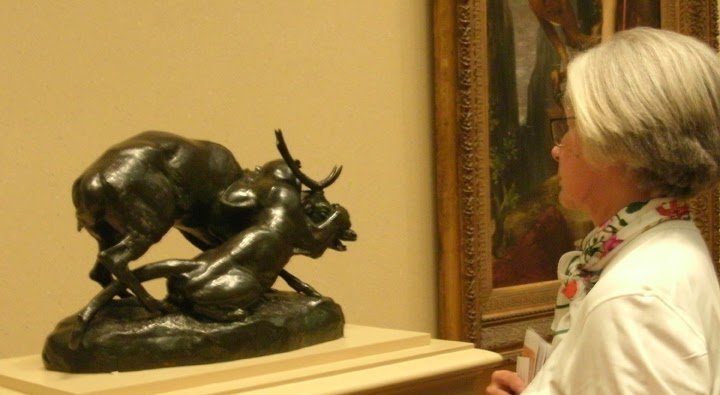
Below, are photos taken at the Metropolitan Museum of Art in New York of "Panther Seizing a Stag" by Bayre.
I've experienced many influences over the years both in printmaking and in sculpture. I parrot the advice of my friend,
the late Bob Kuhn when asked by my students - "How do you make it as an artist today?" Kuhn's advice: . . .
Go to as many galleries, shows, and openings as you can; read as many art magazines as you can and
find out what's out there and what's being done . . . then do something else.
the late Bob Kuhn when asked by my students - "How do you make it as an artist today?" Kuhn's advice: . . .
Go to as many galleries, shows, and openings as you can; read as many art magazines as you can and
find out what's out there and what's being done . . . then do something else.
For me, the Greeks and ancients continue to be the source of influence and inspiration.
I feel a need to go directly to the freshness of the ancients in search of their mysteries.
I'm always learning, and while fascinated by the beauty of Rodin's surfaces . . .
my ongoing struggle continues to be refining the craft and a search for inner beauty and essence of the subject.
This blog ends a series of ten posts regarding a portion of art history and resulting influences.
Importantly, I have found that by turning to nature - the source of all life - and not to other artists' work,
the ultimate inspiration and influence can be experienced.
I feel a need to go directly to the freshness of the ancients in search of their mysteries.
I'm always learning, and while fascinated by the beauty of Rodin's surfaces . . .
my ongoing struggle continues to be refining the craft and a search for inner beauty and essence of the subject.
This blog ends a series of ten posts regarding a portion of art history and resulting influences.
Importantly, I have found that by turning to nature - the source of all life - and not to other artists' work,
the ultimate inspiration and influence can be experienced.
Go to the BLOG INDEX on the right for more information.
Blog, text, photos, drawings, and sculpture . . . © Sandy Scott and Trish
Labels:
Barye,
fragments,
Greek sculpture,
influence,
Rodin
Wednesday, 17 December 2014
#592 The Greeks, fragments, Rodin, and influence . . .
Please start this series of blogs with # 584 . . . posted Nov. 19, 2014
The focus of this blog is art history . . . specifically fragments, the Greeks, Rodin, and modern art.
The time I spent as a student at the Kansas City Art Institute in the early 1960s, was the most
far-reaching event of my life. Immersed in an academic setting, it was the awakening of my senses as I absorbed the rudiments of what would become a lifelong journey in the arts. I enthusiastically focused upon the study of art and art history and to this day, I thrive upon the knowledge and love for the arts instilled in me by competent instructors.
The time I spent as a student at the Kansas City Art Institute in the early 1960s, was the most
far-reaching event of my life. Immersed in an academic setting, it was the awakening of my senses as I absorbed the rudiments of what would become a lifelong journey in the arts. I enthusiastically focused upon the study of art and art history and to this day, I thrive upon the knowledge and love for the arts instilled in me by competent instructors.
Shown above, is a photo taken earlier this year at the historic art school.
The Nelson-Atkins Museum of Fine Art is located on the campus of KCAI and, like the other students, I spent many hours in the inspiring galleries of the museum. Shown below is the imposing facade of the Nelson-Atkins. Also shown, is a photo of Rodin's "The Thinker" and "Adam" taken last spring during a nostalgic trip to Kansas City. Rodin's work and ancient Greek and Roman sculpture are my earliest influences in sculpture and they continue to inspire me.
Then, and now as a perpetual student . . . I was and am to be found in the antique sculpture galleries.
One of my earliest recollections as a student at KCAI is the museum's marble of the Greek "Lion" - 325B.C. shown below.
All photos in this post were taken this year at the Nelson-Atkins Museum of Art in Kansas City.
Go to the BLOG INDEX on the right for more information.
Blog, text, photos, drawings, and sculpture . . . © Sandy Scott and Trish
Labels:
art history,
Barye,
fragments,
Greek sculpture,
influence,
KCAI,
modern art,
Rodin
Sunday, 14 December 2014
#591 The Greeks, fragments, Rodin, and modern art . . . con't
Please start this series of blogs with # 584 . . . posted Nov. 19, 2014
The focus of this blog is art history . . . specifically fragments, the Greeks, Rodin, and modern art.The Greeks and Michelangelo greatly inspired Rodin but there were many other influences as well.
He studied Rubens' paintings and declared that he learned chiaroscuro in his sculpture from Rembrandt.
Like so many other artists of his day, he was interested in Japanese art. He was always learning from
Egyptian, Aztec, Far Eastern, primitive, as well as18th century French art and spent hours in the Louvre.
His work harked back to the origin of things and later in life, in an effort to eliminate the unessential, he simplified by breaking fragments away from his sculpture. Like Picasso, there's no way to typify Rodin's greatness and originality and there's no way to classify him except as a sculptor who created art during the time of Impressionism, Post-impressionism, Realist, Symbolist, Expressionist, Romantic, Cubism, and Art Nouveau. He was an artistic genius with a vision and focus on the future of modern art. . . nothing and no movement defines him.
Interestingly, the fragments, partial figures, and ancient relics that influenced Michelangelo,
Rodin, and many other artists, gave rise to "modern" art.
There are many great art books about the Greeks, Rodin, and Michelangelo and shown below are a few of them from
my library. A particularly interesting book is "Rodin Rediscovered", published in 1981 and in conjunction with a show at the National Gallery of Art in Washington D.C. Included in the publication are interesting and in-depth essays by different authors and scholars about the master and his working methods.
For more information about Greek art and art history, four great websites are:
http://ancientgreece.com/s/Main_Page/
http://visual-arts-cork.com
http://www.essential-humanities.net
http://pantherfile.uwm.edu/
Go to the BLOG INDEX on the right for more information.
Blog, text, photos, drawings, and sculpture . . . © Sandy Scott and Trish
Labels:
fragments,
Greek sculpture,
Michelangelo,
modern art,
Rodin
Wednesday, 10 December 2014
#590 The Greeks, fragments, Rodin, and modern art . . . con't
Please start this series of blogs with # 584 . . . posted Nov. 19, 2014
The focus of this blog is art history . . . specifically fragments, the Greeks, Rodin, and modern art.
Rodin greatly influenced the direction of modern sculpture in the 20th century and is considered a father of modernism. He pioneered the technique of repeating the same figure multiple times in one sculpture to produce a new composition. Among his innovations was fragmenting, resizing, and assembling figures without concern for the subject.
He was the first to consider fragments, assemblages, and partial figure such as hands
to be complete works of art capable of conveying meaning and emotion.
Below, is an image of "The Cathedral".
Rodin adhered to the studio practices that date back to the Renaissance but rarely participated in the production of his finished pieces. He created in clay or wax and assistants replicated them in plaster, enlarging or reducing them according to his desires. As his fame and demand for his work spread, he had over 50 assistants in his studio.
His plasters were both exhibited and sent to the foundries for casting in bronze.
Below, are two images of one of my favorite sculptures by the master:
"She Who Was the Helmet Makers Beautiful Wife"
One of Rodin's ongoing sources of inspiration was the antique and excavations and discoveries
of fragments from the glory of the Greco-Roman Period and by frequent visits to the antique sculpture galleries
at the Louvre . . . the Egyptian, Greek, and Etruscan.
He had a large collection of artifacts in his studio and delighted in showing them to visitors.
His use of the partial figure, the fragment and the creation of new forms by assemblage
as a complete work of art in effect, posed a question crucial to modern sculpture:
What can sculpture do without?
Below, is an image of "Bust of the Painter Puvis De Chavennes"
Rodin greatly influenced the direction of modern sculpture in the 20th century and is considered a father of modernism. He pioneered the technique of repeating the same figure multiple times in one sculpture to produce a new composition. Among his innovations was fragmenting, resizing, and assembling figures without concern for the subject.
He was the first to consider fragments, assemblages, and partial figure such as hands
to be complete works of art capable of conveying meaning and emotion.
Below, is an image of "The Cathedral".
Rodin adhered to the studio practices that date back to the Renaissance but rarely participated in the production of his finished pieces. He created in clay or wax and assistants replicated them in plaster, enlarging or reducing them according to his desires. As his fame and demand for his work spread, he had over 50 assistants in his studio.
His plasters were both exhibited and sent to the foundries for casting in bronze.
Below, are two images of one of my favorite sculptures by the master:
"She Who Was the Helmet Makers Beautiful Wife"
One of Rodin's ongoing sources of inspiration was the antique and excavations and discoveries
of fragments from the glory of the Greco-Roman Period and by frequent visits to the antique sculpture galleries
at the Louvre . . . the Egyptian, Greek, and Etruscan.
He had a large collection of artifacts in his studio and delighted in showing them to visitors.
His use of the partial figure, the fragment and the creation of new forms by assemblage
as a complete work of art in effect, posed a question crucial to modern sculpture:
What can sculpture do without?
Below, is an image of "Bust of the Painter Puvis De Chavennes"
Go to the BLOG INDEX on the right for more information.
Blog, text, photos, drawings, and sculpture . . . © Sandy Scott and Trish
Labels:
art history,
fragments,
Greek sculpture,
modern art,
Rodin
Sunday, 7 December 2014
#589 The Greeks, Fragments, Rodin, and modern art
Please start this series of blogs with # 584 . . . posted Nov. 19, 2014
The focus of this blog is art history . . . specifically fragments, the Greeks, Rodin, and modern art.
By accident of the year of his birth, Rodin should be considered an Impressionist,
but that label detracts from the scope of his contributions to sculpture.
The key to his facility as a sculptor rests with his ability to translate emotional gestures and movement.
Rodin achieved movement and life in his sculptures by creating a broad range of surface treatments.
These undulating, uneven surfaces come alive when struck by light as shown in the close-up images below of
"Monumental Head of Balzac", modeled in 1887.
Rodin preserved the sketch-like surface qualities and textures of his clay and wax models when they were cast in bronze. Rodin's rugged, irregular sculpture surfaces went against the accepted convention of highly finished surfaces.
Shown below in the of image of "Jean d'Aire", 2nd maquette from the "Burgher of Calais", 1885.
Photos were taken last spring at the Nelson-Atkins Museum of Art in Kansas City.
Rodin's style and talent reasserted sculpture's position as a vital art form in modern times.
He cleared away the academic limits on the sculptor's imagination and prepared the way
for the twentieth-century modern artist's unlimited experimentation with form and mass.
By accident of the year of his birth, Rodin should be considered an Impressionist,
but that label detracts from the scope of his contributions to sculpture.
The key to his facility as a sculptor rests with his ability to translate emotional gestures and movement.
Rodin achieved movement and life in his sculptures by creating a broad range of surface treatments.
These undulating, uneven surfaces come alive when struck by light as shown in the close-up images below of
"Monumental Head of Balzac", modeled in 1887.
Rodin preserved the sketch-like surface qualities and textures of his clay and wax models when they were cast in bronze. Rodin's rugged, irregular sculpture surfaces went against the accepted convention of highly finished surfaces.
Shown below in the of image of "Jean d'Aire", 2nd maquette from the "Burgher of Calais", 1885.
Photos were taken last spring at the Nelson-Atkins Museum of Art in Kansas City.
Rodin's style and talent reasserted sculpture's position as a vital art form in modern times.
He cleared away the academic limits on the sculptor's imagination and prepared the way
for the twentieth-century modern artist's unlimited experimentation with form and mass.
Go to the BLOG INDEX on the right for more information.
Blog, text, photos, drawings, and sculpture . . . © Sandy Scott and Trish
Labels:
art history,
fragments,
Greek sculpture,
modern art,
Rodin
Subscribe to:
Posts (Atom)