Showing posts with label Greek sculpture. Show all posts

Wednesday, 7 January 2015

#598 Paris, con't . . . "The Venus de Milo"


Trish and I spent three weeks in Paris last month exploring museums and monuments and enjoying the art, architecture,
and ambiance of the beautiful city.  Please visit the previous
three blogs for more info about the art we experienced.


The focus of this blog is the Greek Hellenistic masterpiece, "The Venus de Milo" located in the Louvre.
The six foot eight inch high Parian marble carving was discovered on the island of Milo in 1820 by a French explorer with the help of a  peasant and was acquired in1821, a gift from King Louis XVIII who received it from the Marquis de Riviere.

Everyone was charmed by the exquisite grace and beauty of the sculpture and its arrival in Paris caused great
 excitement resulting in violent disputes about its history.  Shown below, is an image of "The Venus de Milo".


The sculpture represents the mythological Goddess of Love and Beauty, called Aphrodite by the Greeks
and Venus by the Romans and has come to represent the universal standard of perfection.

Importantly, the much adulated sculpture is an original Greek statue and not a Roman copy.
Below, is another image of "The Venus de Milo" taken last month in the Louvre.


The sculpture belongs to the Hellenistic age of about 130 BC and some scholars believe it almost certainly was
created by Praxiteles.  Like other works by this great sculptor, the figure is slightly off balance in a contrapposto pose.

Contrapposto is an Italian term that means "counterpose" or "opposite" and it was originated by the ancient Greeks.
It is used in the visual arts to describe a human figure standing with most of its weight on one foot so that its shoulders
and arms twist off-axis from the hips and legs . . . the weight is therefore unequally distributed between the two legs,
resulting in a slight curvature of the torso and an elegant tilting of the pelvis and shoulders in opposite directions.


While some scholars believe the contrapposto and the face is in the style of Praxiteles, there are many who think the calm strength of the countenance suggests the school of the great sculptor, Phidias.  To further complicate the matter, some think the proportions of the body follow the school of the sculptor Lysippus.
The most recent theory, is thought to be the work of Alexandro of Antioch
due to an inscription found on what may have been its original pedestal.


Arguments also prevail as to how the sculptor placed the arms . . .
many ideas have been proposed - some think she held an apple in
her raised left hand -  but, unless further discoveries are made, the position of the arms will always remain a mystery.

There are also conflicting ideas about how the statue was discovered
but despite the controversy and unknown data, "The Venus de Milo"
is thought to represent the ideal of feminine beauty and she
remains one of the most famous sculptures in the world.

Fortunately, after discovery and after several attempts,
it was decided not to replace the missing arms since the
original design remains unclear and unknown.

Additional images of the sculpture are shown below.


Rodin loved "The Venus de Milo" and wrote an essay about the work in "Art and Progress" in 1911.
The link to the translation is http://www.jstor.org/stable/20560537

Much, much more has been written about the famous sculpture which is beyond the scope of this blog.
More information can be obtained online.


At the end of each blog about art in Paris, I'll include a personal glimpse and souvenir of our excellent
experience last month which those of you who have visited the beautiful city can relate to.
Remember . . . souvenir in French means "memory".

Below, is a photo of bargaining for an antique book from a bookstall vendor along the Seine.
I now agonize over not purchasing the old art book . . . the price was right but it was very heavy and by this time
 I had already filled a newly purchased suitcase with books and had shipped others as well.  I must go back!


Go to the BLOG INDEX on the right for more information. 


Blog, text, photos, drawings, and sculpture . . . © Sandy Scott and Trish


Sunday, 28 December 2014

#595 Paris: "The Victory of Samothrace"


Trish and I just returned from three weeks in Paris.  Our time was spent in museums, visiting monuments,
 and enjoying great food in the beautiful city.   We've been to Paris several times over the years but have never
 spent such a lengthy time there.  Typically, we go in the winter and miss the crowds in the museums . . . 
weather seems to be more manageable than standing ten or more people deep in front of the art.  

The primary reason for the trip was sculpture and I'll return to the Paris experience
 often in upcoming blog posts with images and comments.


Greek art has had a great influence on my work as explained in earlier December posts.  I consider Greek art the ultimate source of inspiration and am particularly inspired by the Classical and Hellenistic periods.  Briefly,  Classical Greek art,
which follows the Archaic period and runs from the fifth century B.C. to the
death of Alexander the Great in 323 B.C., brought the widespread
mastery of anatomy and naturalism while depicting the perfect human body.
The Classical period was followed by the Hellenistic period which
 is a more sensual and emotional style than the Classical ideal.  

Shown at right is my all-time favorite Greek sculpture: "The Victory of Samothrace" - also known as "Winged Victory" - which resides in the Louvre in Paris.  I had seen it many times perched at the the top of the museum's Daru staircase and was excited
to once again see the colossal winged image of power and grace.

When I saw it several years ago, it had a pale yellow ochre color as shown below in an older photograph.   It has recently been cleaned, is presented on the bow of a ship, and is now much whiter that when I had seen it earlier. 


At left, is an image of the Hellenistic masterpiece:

"The Victory of Samothrace".

It is over 9 feet high without base and represents the Greek god,
Nike. The marble sculpture was carved during the 
Greek Hellenistic period approximately 200 B.C.
The female figure is alive with palpitating energy
and sensual force and was created to celebrate
the winning of a naval battle. 


Shown below, is an older photo of the sculpture before cleaning.


Shown below, the dramatic torso is thrust forward with a conquering motion as the wings beat heading into the wind on the bow of a ship and the flowing drapery flutters behind.  The garment is held against the figure's body by the force of the wind while a strong, vertical line leads up the right leg to the top of the torso.  I was fascinated by how the wings were attached to the body . . . they seemed to have grown to the shoulders in a natural way.


The sculpture was discovered and excavated in 1863 on the island of Samothrace in the Aegean Sea 
and sent to the Louvre where some parts were restored in plaster.  It was removed from the Louvre 
for safekeeping in 1939 in anticipation of the outbreak of World War II then returned after the war.  

"The Victory of Samothrace" is held to be one of the great surviving masterpieces of sculpture 
from the Hellenistic Period, and from the entire Greco-Roman era.


Go to the BLOG INDEX on the right for more information. 


Blog, text, photos, drawings, and sculpture . . . © Sandy Scott and Trish


Sunday, 21 December 2014

#593 The Greeks, fragments, Rodin, Barye, and influence . . . con't


Please start this series of blogs with # 584 . . . posted Nov. 19, 2014
The focus of this blog is art history . . . specifically fragments, the Greeks, Rodin, Barye, and modern art.
This post concludes a series of blogs about the influence of artists of the past on a living artist.
All blogs starting with November 30 were pre-posted while Trish and I were in Paris.

Artists are often asked:  What has been the biggest influence in your art?
Every artist is influenced by something or someone . . . maybe an instructor, a favorite living or deceased artist or school of art, or even what is perceived as popular and selling well.  Also, throughout an artist's life, many different influences, people, and events continue to affect an artist's creative direction and work.  

On a personal note, I was and am influenced by the art that came before me.  If I had to choose only one school of art . . . it would be Greek art of the Hellenistic and Golden Age.  If I had to choose only one artist,
who early in my career and now, influences me - it is Antoine-Louis Barye [1796 - 1875] .
His knowledge and execution of anatomy is without peer.


Keep in mind, the giants throughout art history such as Rodin were influenced by someone and something.
Rodin was exclusively working for someone else until he was 30 and it was an invaluable learning experience.
Interestingly, Rodin studied briefly under Barye and while he was a powerful artist, Barye was lacking as a teacher and Rodin entered the studio of Carrier-Belleuse [1824 - 1887].

While Barye was a sculptor of animals, Rodin was a sculptor of the human figure.  Rodin had a desire to create an equestrian monument and in 1886 modeled the sculpture entitled "Maquette of General Lynch'" shown below and at the Nelson-Atkins Museum of Art.  The monument was never realized and later Rodin conjoined part of the horse to a nude female figure and created another sculptural statement.


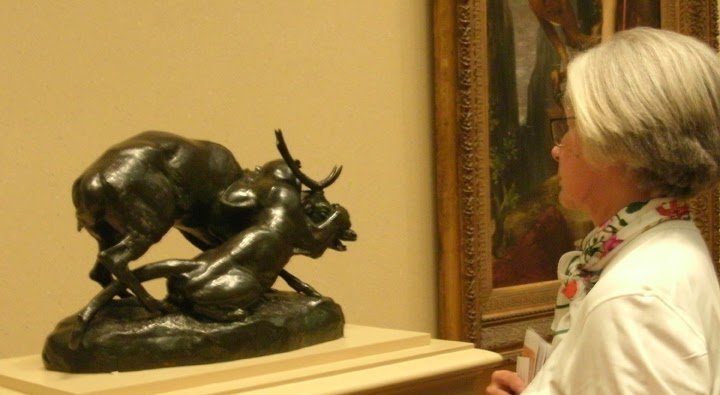
Below, are photos taken at the Metropolitan Museum of Art in New York of "Panther Seizing a Stag" by Bayre.


I've experienced many influences over the years both in printmaking and in sculpture.  I parrot the advice of my friend,
the late Bob Kuhn when asked by my students - "How do you make it as an artist today?"   Kuhn's advice: . . .
Go to as many galleries, shows, and openings as you can; read as many art magazines as you can and
find out what's out there and what's being done . . . then do something else.   

For me, the Greeks and ancients continue to be the source of influence and inspiration.
I feel a need to go directly to the freshness of the ancients in search of their mysteries.
 I'm always learning, and while fascinated by the beauty of Rodin's surfaces . . .
my ongoing struggle continues to be refining the craft and a search for inner beauty and essence of the subject.

 This blog ends a series of ten posts regarding a portion of art history and resulting influences.
Importantly, I have found that by turning to nature - the source of all life - and not to other artists' work,
the ultimate  inspiration and influence can be experienced.


Go to the BLOG INDEX on the right for more information. 


Blog, text, photos, drawings, and sculpture . . . © Sandy Scott and Trish


Wednesday, 17 December 2014

#592 The Greeks, fragments, Rodin, and influence . . .


Please start this series of blogs with # 584 . . . posted Nov. 19, 2014
The focus of this blog is art history . . . specifically fragments, the GreeksRodin, and modern art.


The time I spent as a student at the Kansas City Art Institute in the early 1960s, was the most
far-reaching event of my life. Immersed in an academic setting, it was the awakening of my senses as I absorbed the rudiments of what would become a lifelong journey in the arts.  I enthusiastically focused upon the study of art and art history and to this day, I thrive upon the knowledge and love for the arts instilled in me by competent instructors.


Shown above, is a photo taken earlier this year at the historic art school.

The Nelson-Atkins Museum of Fine Art is located on the campus of KCAI and, like the other students, I spent many hours in the inspiring galleries of the museum.  Shown below is the imposing facade of the Nelson-Atkins.  Also shown, is a photo of Rodin's "The Thinker" and "Adam" taken last spring during a nostalgic trip to Kansas City.  Rodin's work and ancient Greek and Roman sculpture are my earliest influences in sculpture and they continue to inspire me.


Then,  and now as a perpetual student . . . I was and am to be found in the antique sculpture galleries.
One of my earliest recollections as a student at KCAI is the museum's marble of the Greek "Lion" - 325B.C. shown below.
All photos in this post were taken this year at the Nelson-Atkins Museum of Art in Kansas City.


Go to the BLOG INDEX on the right for more information. 


Blog, text, photos, drawings, and sculpture . . . © Sandy Scott and Trish


Sunday, 14 December 2014

#591 The Greeks, fragments, Rodin, and modern art . . . con't


Please start this series of blogs with # 584 . . . posted Nov. 19, 2014
The focus of this blog is art history . . . specifically fragments, the GreeksRodin, and modern art.

The Greeks and Michelangelo greatly inspired Rodin but there were many other influences as well.
 He studied Rubens' paintings and declared that he learned chiaroscuro in his sculpture from Rembrandt.
Like so many other artists of his day, he was interested in Japanese art.  He was always learning from
Egyptian, Aztec, Far Eastern, primitive,  as well as18th century French art and spent hours in the Louvre.

His work harked back to the origin of things and later in life,  in an effort to eliminate the unessential, he simplified by breaking fragments away from his sculpture.  Like Picasso, there's no way to typify Rodin's greatness and originality and there's no way to classify him except as a sculptor who created art during the time of Impressionism, Post-impressionism,  Realist, Symbolist, Expressionist, Romantic, Cubism, and Art Nouveau.  He was an artistic genius with a vision and focus on the future of modern art. . . nothing and no movement defines him.

Interestingly, the fragments, partial figures, and ancient relics that influenced Michelangelo,
Rodin, and many other artists, gave rise to "modern" art.

There are many great art books about the Greeks, Rodin, and Michelangelo and shown below are a few of them from
 my library.  A particularly interesting book is "Rodin Rediscovered",  published in 1981 and in conjunction with a show at the National Gallery of Art in Washington D.C.  Included in the publication are interesting and in-depth essays by different authors and scholars about the master and his working methods.


For more information about Greek art and art history, four great websites are:


http://ancientgreece.com/s/Main_Page/

http://visual-arts-cork.com

http://www.essential-humanities.net

http://pantherfile.uwm.edu/


Go to the BLOG INDEX on the right for more information. 


Blog, text, photos, drawings, and sculpture . . . © Sandy Scott and Trish


Wednesday, 10 December 2014

#590 The Greeks, fragments, Rodin, and modern art . . . con't


Please start this series of blogs with # 584 . . . posted Nov. 19, 2014
The focus of this blog is art history . . . specifically fragments, the Greeks, Rodin, and modern art.

Rodin greatly influenced the direction of modern sculpture in the 20th century and is considered a father of modernism.  He pioneered the technique of repeating the same figure multiple times in one sculpture to produce a new composition.  Among his innovations was fragmenting, resizing, and assembling figures without concern for the subject.
 He was the first to consider fragments, assemblages, and partial figure such as hands
to be complete works of art capable of conveying meaning and emotion.

Below, is an image of "The Cathedral".


Rodin adhered to the studio practices that date back to the Renaissance but rarely participated in the production of his finished pieces.  He created in clay or wax and assistants replicated them in plaster, enlarging or reducing them according to his desires.  As his fame and demand for his work spread, he had over 50 assistants in his studio.
 His plasters were both exhibited and sent to the foundries for casting in bronze.

Below, are two images of one of my favorite sculptures by the master:
"She Who Was the Helmet Makers Beautiful Wife"


One of Rodin's ongoing sources of inspiration was the antique and excavations and discoveries
 of fragments from the glory of the Greco-Roman Period and by frequent visits to the antique sculpture galleries
at the Louvre . . .  the Egyptian, Greek, and Etruscan.
He had a  large collection of artifacts in his studio and delighted in showing them to visitors.
His use of the partial figure, the fragment and the creation of new forms by assemblage
as a complete work of art in effect, posed a question crucial to modern sculpture:
What can sculpture do without?

Below, is an image of "Bust of the Painter Puvis De Chavennes"


Go to the BLOG INDEX on the right for more information. 


Blog, text, photos, drawings, and sculpture . . . © Sandy Scott and Trish


Sunday, 7 December 2014

#589 The Greeks, Fragments, Rodin, and modern art


Please start this series of blogs with # 584 . . . posted Nov. 19, 2014
The focus of this blog is art history . . . specifically fragments, the Greeks,  Rodin, and modern art.

By accident of the year of his birth, Rodin should be considered an Impressionist,
but that label detracts from the scope of his contributions to sculpture.
The key to his facility as a sculptor rests with his ability to translate emotional gestures and movement.

Rodin achieved movement and life in his sculptures by creating a broad range of surface treatments.
These undulating, uneven surfaces come alive when struck by light as shown in the close-up images below of
"Monumental Head of Balzac", modeled in 1887.


Rodin preserved the sketch-like surface qualities and textures of his clay and wax models when they were cast in bronze.   Rodin's rugged, irregular sculpture surfaces went against the accepted convention of highly finished surfaces.

Shown below in the of image of "Jean d'Aire", 2nd maquette from the "Burgher of Calais", 1885.
Photos were taken last spring at the Nelson-Atkins Museum of Art in Kansas City.


  Rodin's style and talent reasserted sculpture's position as a vital art form in modern times.
He cleared away the academic limits on the sculptor's imagination and prepared the way
 for the twentieth-century modern artist's unlimited experimentation with form and mass.


Go to the BLOG INDEX on the right for more information. 


Blog, text, photos, drawings, and sculpture . . . © Sandy Scott and Trish


Wednesday, 3 December 2014

#588 Fragments, the Greeks, Rodin, and Michelangelo . . . con't


Please start this series of blogs with # 584 . . . posted Nov. 19, 2014
The focus of this blog is art history . . . specifically fragments, the Greeks, Michelangelo, and Rodin.

Rodin visited Italy in 1876 to study the work of the great Renaissance sculptor Michelangelo and the antique Greek
 and Roman fragments and sculpture that had not only influenced Michelangelo, but cast a spell on Rodin as well.
The momentous journey inspired and revolutionized his sculpture.
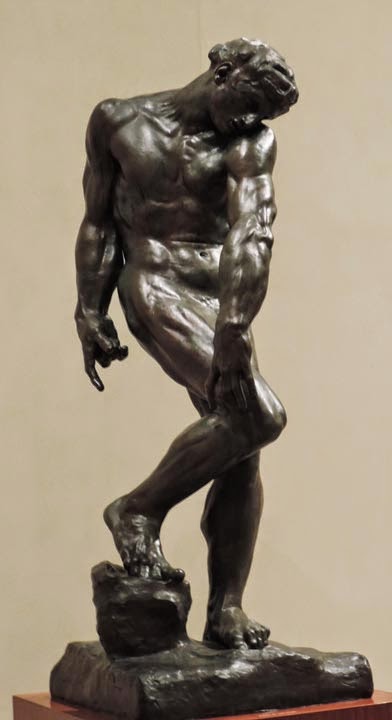
After his return to France, he created "Adam" which reveals the influence of the Italian master
with its twisting torso, obliquely crossed arm, and bent knee.

Shown below, is an image of Rodin's "Adam" that I photographed in the
Nelson-Atkins Museum of Art in Kansas City last spring.


Both Michelangelo and Rodin were influenced
and inspired by ancient Greek sculpture.
The eloquent truncated mass of the
Belvedere Torso shown at right and
located in the Vatican in Rome,
had a great effect on both
sculptors.  Rodin kept a huge
collection of ancient Greek
fragments and antiques in his
studio that he considered
precious and inspirational.

Shown below, is Rodin's "Small Torso of Falling Man" modeled in 1882.
The most conspicuous variety of the partial figure is the torso-fragment,
in which the core of the human torso is represented without head and/or limbs.
Rodin created scores of independent fragments and partial figures that were not drawn from an identifiable previous work.


Shown below, is "Narcissus" also modeled in 1882 . . . another Rodin sculpture in the Iris and B. Gerald Cantor
 collection on display at the Nelson-Atkins Museum of Art in Kansas City.


Go to the BLOG INDEX on the right for more information. 


Blog, text, photos, drawings, and sculpture . . . © Sandy Scott and Trish


Sunday, 30 November 2014

#587 Fragments, the Greeks, Rodin, and Michelangelo . . . con't


I've taught sculpture in workshops for almost 30 years and am routinely asked to discuss art history.
 I was fortunate to have an academic background by studying at the Kansas City Art Institute.
My time there inspired a life-long interest in art history . . . then and now I devour information
and continue to be inspired by artists from the past.
This short series of blogs is in response to requests from students and others
who also posses a passion for the arts and its history.

Please start this series of blogs with # 584 . . . posted Nov. 19, 2014
The focus of this blog is art history . . . specifically, the Greeks, fragments, Rodin, and inspiration.

Below, are two sculptures by Rodin:  "St. John the Baptist", 1878; and "The Age of Bronze", 1876


Auguste Rodin,  was born in Paris in 1840 and died in1917.  When he was young, he spent several
years of his apprenticeship with an ornamental modeler doing nothing but leaves, fruit, and flowers.
He could not afford to study with French masters of the time and turned to antique Greek statues and
fragments and to the works of Michelangelo, Donatello, and the Renaissance for inspiration in 1876.

When he was 36 years old, he traveled to Rome, Florence, Venice, and Naples to study the works of Michelangelo and Donatello and returned to Paris filled with the influence of the Renaissance.  While in Italy, he saw how the Greek sculptor, Phidias and other masters of the Golden Age of Greece modeled strength into their figures by studying ancient fragments and statuary discovered in Italy and elsewhere.   Rodin, like Michelangelo was greatly inspired by the discoveries of ancient Greek fragments and sculpture and had a collection of them in his studio.

Soon after returning from Italy, Rodin created what was to become a key juncture in his career . . .
the monumental bust, "Bellona".  The sculpture established him as an artistic personality in his own right.
 Note:  The helmet is similar to the helmet of Michelangelo's "Lorenzo de Medici"
and like other works of this period, reflects Rodin's close study of Michelangelo.


 While Rodin's 1876 trip to Italy was an inspirational turning point in his career, his early known works are few.
"Man With the Broken Nose", created in 1864, was refused by the Salon.  A close-up of the sculpture is shown below.   Also shown is a sculpture created in 1863, entitled "Father Pierre-Julien Eymard".
After his enlightening and inspirational trip to Italy and under the influence of the
 Greeks, Michelangelo, and the Renaissance, his career and reputation grew rapidly.


Go to the BLOG INDEX on the right for more information. 


Blog, text, photos, drawings, and sculpture . . . © Sandy Scott and Trish


Wednesday, 26 November 2014

#586 Fragments, the Greeks, and Rodin


Please start this series of blogs with # 584 . . . posted Nov. 19, 2014
The focus of this blog is art history . . . specifically fragments, the Greeks, and Rodin.

While the fragmented Greek discoveries in Rome and elsewhere during the Renaissance were
accidental amputation, in the late 1890s, his fame firmly established, Auguste Rodin explored the
creative possibilities offered by fragmentation, the partial figure, and deconstruction of his own work.

Rodin, who was greatly influenced and inspired by Greek and Roman antique sculpture believed in the
aesthetic self-sufficiency of the fragment and truncated sculpture he had experienced in Italy years earlier.
 He produced hundreds of studies of the human hand in a passionate investigation of the form's expressive capabilities.
Note:   Not all of Rodin's partial figures are fragments of previously executed works.

 Shown below, his hand study studies are invested with such vitality that each exists as an independent work of art.


Late in Rodin's career, he abandoned sculpting from living models
and turned to the huge quantity of already sculpted figures and
fragments of heads, legs, hands, and feet that he had produced
during his career.  He assembled them to create new works
such as "Head of Shade with Two Hands" shown below.


 While studio assistants made plaster copies of his clay or wax models, the innovative
process allowed him to produce a startling number of variation on identical figures.
The sculpture shown below is comprised of three identical casts of  Rodin's "Adam"
and is entitled, "The Three Shades".
Rodin compensated for the viewer's inability to see the figure in the round by
presenting views from the front and sides.


Go to the BLOG INDEX on the right for more information. 


Blog, text, photos, drawings, and sculpture . . . © Sandy Scott and Trish