Showing posts with label patina. Show all posts

Monday, 16 November 2015

#686 New sculpture: "Silver Wings - Trumpeter Swan"

   "Silver Wings - Trumpeter Swan" is a new sculpture introduced in Cody this fall.  Please go to the search box and type in trumpeter swan for more information about the creation of this work . . . drawings and photos are shown. 

 Below are images of the work in progress in clay and the finished sculpture cast in bronze.


Shown below . . .  the flexible rubber mold in progress.


Shown below . . . silver nitrate being applied during the patina process at the foundry.


Shown below . . . two images of the completed and based bronze casting.


Go to the BLOG INDEX and Reference Page for more information.  

Blog, text, photos, drawings, and sculpture . . . © Sandy Scott and Trish


Sunday, 7 June 2015

#641 Prix de West, 2015


By this time next Sunday, Prix de West in Oklahoma City will be over and I'll post and update.
For more information about the exhibition, go to the museum and catalogue links and the blog links below:

This year is my 27th year to be invited to participate in the Prix de West Exhibition at the National Cowboy Museum and Western Heritage Center in Oklahoma City.  Like most artists, it's important for me to introduce new work at the prestigious event and no one wants to drop the ball!  The collector and museum expects new work and my studio method and working challenges demand it. The Prix de West, like the Autry, Eiteljorg, Briscoe, Jackson, Cody, and others gives the artist an opportunity to engage in a catalogued museum gala venue and sale that is as good as the artist chooses to make it . . . 
I can't imagine not giving it my best and respond with new work and over the years, I've attempted to do just that.

Below, are images of one of the new works for the exhibition entitled, "Jake".
The sculpture is a quiet study of a young male Wild Turkey and is shown cast in bronze and during patina.


The patina is achieved by applying liver of sulfur to cold metal then scrubbing back, revealing darks in the negatives
and lights on the high points.  Next the sculpture is heated and cupric nitrate is sizzled on to the hot metal.
Then, ferric nitrate is applied while the bronze is still hot.  The sculpture is waxed with Johnson's Paste Wax
after cool-down, and "Jake" is placed on a walnut base.


The close-ups reveal the "woodsy" feel and coloration I was attempting to convey with the patina.


For more information about see post
#635 May 17, 2015


Go to the BLOG INDEX on the right for more information.

Blog, text, photos, drawings, and sculpture . . . © Sandy Scott and Trish


Sunday, 24 May 2015

#637 In the studio: Green Heron


Compared to most herons, the Green Heron is small, dark, short and stocky with short legs, broad wings, 
long bill, and thick neck.   The crow-sized bird is sometimes call the Green-backed Heron.

Below, is John James Audubon's (1785 - 1851) lithograph of the Green Heron.


The Green Heron is typically concealed in vegetation and is hard to see because its coloration appears dark.
The little heron is solitary and secretive and lives around small bodies of water or densely vegetated areas.  
Seeing them is tricky and I've seen the bird only a few times in the wild and always along shallow marsh edges.

Below, are drawings created during a rare encounter with a Green Heron while in the South Carolina Low Country.


The Green Heron's neck is often pulled up against the body when at ease . . .  but when feeding, 
the bird thrusts its neck forward and the long, dagger-like bill strikes swiftly to catch prey.

Below, is a clay model of a recent sculpture of the Green Heron.  I chose a pose that depicts the bird hunting and about
to plunge for its its prey.  The heron appears dark while hunting in the shadows, but is beautifully colored in the sun.


The sculpture was modeled with a dark brown Classic Clay which is a very fine product and one 
of several different types and brands of oil based plasteline clay I use.  Typically, if the wings are extended, 
I use Chavant's Le Beau Touche clay because it is sticky and will adhere to armature wire and aluminum foil better.
 Note:  It's difficult to photograph Classic Clay because of its dark pigment


Below, is the new sculpture, "Green Heron" cast in bronze.
The patina was achieved with liver of sulfur, cupric nitrate, and a trace of ferric nitrate.


Green Heron
11"H 15"W 9"D
Edition 50
3,000


Go to the BLOG INDEX on the right for more information.

Blog, text, photos, drawings, and sculpture . . . © Sandy Scott and Trish


Wednesday, 13 May 2015

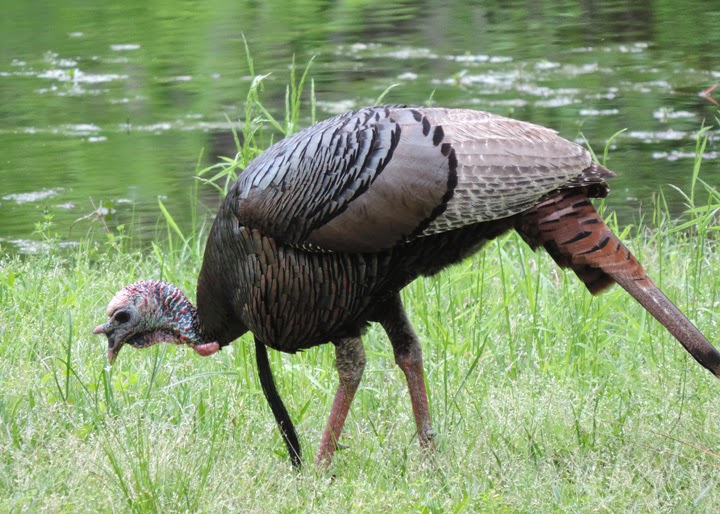
#634 Wild Turkeys at Brookgreen Gardens


For more information about Brookgreen Gardens, see blog posts #625 and #627 throughout #631.
Additional info can be obtained by typing in Brookgreen Gardens in the "search this blog" box.

brookgreen.org

Brookgreen Gardens, located in Murrell's Inlet, South Carolina is an accredited museum boasting the the largest and most important collection of American figurative sculpture in existence.  I recently returned from there and am still under the spell of beautiful Brookgreen.  While the sculpture collection is paramount, the 9,000 acre grounds are an award winning horticulture masterpiece and home to an accredited zoo and aviary.  Over the years, I've come to know Brookgreen well 
and upon entering the grounds - especially in the early morning - I'm sure to encounter free ranging 
Wild Turkeys which is the subject of this and the next two blog posts.

For many years I have visited Brookgreen and continue to know it as an "in the field" experience. . . 
a camera and sketchbook is always close by and I've accumulated lots of photos and drawings of Wild Turkeys.

Below, are photos taken last month at Brookgreen.


Below, is a new sculpture entitled "Tom".  Also shown,  is the clay model in progress before the mold was made.


Additional images are shown of the bronze sculpture during the patina process at the foundry.
The patina was achieved with the following chemicals:  Liver of sulfur, cupric nitrate, and ferric nitrate.


Go to the BLOG INDEX on the right for more information.

Blog, text, photos, drawings, and sculpture . . . © Sandy Scott and Trish

Wednesday, 11 February 2015

#608 In the foundry: Patina, con't . . .


Please see the previous post and for a more in-depth discussion about patina application and 
patina recipes, go to blog #391, posted Feb.13, 2013 through blog #401, posted March 3, 2013.

The color of a bronze sculpture is called a patina and the artist's color choice can
 greatly enhance the overall emotional effect and presence of the work.


Below, are two totally different patinas used on a recent head study of an owl which demonstrates the power of color:
The cool cupric nitrate blue-green used on the first image suggests the nocturnal nature of the species while 
the warm ferric nitrate chemical used on the second image implies the bird's natural color. . .
 each one delivers a different sentiment yet the sculpture is the same!


Shown below, is the owl head sculpture being heated with a propane torch in the foundry.
The patina technician then applies ferric nitrate to the hot surface.  The more heat and chemical that is applied, 
the darker and richer the color. . . from a pale yellow to a rich orange-brown to a very dark blackish-brown.
Note:  The darks in the negatives are achieved by first applying liver of sulfur, then scrubbing the surface
with a Scotch-brite pad . . . the highlighted positives are then heated and ferric is applied.


Below, is a photo taken last year at Brookgreen Gardens in Murrell's Inlet, South Carolina, and the clay study
 of a Great-horned Owl which was modeled while teaching a bird sculpture workshop in the museum's aviary.
Note:  Brookgreen Gardens boasts the largest and most important collection of American sculpture in existence.
http://www.brookgreen.org


Go to the BLOG INDEX on the right for more information.


Blog, text, photos, drawings, and sculpture . . . © Sandy Scott and Trish


Sunday, 8 February 2015

#607 In the foundry: Patina


The color of a bronze sculpture is called a patina.  Color has a profound effect on the sculpture's final appearance
and the impression it makes on the viewer.  The patina color choice can enhance or detract from the emotional effect
 and overall presence of the artist's work.  Typically, patinas are applied in the foundry with various chemicals.

Below, are images of three recent fragment works showing two different patinas on each design.
 For a more in-depth discussion about patinas and patina application and recipes, please go to
blog #391, posted Feb. 13, 2013 through blog #401, posted March 3, 2013.

Blog #391     . . .    click on this link, then click newer posts.


The first photo depicts "Setter II" with a greenish "old-world" cupric nitrate patina.
Bronze is over 95% copper and cupric imparts a time-honored look . . . similar to an old copper penny.


The photo below is of "Setter II" with a ferric nitrate patina . . . similar to a new copper penny.


The image below is of "Setter IV" with a cupric nitrate patina.


The image below is of "Setter IV" with a ferric nitrate patina.


The image below is of "Setter II" with a cupric nitrate patina.


The image below is of "Setter II" with a ferric nitrate patina.


Go to the BLOG INDEX on the right for more information.


Blog, text, photos, drawings, and sculpture . . . © Sandy Scott and Trish


Wednesday, 4 February 2015

#606 In the foundry: "The Taker"


Below, are photos taken in the foundry depicting the application of the patina to The Taker.   


 The first photo shows the patina technician polishing the bronze.


Next, liver of sulfur is applied which darkens the bronze sculpture.


The bronze is then heated with a propane torch and cupric nitrate is sizzled on.


The sculpture now has a cool blueish-green color and is allowed to cool down.
When cool,  the stainless steel ball is ready to be welded in, the weld heat marks are then touched up with liver of sulfur.
Wax is applied, and I sign and number the back of each casting with an engraver.


Go to the BLOG INDEX on the right for more information.


Blog, text, photos, drawings, and sculpture . . . © Sandy Scott and Trish