Showing posts with label dogs. Show all posts

Wednesday, 18 November 2020

#761 "Hard Turn to Starboard"


"Hard Turn to Starboard

"Hard Turn to Starboard"
8"H 11"W 5"D
Ed. Size 50
1,800

                               Blog, text, photos, drawings, and sculpture ... © Sandy Scott and Trish

Monday, 25 November 2019

#742 "Scottie Study"


Sandy's new sculpture for Scottie lovers is a
high-relief mantlepiece mounted on post and plate.


"Scottie Study"
14"H 7"W 6"D
Edition 50
1,800


Blog, text, photos, drawings, and sculpture . . . © Sandy Scott and Trish

Saturday, 28 September 2019

#733 "Westie Pup"


"Westie Pup"
5"H 8"H 6"D
Edition  100
960


Blog, text, photos, drawings, and sculpture . . . © Sandy Scott and Trish


Saturday, 31 August 2019

#732 "Boykin"


"Boykin"
9"H 7"W 7"D
Edition 65
1,800


The Boykin Spaniel was originally bred by South Carolina sportsmen to hunt ducks
and wild turkeys.   It is medium sized, slightly larger than the Cocker Spaniel and is
known for its rich brown coat.  Traditionally, the tail is docked, and the bred is easily
identified by the long, feathered ears that hang close to the checks.  The web-toed
dog has a very sweet disposition, is impressive in the field and makes a great pet.
It is the state dog of South Carolina.


 Blog, text, photos, drawings, and sculpture . . . © Sandy Scott and Trish


#731 "My Buddy"


"My Buddy"
8"H 9"W 9"D
Edition of 35
1800


The Labrador Retriever is one of the most popular dog breeds in the United States 
and Canada.  The large gun dog is prized by sportsmen in the field.  Their interwoven 
coat is relatively waterproof and their webbed feet make them excellent swimmers for 
retrieving waterfowl.  The handsome canine is very even-tempered making it an excellent family pet. 
Labs are registered in three colors:  black, yellow, and chocolate.   


Blog, text, photos, drawings, and sculpture . . . © Sandy Scott and Trish


Tuesday, 27 August 2019

#730 "Golden Promise"


"Golden Promise"
10"H 10"W 10"D
Edition 50
3,000


The Golden Retriever is a large gun dog known for an outstanding 
ability to retrieve downed waterfowl and upland game birds. 
The beautiful canine is one of the most popular breeds in America 
due to their friendly and gentle temperament.

While the good-natured dog is respected by hunters in the field, 
they make an excellent family pet.


  Blog, text, photos, drawings, and sculpture . . . © Sandy Scott and Trish


Sunday, 15 February 2015

#609 In the studio: Flexible molds


A flexible mold is the term commonly used for a rubber mold and is the type of mold used by most sculptors today.  

For an in-depth discussion about flexible molds, please go to blog #572,
posted October 8, 2014 and blog #574, posted October 15, 2014.
Blog #572              Blog #574


Flexible molds have a varied longevity or "shelf life" which refers to how long the completed mold will last in years.  
Note: Some sculptors refer to shelf life as "library life" or time in storage.  My molds have been made in the studio by 
Trish for over 25 years and during that time, while using Black-Tuffy, Smooth-on, and other products, we've experienced numerous mold failures or loss of mold usage due to the rubber liquifying and turning to an unusable goo.   
Keep in mind, the possible short shelf life of these products is printed on their labels and after losing
some of our older molds before the edition was cast, we've changed to a newer, more stable product. 


Inexplicably, we have 20 year old molds made from Smooth-on that are still good while some have failed after less than 4 years of use!  Most of the old ones, however have failed.  For the past six years, we've been using a product called Polytek
(see blogs #572 and #574) and so far, have experienced no mold failures.


The sculpture shown below, entitled Takers of the Anasazi Sun was introduced and sold at
 Prix de West in 1994 and another one was cast and consigned to Knox Gallery in Colorado.
The sculpture is listed in the book about my work - Spirit of the Wild Things - The Art of Sandy Scott -
as an edition of 35 but only two were cast before the Smooth-on mold failed after less than 3 years.
The clay model of the work does not exist nor is there a wax replica of the piece in existence.

http://Spirit of the Wild Things


While works such as the sculpture show above will never be cast again, another older work has been given new life.
In 1999, I created a sculpture entitled, Promising Pup.  After only a few castings, the mold failed but a wax replica
of the clay model was retained before the mold had to be discarded.  Last summer, I totally remodeled and
reworked the wax and Trish molded it into a similar but new sculpture entitled, First Season Promise.

Shown below, is First Season Promise in clay and Trish starting the mold.
More about flexible molds in next Wednesday's blog.


Shown below is view #1 of the new bronze, First Season Promise which will be introduced at two upcoming shows:
The Briscoe Museums's Night of the Artists on March 28, 2015 and
The Cheryl Newby Gallery's The Power of Three show which opens April 25, 2015.

More about both shows in upcoming blogs.

http://Night of the Artists

http://Cheryl Newby Gallery.com


First Season Promise
11"H 15"W 9"D


Go to the BLOG INDEX on the right for more information.


Blog, text, photos, drawings, and sculpture . . . © Sandy Scott and Trish

Sunday, 8 February 2015

#607 In the foundry: Patina


The color of a bronze sculpture is called a patina.  Color has a profound effect on the sculpture's final appearance
and the impression it makes on the viewer.  The patina color choice can enhance or detract from the emotional effect
 and overall presence of the artist's work.  Typically, patinas are applied in the foundry with various chemicals.

Below, are images of three recent fragment works showing two different patinas on each design.
 For a more in-depth discussion about patinas and patina application and recipes, please go to
blog #391, posted Feb. 13, 2013 through blog #401, posted March 3, 2013.

Blog #391     . . .    click on this link, then click newer posts.


The first photo depicts "Setter II" with a greenish "old-world" cupric nitrate patina.
Bronze is over 95% copper and cupric imparts a time-honored look . . . similar to an old copper penny.


The photo below is of "Setter II" with a ferric nitrate patina . . . similar to a new copper penny.


The image below is of "Setter IV" with a cupric nitrate patina.


The image below is of "Setter IV" with a ferric nitrate patina.


The image below is of "Setter II" with a cupric nitrate patina.


The image below is of "Setter II" with a ferric nitrate patina.


Go to the BLOG INDEX on the right for more information.


Blog, text, photos, drawings, and sculpture . . . © Sandy Scott and Trish


Sunday, 9 November 2014

#581 In the Field: Birds of the North Country, con't . . .


This blog is part of a series of posts about my island studio and cabin located on Lake of the Woods in Ontario, Canada.
The series starts with #568, posted September 24 of this year.
There are many earlier posts about the cabin that can
be seen by going to the blog index.


The focus of this post is the Ruffed Grouse and is a continuation of the last post.  The Ruffed Grouse is one of
many birds who do not migrate or move out during the frigid winter of the Canadian North Country.
They can routinely be seen year around on the island where my cabin and studio is located.


Below, is a detail from an original watercolor-tinted etching of a Ruffed Grouse.


Ruffed Grouse are territorial and stakes claim on a territory based on water,  food supply and cover - including vertical cover from raptors such as owls.  Decidious trees such as birch are a food source and conifers are needed for roosting and protection from weather and predators.  All of these things define grouse country and define the island.


Ruffed Grouse are a game bird and just like White-tailed Deer and other territorial species,  it's important to move the animals in the fall to prevent inbreeding and weakening of the gene pool.  The birds will fly the short distance to
other islands or the mainland to breed with other birds and the deer will swim off the island when pursued as well.
 Every ethical hunter and sportsman knows and understands this age old way of nature and conservation.
The hardy winter residents survive in the North Country, multiply in the spring, and survive on this planet.

Below, good Ruffed Grouse hunting can be found on the mainland on old logging roads.
The Canadians call the bird partridge and we like to hunt them with a bird dog.
We  have a Brittany named Penny who is in her element in the fall hunting Ruffed Grouse.
there is nothing like being afield with a bird dog on a glorious autumn day!


At right, Penny is loaded, eager, and ready for the morning hunt.  Ethics abound in every sport and the most basic in hunting
is the concept of fair chase.  There is a great axiom that
states a hunter's best conservation tool is a well-trained
dog . . . hunters have an ethical obligation to retrieve
what is shot and we rely on Penny's nose and
determination to find downed birds in heavy cover.


Below, is an image of a dog who lives the life she was
bred to live . . . exhausted and content,
in front of a wood fire, after the hunt.


Every fall we harvest one or two Ruffed Grouse from the island and eat them for 
Canadian Thanksgiving which is the second Monday in October.   
Ruffed Grouse are excellent table fare and is one of 
the most sought after north woods game birds.


Below, is a good recipe for cooking Ruffed Grouse.  Being a non-migrant, the breast meat is white and
almost any chicken recipe can be used when cooking the bird.  One bird per person works for us.


       Dredge the grouse in flour, salt, and pepper.
       In a cast iron skillet, brown breasts and legs 
       and mushrooms in butter, bacon fat or oil.
       Add a prepared white sauce such as alfredo, 
       mushroom soup, etc.
       Cover, simmer until cooked but not dry 
       During the last few minutes of cooking, 
       add sour cream.
       Serve with wild rice, pasta, or potatoes,
       caesar salad and a crisp Sauvignon Blanc.
     
       Also, a tart side-sauce such as cranberry is
       good with this.


Below, I use the wings and tail as reference in my bird sculpture workshops.


Below, is a little still life painting of a Ruffed Grouse in progress.
The island studio has beautiful north light.


Much of the inspiration for my art is gleaned from the wildlife and wilderness experience that surrounds the studio.
Trish and I have closed the cabin for the season but the influence and memories of the past remains.


Go to the BLOG INDEX on the right for more information. 


Blog, text, photos, drawings, and sculpture . . . © Sandy Scott and Trish

Wednesday, 26 February 2014

#508 Ex Libris


I love books and I love to read.

I collect books - new books, old books, and rare books . . .
about many different subjects.  My focus, however, is on art,
animals, and history.  I have a real library filled floor to
ceiling with books arranged in a peculiar system that only
I know but cannot explain.  When I shuttle a book
between the library and studio, I always return it to the
same place.  Typically, I can lay my hands on any
book at any given time and I have an uncanny way
of knowing if a book is missing or is out of place. 
I love ripping cellophane off of new books and the sound of a book
being opened for the first time.  I love the pictures, illustrations,
and maps in books.  I love the bindings, marbling, bookplates,
and pressed flowers that I find in old books.


My library is a baronial-sized room that is my sanctuary,
and when I enter it, adventure is imminent.
I love the reassurance of having a book nearby,
and I'm uncomfortable in a room where there are no books. 


   Although the internet has opened a wealth of access and knowledge to "information  junkies" like me . . .
nothing will ever replace a book.
While a computer can answer specific questions
and epitomizes the ultimate reference source. . .
a book offers the surprise of discovery and may present information that one, perhaps, had not thought to ask about! 


Below, are images of my library and various studio bookcases and shelves.


What are books without bookends?  I love bookends and over the years have created over
30 different designs . . . below are samples.


Quail Gamebird Bokends


 Remembering Will James Bookends


 Reflection and Resolve Bookends


 Rooster Head Bookends


Turkey Bookends


To learn more about the subjects in this blog go to the links below.  
For a complete list of the blog index go to the Index Page and 
type the subject in the Search This Blog link on the right.


Blog, text, photos, drawings, and sculpture . . . © Sandy Scott and Trish Smith


Friday, 8 February 2013

#388 In the field: Settlers West "American Miniatures '13"


Tomorrow night is the annual Settlers West Gallery American Miniatures '13 show and sale.  Located in Tucson, Arizona, the show features works sold at their set price by an Intent to Purchase draw.  Some of the most talented
and accomplished artists creating today provide art for the celebrated show.

The reception begins at 5:30 PM, and the Intent to Purchase drawing is at 7PM.  Patrons need not be in attendance
to participate.  Please contact the gallery by phone or email by noon tomorrow, Feb. 9, and they will fill out an Intent
to Purchase slip on your behalf.

This is an opportunity to purchase one of the remaining castings of the new Cody Moose sculpture . . . 
15 of the small edition of 21 have been sold. 

For information:  http://www.settlerswest.com  

Phone: (520) 299-2607
Email: info@settlerswest.com


 Cody Moose
16H


Working the Singles
11"H

Monday, 31 December 2012

#368 In the studio: Alaskan Malamute


The Alaskan Malamute is the official state dog of Alaska and its history can be traced back 3000 years to the
Kobuk Inupiat tribe of upper western Alaska.  Originally bred for use as a sled dog, the large brown eyed dog is often mistaken for the smaller, blue eyed husky.  The breed is fond of people and is a sought-after family house dog.

My nephew owns a Malamute named Cailan and shown below is a drawing of his beloved dog.


Friday, 21 December 2012

#362 In the studio: Etching, the early years


Although, the Oredman book was published in black
and white, the etchings included, will be posted at
a later date, showing the original sepia and colors.
During the early 1970's,  my etchings of wildlife, sporting, and rural subjects became widely known to collectors and galleries across the United States.  They received national attention when Gray's Sporting Journal selected a new etching for every back cover of their early publications.  The etchings were also used as illustrations in many national magazine, book publications, and advertising such as
Remington Arms and Leupold Optics.

I had been exposed to original printmaking at the Kansas City Art Institute in the early 60's and later developed a unique and innovative technique, using sepia ink and applying transparent watercolor washes.  The warm, sepia earth-toned ink acted as an underpainting and the result became my trademark. The small, hand-pulled editions were printed on exquisite French buff-colored rag paper and at one time could be found in over 100 galleries nationwide.

In 1980, I turned my attention to sculpture and produced my last portfolio of etchings in 1983.  They were put in storage to be reintroduced at
a later time and recently, I've begun sending a limited few to select galleries.


Below, Trout and Mayfly, appeared on the back cover of an early issue of Gray's Sporting Journal. 
The warm, sepia ink plate-tone provided underpainting for the transparent watercolor.


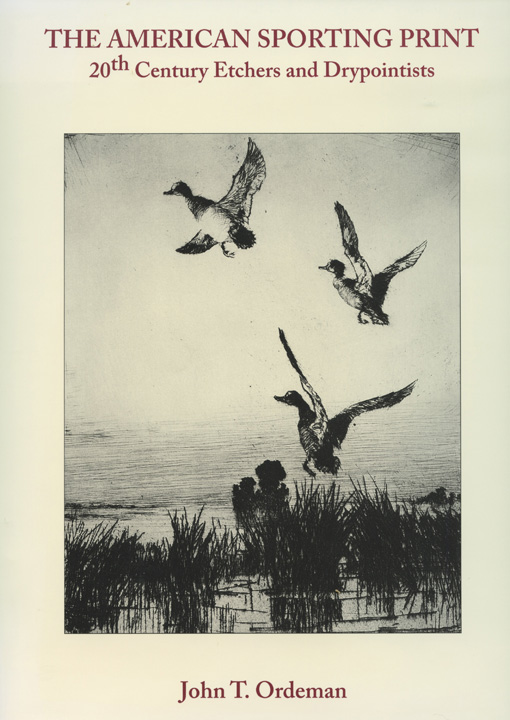
Below, in 2007, John T. Ordeman's publication included my etchings.


Friday, 7 December 2012

#355 In the studio: Corgi Door Knocker


I've created many door knocker designs over the years and one of my galleries has a client who requested a
Corgi motif for a Christmas gift.  I love sculpting dogs and creating functional art is a time- honored assignment
for the sculptor.

The dark clay was difficult to photograph and I will show another image after the sculpture has been patinaed.
Also, I've included a picture of the work after one coat of rubber mold material was applied.  This process - called a blanket mold - requires no shimming.  For more info about mold making, start with post #352, Dec. 1, 2012.


Above, clay model of Corgi door knocker, 13"H
below, blanket mold in progress