Showing posts with label Michelangelo. Show all posts

Sunday, 4 January 2015

#597 Paris: Michelangelo's "Slaves"


Trish and I spent three weeks in Paris last month visiting museums, monuments, and enjoying the beautiful city 
without the tourists and crowds. . . more info about the trip can be found on blog # 595, posted Dec. 28, 2014.  
I will continue to periodically refer to the trip in upcoming blogs and spotlight different museums and 
the art we experienced.  As usual, sculpture will be the main topic.


The focus of this blog are the two magnificent marble carvings of Michelangelo's "Slaves" located in the Louvre.  The sculptures, entitled "Bound Slave" and
"Captive Slave" are two of six "Slave" sculptures that were created between 1513
and 1520 for the tomb of Julius II when Michelangelo was at the height of his power. 


The "Moses" sculpture, also by Michelangelo Buonarroti,  is located in Rome
and was planned for the tomb as well but the tomb was never completed and
the statues are now separated.  There are four additional "Slaves" or "Captives"
in the Gallery of the Academy in Florence, Italy - the "Unfinished Captives" -
that were intended to be included in the tomb of Julius II.
The two "Slaves" that reside in Paris were given to Henry II of France
in 1550 and found their way to the Louvre during the French Revolution.


   Below, are images of the two "Slaves" taken in the Louvre last month.  We had the gallery where they are located all to ourselves most of the morning on our first visit to the museum and upon entering the Louvre, we walked directly to 
"The Victory of Samothrace", (blog # 595) , then to the " Bound Slave" and "Captive Slave",
 and then to "The Venus De Milo" which will be discussed in next Wednesday's blog.
 These sculptures are among the masterpieces of the Louvre.  
We spent three days in the Louvre.


Scholars disagree about the allegorical meaning of the beautiful, tortured, sculptures.  
Above all, they are the clearest and most powerful expression of the grandeur in thought, the drama, 
and the restless, tormented spirit of Michelangelo.  They, and the unfinished "Slaves" in Florence 
are my favorite sculptures by the Renaissance master.  More about Michelangelo in a future blog.


Below, Trish and I purchased two consecutive ten-day museum passes so entering and leaving the museums
was no problem.  Typically, we would find a little cafe for lunch.   French fries and a crouque was the drill
for Trish and French onion soup with baguette for me . . . red wine - always.


Go to the BLOG INDEX on the right for more information. 


Blog, text, photos, drawings, and sculpture . . . © Sandy Scott and Trish


Sunday, 14 December 2014

#591 The Greeks, fragments, Rodin, and modern art . . . con't


Please start this series of blogs with # 584 . . . posted Nov. 19, 2014
The focus of this blog is art history . . . specifically fragments, the GreeksRodin, and modern art.

The Greeks and Michelangelo greatly inspired Rodin but there were many other influences as well.
 He studied Rubens' paintings and declared that he learned chiaroscuro in his sculpture from Rembrandt.
Like so many other artists of his day, he was interested in Japanese art.  He was always learning from
Egyptian, Aztec, Far Eastern, primitive,  as well as18th century French art and spent hours in the Louvre.

His work harked back to the origin of things and later in life,  in an effort to eliminate the unessential, he simplified by breaking fragments away from his sculpture.  Like Picasso, there's no way to typify Rodin's greatness and originality and there's no way to classify him except as a sculptor who created art during the time of Impressionism, Post-impressionism,  Realist, Symbolist, Expressionist, Romantic, Cubism, and Art Nouveau.  He was an artistic genius with a vision and focus on the future of modern art. . . nothing and no movement defines him.

Interestingly, the fragments, partial figures, and ancient relics that influenced Michelangelo,
Rodin, and many other artists, gave rise to "modern" art.

There are many great art books about the Greeks, Rodin, and Michelangelo and shown below are a few of them from
 my library.  A particularly interesting book is "Rodin Rediscovered",  published in 1981 and in conjunction with a show at the National Gallery of Art in Washington D.C.  Included in the publication are interesting and in-depth essays by different authors and scholars about the master and his working methods.


For more information about Greek art and art history, four great websites are:


http://ancientgreece.com/s/Main_Page/

http://visual-arts-cork.com

http://www.essential-humanities.net

http://pantherfile.uwm.edu/


Go to the BLOG INDEX on the right for more information. 


Blog, text, photos, drawings, and sculpture . . . © Sandy Scott and Trish


Wednesday, 3 December 2014

#588 Fragments, the Greeks, Rodin, and Michelangelo . . . con't


Please start this series of blogs with # 584 . . . posted Nov. 19, 2014
The focus of this blog is art history . . . specifically fragments, the Greeks, Michelangelo, and Rodin.

Rodin visited Italy in 1876 to study the work of the great Renaissance sculptor Michelangelo and the antique Greek
 and Roman fragments and sculpture that had not only influenced Michelangelo, but cast a spell on Rodin as well.
The momentous journey inspired and revolutionized his sculpture.
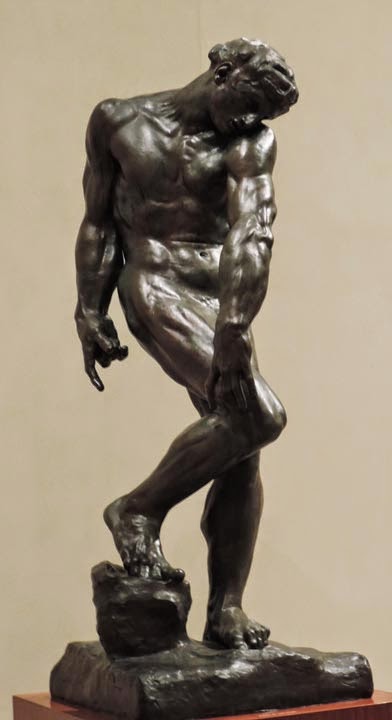
After his return to France, he created "Adam" which reveals the influence of the Italian master
with its twisting torso, obliquely crossed arm, and bent knee.

Shown below, is an image of Rodin's "Adam" that I photographed in the
Nelson-Atkins Museum of Art in Kansas City last spring.


Both Michelangelo and Rodin were influenced
and inspired by ancient Greek sculpture.
The eloquent truncated mass of the
Belvedere Torso shown at right and
located in the Vatican in Rome,
had a great effect on both
sculptors.  Rodin kept a huge
collection of ancient Greek
fragments and antiques in his
studio that he considered
precious and inspirational.

Shown below, is Rodin's "Small Torso of Falling Man" modeled in 1882.
The most conspicuous variety of the partial figure is the torso-fragment,
in which the core of the human torso is represented without head and/or limbs.
Rodin created scores of independent fragments and partial figures that were not drawn from an identifiable previous work.


Shown below, is "Narcissus" also modeled in 1882 . . . another Rodin sculpture in the Iris and B. Gerald Cantor
 collection on display at the Nelson-Atkins Museum of Art in Kansas City.


Go to the BLOG INDEX on the right for more information. 


Blog, text, photos, drawings, and sculpture . . . © Sandy Scott and Trish


Sunday, 30 November 2014

#587 Fragments, the Greeks, Rodin, and Michelangelo . . . con't


I've taught sculpture in workshops for almost 30 years and am routinely asked to discuss art history.
 I was fortunate to have an academic background by studying at the Kansas City Art Institute.
My time there inspired a life-long interest in art history . . . then and now I devour information
and continue to be inspired by artists from the past.
This short series of blogs is in response to requests from students and others
who also posses a passion for the arts and its history.

Please start this series of blogs with # 584 . . . posted Nov. 19, 2014
The focus of this blog is art history . . . specifically, the Greeks, fragments, Rodin, and inspiration.

Below, are two sculptures by Rodin:  "St. John the Baptist", 1878; and "The Age of Bronze", 1876


Auguste Rodin,  was born in Paris in 1840 and died in1917.  When he was young, he spent several
years of his apprenticeship with an ornamental modeler doing nothing but leaves, fruit, and flowers.
He could not afford to study with French masters of the time and turned to antique Greek statues and
fragments and to the works of Michelangelo, Donatello, and the Renaissance for inspiration in 1876.

When he was 36 years old, he traveled to Rome, Florence, Venice, and Naples to study the works of Michelangelo and Donatello and returned to Paris filled with the influence of the Renaissance.  While in Italy, he saw how the Greek sculptor, Phidias and other masters of the Golden Age of Greece modeled strength into their figures by studying ancient fragments and statuary discovered in Italy and elsewhere.   Rodin, like Michelangelo was greatly inspired by the discoveries of ancient Greek fragments and sculpture and had a collection of them in his studio.

Soon after returning from Italy, Rodin created what was to become a key juncture in his career . . .
the monumental bust, "Bellona".  The sculpture established him as an artistic personality in his own right.
 Note:  The helmet is similar to the helmet of Michelangelo's "Lorenzo de Medici"
and like other works of this period, reflects Rodin's close study of Michelangelo.


 While Rodin's 1876 trip to Italy was an inspirational turning point in his career, his early known works are few.
"Man With the Broken Nose", created in 1864, was refused by the Salon.  A close-up of the sculpture is shown below.   Also shown is a sculpture created in 1863, entitled "Father Pierre-Julien Eymard".
After his enlightening and inspirational trip to Italy and under the influence of the
 Greeks, Michelangelo, and the Renaissance, his career and reputation grew rapidly.


Go to the BLOG INDEX on the right for more information. 


Blog, text, photos, drawings, and sculpture . . . © Sandy Scott and Trish


Sunday, 23 November 2014

#585 Fragments, the Greeks, and Michelangelo


Since my art school days in the 1960s and ongoing travels to the world's great museums over the years, I have been captivated and greatly influenced by ancient sculpture.  The legacy of Greek art and art of older civilizations is the root of Western figurative art and to this day, I can be found in the antique sculpture galleries when visiting a world-class museum.

At left, I'm in one of the antique sculpture galleries
at the Metropolitan Museum in New York.

Below, is an image of a resin casting of an antique fragment from the Parthenon frieze  purchased in the museum's gift shop. . .
                                                                                  a constant inspiration in my studio.


The focus of this blog is art history . . . specifically, fragments, the Greeks, and Michelangelo.

Artistically speaking, Greek art reached perfection during the fifth and fourth centuries B. C.   These periods,
called the Golden Age and the Hellenistic Age to the end of the second century, B.C.
 are considered one of the highest levels of artistic achievements ever attained by man.
Sculptors broke away from old laws of frontally and studied athletes in action.
Sculpture was created which depicted anatomy, balance, and ideal proportions of the human body.

When the Romans conquered Greece and plundered her art treasures, they filled their
villas with Greek art and copies of Greek art . . . much of it was discovered in places like the
Forum in Rome in the form of broken and fragmented pieces during the early Renaissance.

The discovery of acknowledged Greek masterpieces like "The Apollo Belvedere", "The Belvedere Torso",
 and "The Laocoon",  located in the Vatican in Rome,  created a universal standard of art and perfection
in Western art.  Greek truncated, fragmented, and partial figures were highly collected and regarded
 as the ideal in figurative art.  Today, they remain the pinnacle of perfection.

Shown below, are images of the above mentioned Greek masterpieces.

Apollo Belvedere


Belvedere Torso


Laocoon


  "The Belvedere Torso" located in the Vatican Museum was greatly admired by Michelangelo and there's no
doubt that these discoveries greatly influenced the Renaissance.  Although Michelangelo represents the
final spirit of the Renaissance,  his early stay in Rome brought him into contact with ancient sculpture
and firmly directed his style as he initiated mannerism and the Baroque in Florence.

 Note:  The fragmented or truncated figures that were discovered and have survived the centuries,
would have been intolerable to the Greek ideal of wholeness and beauty.

 Shown below are images of sculpture by Michelangelo and shows the influence of  Roman copies
of  Greek fragments that ushered in his classical perception of the perfect nude.  More about his
"emerging" or "unfinished" style presented in these works in an upcoming blog.

Young Captive


 Captive Awakening


Captive Known As Atlas


Go to the BLOG INDEX on the right for more information. 


Blog, text, photos, drawings, and sculpture . . . © Sandy Scott and Trish