Showing posts with label influence. Show all posts

Sunday, 12 April 2015

#625 "Riders of the Dawn" . . . the horse, con't


Please start this series of posts about the horse with blog #616

One of my all-time favorite equestrian monuments is a sculpture entitled "Riders of the Dawn" 
by Adolph Alexander Weinman, (1870 -1952).   Located at Brookgreen Gardens in Murrell's Inlet, South Carolina,  
it was commissioned by the Brookgreen founders,  Archer and Anna Hyatt Huntington in 1940.
The sculpture depicts a heroic group of two galloping horses ridden by jubilant young men blowing trumpets.  
Weinman combines every element to create the feeling of a great surge of high spirits and youthful vigor.  The powerful masses, the patterns of muscles, the wind-tossed manes, and the scrolled waves all contribute to the effect.

Below, is an image of "Riders of the Dawn".


Adolph Alexander Weinman was born in Germany and came to New York when he was 10 years old.
At the age of 15, he attended evening classes at Copper Union and later studies at the Art Student's League.  He later apprenticed and worked for Augustus Saint-Gaudens and Daniel Chester French and opened his own studio in 1904.  Weinman in known as an expert in medallic art, a carver of architectural ornament, and a sculptor of monuments.  
Many important buildings were beautified by his additions in New York, Washington D.C., 
 the state capitals of Missouri and Wisconsin and elsewhere.

Below, are details from the superb equestrian monument:  "Riders of the Dawn" which has had an enormous 
effect on my approach to equine sculpture since I first laid eyes on in it  almost 35 years ago.


Go to the BLOG INDEX on the right for more information.

Blog, text, photos, drawings, and sculpture . . . © Sandy Scott and Trish


Wednesday, 14 January 2015

#600: Throw on another log . . . the influence of Bugatti, con't


Throw on another log is a commentary and opinion about art
and this blog is a continuation of the previous post . . . 
Please scroll back to blog # 599,  posted Jan. 11, 2015.

I welcome your comments and observations.


Since the last post,  I've received several comments and inquiries from
former students and others about the influence of Bugatti regarding my
 work.  Years ago, I purchased the big Bugatti book - cover shown at right -
and while it had a definite presence in the studio, it was not a
"go-to" source of reference during the early, formative years . . .
 There's no clay on the pages which attests to the fact.

 The trip to Paris last month has directed my attention to this incomparable sculptor of animals.  I was mesmerized by his plasters at the Musee d'Orsay,  (shown in the previous post),  and spent hours in the Petit Palais,
(also shown),  with his sculptures . . . captivated and influenced.


Bugatti died young - he committed suicide at age 31 - and during his short life he created over 300 sculptures. 
 He explored many different methods and styles while creating a multitude of masterpieces . . . each one a classic observation of the animal . . . in gesture and in spirit.  Every sculptor would be well-served to study his work.   

While I can't say my work has been grounded and influenced by Bugatti over the years, since returning from Paris,
 I'm haunted by the memory of experiencing his sculpture in the museums.  This morning, I created a study of a walking panther - shown below -  that would not have been on my radar to do without being under his spell.  

Every artist is the sum total of their interests, experience, knowledge, and feelings.
Artists and their styles evolve naturally while searching various possibilities of design.

Style, like feelings, cannot be forced.


Shown below, are images of Bugatti's cats.  Note the various surface treatments and styles.


I'm concluding each art blog about our trip to Paris last month with a glimpse of life in the beautiful city.

Below, the morning sun streams through the window of the upper level cafe as Trish and i enjoy coffee,
a baguette, and cheese at the Musee d'Orsay . . . an enlightening day, experiencing Bugatti.

Also shown is the incredible Sorolla painting that is close to the cafe.


Go to the BLOG INDEX on the right for more information. 


Blog, text, photos, drawings, and sculpture . . . © Sandy Scott and Trish


Sunday, 11 January 2015

#599: Throw on another log . . . the influence of Bugatti


Throw on another log is a commentary and opinion about art.
It is directed toward students, artists, collectors, galleries,
museums, and those interested in the visual arts.
I welcome your comments on this blog and on Facebook.

I've learned through my association with painters over the years and by engaging in social media such as Facebook and artist's blogs that without a doubt, the two non-living painters who have had the greatest influence on representational painters are
John Singer Sargent and Joquim Sorolla.  Among the living painters, the most influential is certainly, Richard Schmid.


Among anamaliers - or sculptors of animals - one name prevails:  Rembrandt Bugatti (1884 - 1916).  
He was Italian, came from the famous Bugatti family, designers of art nouveau furniture and automobiles, 
and lived and worked in Paris and Antwerp.  He worked from zoo animals.

 Bugatti has, by far, had the most influence on today's animal sculptors . . . even more than Barye.
Bugatti was fairly obscure when I directed my attention toward sculpture in the late 1970s'
 and early 1980s'.  I had seen and remembered his work from an early trip to Paris but it 
was my friend and fellow sculptor, Ken Bunn who turned me on to his incredible work early on.  
Many sculptors were certainly aware of Bugatti's work back then and were influenced by his loose, 
juicy, thumby, and impressionistic surfaces coupled with his heightened sense of form and structure.  

The enormous amount of time he spent at the zoo facilitated his understanding of the animals he modeled
 and his great ability to find the pose and gesture, captured his subject's essence.   
Below, are images of Bugatti's sculpture.


Today, every sculptor I know is aware of Rembrandt Bugatti.  Books have been written about him and his works 
are coveted by museums and sell in the millions.  He produced over 300 works in his short life,
 before committing suicide at age 31.  Much more can be learned about him online.  

To me,  Bugatti is style, simplicity, and elegance . . . the subject, beautifully observed.
I read that he would tear down and start over if he could not complete a study in a day at the zoo.
Incredibly, some of Bugatti's works are mannered, tight, and art nouveau in concept and execution.  
His work is usually based on a perfectly flat plate like the zoo cage surfaces he knew so well.

Below, are images of Bugatti's plasters in the Musee d'Orsay.  Note the careful modeling of the lion.
Bugatti's "Pelicans" are located in the Petit Palais Museum.


   The good sculptors, like Bunn and others, developed their own statements under Bugatti's influence. 
Sadly, there are those who continue to misunderstand anatomy and structure and misinterpret what they
 are seeing when they look at spontaneous, active surfaces such as Bugattis' or Rodins' for that matter.

 Misunderstood form and sloppy, meaningless surface continues to be put out there in the name of "loose".


Below, is an image of Ken Bunn's "Drinking Lion" and "Jackie" by Richard Schmid 
from my collection.


I'm concluding each art blog about our trip to Paris last month with a glimpse of life in the beautiful city.

Below, crepes are being made in a little open- air kitchen in Montmartre.  The batter is ladled onto the
hot cooking surface and after the crepe is cooked, it is fill with Nutella, or the sweet filling of your choice.
We stayed in Monmartre and I eventually had to avoid this place.  As I emerged from the metro, the aroma filled the air . . .  they're too good and eating one meant no supper for me.
The skinny guy cooking them obviously doesn't eat them.


Go to the BLOG INDEX on the right for more information. 


Blog, text, photos, drawings, and sculpture . . . © Sandy Scott and Trish


Sunday, 21 December 2014

#593 The Greeks, fragments, Rodin, Barye, and influence . . . con't


Please start this series of blogs with # 584 . . . posted Nov. 19, 2014
The focus of this blog is art history . . . specifically fragments, the Greeks, Rodin, Barye, and modern art.
This post concludes a series of blogs about the influence of artists of the past on a living artist.
All blogs starting with November 30 were pre-posted while Trish and I were in Paris.

Artists are often asked:  What has been the biggest influence in your art?
Every artist is influenced by something or someone . . . maybe an instructor, a favorite living or deceased artist or school of art, or even what is perceived as popular and selling well.  Also, throughout an artist's life, many different influences, people, and events continue to affect an artist's creative direction and work.  

On a personal note, I was and am influenced by the art that came before me.  If I had to choose only one school of art . . . it would be Greek art of the Hellenistic and Golden Age.  If I had to choose only one artist,
who early in my career and now, influences me - it is Antoine-Louis Barye [1796 - 1875] .
His knowledge and execution of anatomy is without peer.


Keep in mind, the giants throughout art history such as Rodin were influenced by someone and something.
Rodin was exclusively working for someone else until he was 30 and it was an invaluable learning experience.
Interestingly, Rodin studied briefly under Barye and while he was a powerful artist, Barye was lacking as a teacher and Rodin entered the studio of Carrier-Belleuse [1824 - 1887].

While Barye was a sculptor of animals, Rodin was a sculptor of the human figure.  Rodin had a desire to create an equestrian monument and in 1886 modeled the sculpture entitled "Maquette of General Lynch'" shown below and at the Nelson-Atkins Museum of Art.  The monument was never realized and later Rodin conjoined part of the horse to a nude female figure and created another sculptural statement.


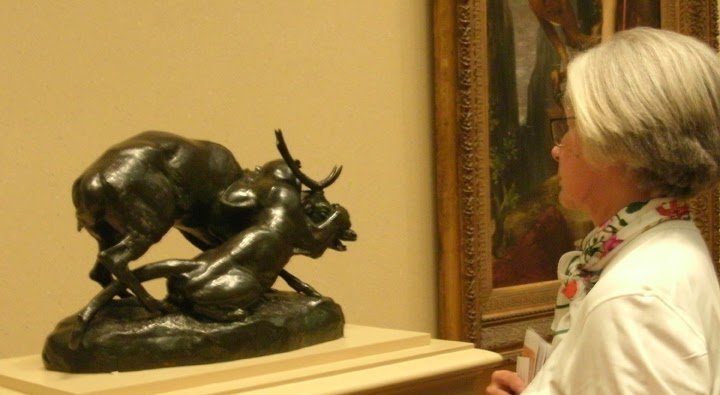
Below, are photos taken at the Metropolitan Museum of Art in New York of "Panther Seizing a Stag" by Bayre.


I've experienced many influences over the years both in printmaking and in sculpture.  I parrot the advice of my friend,
the late Bob Kuhn when asked by my students - "How do you make it as an artist today?"   Kuhn's advice: . . .
Go to as many galleries, shows, and openings as you can; read as many art magazines as you can and
find out what's out there and what's being done . . . then do something else.   

For me, the Greeks and ancients continue to be the source of influence and inspiration.
I feel a need to go directly to the freshness of the ancients in search of their mysteries.
 I'm always learning, and while fascinated by the beauty of Rodin's surfaces . . .
my ongoing struggle continues to be refining the craft and a search for inner beauty and essence of the subject.

 This blog ends a series of ten posts regarding a portion of art history and resulting influences.
Importantly, I have found that by turning to nature - the source of all life - and not to other artists' work,
the ultimate  inspiration and influence can be experienced.


Go to the BLOG INDEX on the right for more information. 


Blog, text, photos, drawings, and sculpture . . . © Sandy Scott and Trish


Wednesday, 17 December 2014

#592 The Greeks, fragments, Rodin, and influence . . .


Please start this series of blogs with # 584 . . . posted Nov. 19, 2014
The focus of this blog is art history . . . specifically fragments, the GreeksRodin, and modern art.


The time I spent as a student at the Kansas City Art Institute in the early 1960s, was the most
far-reaching event of my life. Immersed in an academic setting, it was the awakening of my senses as I absorbed the rudiments of what would become a lifelong journey in the arts.  I enthusiastically focused upon the study of art and art history and to this day, I thrive upon the knowledge and love for the arts instilled in me by competent instructors.


Shown above, is a photo taken earlier this year at the historic art school.

The Nelson-Atkins Museum of Fine Art is located on the campus of KCAI and, like the other students, I spent many hours in the inspiring galleries of the museum.  Shown below is the imposing facade of the Nelson-Atkins.  Also shown, is a photo of Rodin's "The Thinker" and "Adam" taken last spring during a nostalgic trip to Kansas City.  Rodin's work and ancient Greek and Roman sculpture are my earliest influences in sculpture and they continue to inspire me.


Then,  and now as a perpetual student . . . I was and am to be found in the antique sculpture galleries.
One of my earliest recollections as a student at KCAI is the museum's marble of the Greek "Lion" - 325B.C. shown below.
All photos in this post were taken this year at the Nelson-Atkins Museum of Art in Kansas City.


Go to the BLOG INDEX on the right for more information. 


Blog, text, photos, drawings, and sculpture . . . © Sandy Scott and Trish