Showing posts with label KCAI. Show all posts

Wednesday, 17 December 2014

#592 The Greeks, fragments, Rodin, and influence . . .


Please start this series of blogs with # 584 . . . posted Nov. 19, 2014
The focus of this blog is art history . . . specifically fragments, the GreeksRodin, and modern art.


The time I spent as a student at the Kansas City Art Institute in the early 1960s, was the most
far-reaching event of my life. Immersed in an academic setting, it was the awakening of my senses as I absorbed the rudiments of what would become a lifelong journey in the arts.  I enthusiastically focused upon the study of art and art history and to this day, I thrive upon the knowledge and love for the arts instilled in me by competent instructors.


Shown above, is a photo taken earlier this year at the historic art school.

The Nelson-Atkins Museum of Fine Art is located on the campus of KCAI and, like the other students, I spent many hours in the inspiring galleries of the museum.  Shown below is the imposing facade of the Nelson-Atkins.  Also shown, is a photo of Rodin's "The Thinker" and "Adam" taken last spring during a nostalgic trip to Kansas City.  Rodin's work and ancient Greek and Roman sculpture are my earliest influences in sculpture and they continue to inspire me.


Then,  and now as a perpetual student . . . I was and am to be found in the antique sculpture galleries.
One of my earliest recollections as a student at KCAI is the museum's marble of the Greek "Lion" - 325B.C. shown below.
All photos in this post were taken this year at the Nelson-Atkins Museum of Art in Kansas City.


Go to the BLOG INDEX on the right for more information. 


Blog, text, photos, drawings, and sculpture . . . © Sandy Scott and Trish


Sunday, 22 June 2014

#541 Fundamentals: KCAI and early equine art influence


I attended the Kansas City Art Institute in the early 1960s, and it was the most far-reaching event of my life.  
To this day, I view the time spent there as the awakening of my senses.  My eager young 
mind absorbed the rudiments of what would become a lifelong journey in the arts.  
Nothing since has equaled the enthusiasm in which I immersed myself in the study 
of art fundamentals and art history.   To this day I thrive upon the confidence instilled 
in me by competent instructors who inspired and directed me toward achievement.

Recently, I returned to KCAI and was flooded with heartfelt memories of times past.  We were
there on a weekend and roamed the empty campus while enjoying beautiful spring weather. 

Below, are images taken last month of a nostalgic return to the place that determined my life's work.


Fifty three years ago this summer, my parents and I passed through the gates shown below
after driving from Tulsa to Kansas City to enroll me in KCAI.


The Nelson Atkins Museum is located across the street from the KCAI campus and
Trish and I spent several days last month viewing the outstanding collection.

Shown below is the north side of the Nelson Atkins Museum located across the street from KCAI.
In 1994, Claes Oldenburg's aluminum and plastic sculpture entitled, "Shuttlecocks" replaced Rodin's,
"The Thinker", which was moved to the south side of the building.  As a new student, I'll never forget
 walking under Rodin's, "The Thinker" during the first week of orientation when freshmen
were taken on a tour of the magnificent museum . . . O, the excitement and anticipation of art classes!
pretty heady stuff for an Oklahoma country girl!


I remember more trees and landscaping around the museum in the '60s.  I did a search and found a
link that shows images of what the museum looked like back then.   Nelson/Atkins '60s

Kansas City is known as the "City of Fountains" and the famed Country Club Plaza area - with its many fountains - 
is located a few blocks from the art institute and museum.  In 1958, three years before I entered the art institute,
the sculptor, Henri L. Greber created the J.C. Nichols Memorial Fountain and it was installed
on the Plaza . . . it was the talk of Kansas City.

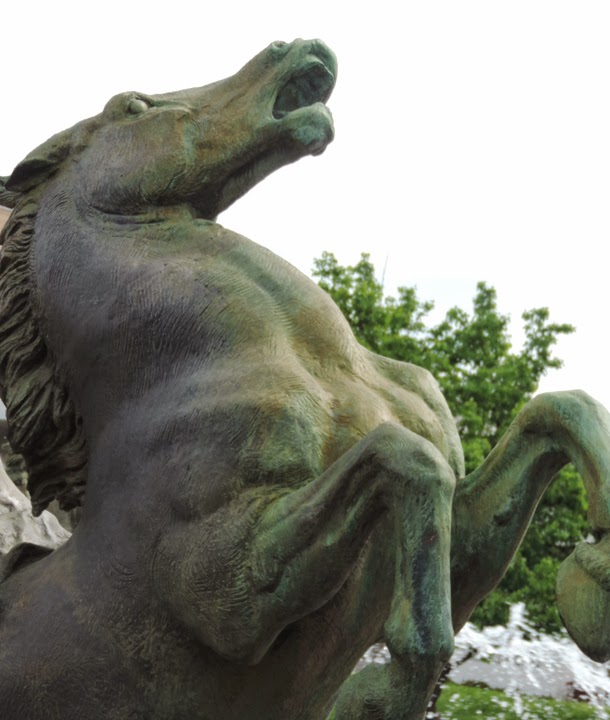
As a young art student, I spent many hours absorbing the wonders of Greber's equine fountain.
From the moment I saw the stunning creation, with its flaring nostrils, flashing hooves, shooting water, and baroque drama . . . I knew I wanted to be a sculptor.

Below, are images of Henri L. Greber's famed masterpiece on the Plaza in Kansas City, Missouri.


To learn more about the subjects go to the links below.

For a complete list of the blog index go to the Index Page and
type the subject in the Search This Blog link on the right.


Blog, text, photos, drawings, and sculpture . . . © Sandy Scott and Trish


Sunday, 1 April 2012

#200 In the studio: Equestrian maquette, con't . . .


Typically, I don't use measuring devices such as calipers, to tell me if my sculpture is "right". I am not blindly dependent on them because the results in clay can come across as a specimen of the figure.

After attending the Kansas City Art Institute years ago, I worked as a background artist in the animation department of Calvin Motion Pictures. While creating a recent sculpture depicting running horses, I referred to an animator's trick which is to "draw the verb".  For instance, while horses are the noun . . . running is the verb.

The sculptor must understand locomotive anatomy; how the muscles bunch and stretch.  The sculptor must know when and how to exaggerate a figure's form and anatomy.  Below, is the initial block-in and work in progress.  By narrowing the waist and lengthening the largest shape - the torso - a sensation of athleticism and speed is felt by the viewer.


Saturday, 14 January 2012

#134 In the studio: Pheasant still life . . .


Hanging Grouse Alexander Pope
Photo courtesy National Museum of Wildlife Art
The "gamepiece" - the still life with game - was beautifully painted by 17th century Dutch painters such as Jan Weenix and Melchior d'Hondecoeter.  In the 18th century Jean Baptiste Oudry continued the genre.  Today, Ken Carlson and Thomas Aquinas Daly carry on the tradition.

As an art student at the Kansas City Art Institute I was fascinated and influenced by 19th century American painters William Harnett and Alexander Pope who painted incredible tromp i'oeil sportsmen's still life masterpieces. While other students were studying  Abstract Expressionism, I was immersed in representational subject matter that I grew up with in rural Oklahoma.

Executed in high relief, my new pheasant still life sculpture is meant to be a decorative wall hanging My goal was to present the pheasant rooster with clarity of contour and expressive form . . . not as a dead bird.  
The upright vertical axis of the new sculpture creates logical balance of mass and quiet simplicity of form.


                                                                                                                                 www.wildlifeart.org/

Life-sized pheasant gamepiece in progress


Go to the BLOG INDEX on the right for more information.

Blog, text, photos, drawings, and sculpture . . . © Sandy Scott and Trish

Sunday, 25 September 2011

#39 In the Field - Cody, Wyoming con't . . .


Senator and Mrs. Alan Simpson (R - WY)

Yesterday, after the brunch, quick draw and auction, Trish and I toured the Cody art galleries.   We met Wyoming Senator Alan Simpson and his lovely wife Ann at the Simpson Gallagher Art Gallery which is owned by their daughter Sue.  We are both fond of this great man and were pleasantly surprised to learn they own a piece of my work.


Afterwords we were invited to the studio of the late sculptor Harry Jackson (1924 - 2011).  We had sat at the same table with his son Matthew during the previous nights' banquet and art auction festivities and jumped at the special invitation.

The three of us spent the afternoon visiting in the solitude of his father's studio: a coveted and profound experience!  As a student at the Kansas City Art Institute in the early 60's modernism was being taught.  I had learned of Jackson and his friendship with Willem de Kooning and Jackson Pollock and over the years have been fascinated by his career as an Abstract Expressionist painter in New York who evolved into a powerful sculptor of western bronzes.

I left feeling that I had actually met him - his work and his life were coming into focus.  I will research and read about him in the coming months and cherish the small sculpture I bought in his studio.

Art must express some force, some emotion, some movement - I felt it all.


Matthew Jackson and Sandy
in Harry Jackson's Cody, WY studio


Go to the BLOG INDEX on the right for more information.

Blog, text, photos, drawings, and sculpture . . . © Sandy Scott and Trish

Saturday, 20 August 2011

#6 Remarque: "Hearts Entwined"

The dove motif has a noteworthy and special meaning to me:  Thirty years ago in 1981 I turned my attention to sculpture which had interested me since early studies at the Kansas City Art Institute.  My etchings and stone lithographs had been in galleries for years and sculpture was not only a diversion but a medium I wanted to add to my portfolio.  I spent a considerable amount of time modelling the first piece to be cast in bronze entitled Fantail Dove.  The work was modeled from life using birds raised and bred at my studio then located in El Paso, Texas. It was well received, won several awards and sold out quickly.  


Printmaking took a back seat to sculpture and I soon moved my studio to the Loveland/Fort Collins, Colorado area where the foundries were located to pursue sculpture — my new passion.


And now, thirty years later I have revisited my beloved subject, the fantail dove and created Hearts Entwined.


Hearts Entwined
12"H 22"L 11"D

Go to the BLOG INDEX on the right for more information.

Blog, text, photos, drawings, and sculpture . . . © Sandy Scott and Trish