Showing posts with label lifestyle. Show all posts

Monday, 21 December 2015

#691 Merry Christmas!


Merry Christmas from our house to yours!


We hope your Christmas is merry and bright . . . if you live in Wyoming, it's sure to be white!

Shown above is my little snowbound studio cabin along the Popo Agie River where I paint. 
The photo was taken this morning looking north from the sculpture design studio.


Go to the BLOG INDEX and Reference Page for more information.  


Blog, text, photos, drawings, and sculpture . . . © Sandy Scott and Trish

Monday, 26 October 2015

#683 Florida . . . birds, alligators, fish, and art


Earlier this month Trish and I were in Florida attending the opening of my Retrospective 
at the Bonita Springs Center for the Arts.  For more info, go to blog #680, posted Oct. 5.


While in South Florida we spent time in the Everglades and went fishing in the Florida Keys.
As usual, when we can enjoy free time, we stay as far away from urban areas as we can.
Below, are images, notes, and memories of a great week spent in beautiful  South Florida.
You will notice only one image of the fishing adventure . . . we were too busy catching fish to take pictures!


Below, while photographing birds in the Everglades, this big guy appeared!


Above,  Trish enjoys a cold one at a beach bar on the Gulf Coast in sunny Florida.
Below, I'm taking my morning coffee and photographing birds outside our cabin door at the fish camp in the Florida Keys.


Go to the BLOG INDEX and Reference Page for more information.  

Blog, text, photos, drawings, and sculpture . . . © Sandy Scott and Trish


Sunday, 16 August 2015

#671 Africa Portfolio 1 . . . "Recumbent Giraffe", con't


Please visit the previous blog for more information about this post.

There are some events that occur in the field that are branded in your memory for the rest of your life . . . 
in Africa, my first sight of a Giraffe in the wild remains one of the most profound animal encounters I've ever experienced.

While driving on the dusty road from Ngorogoro Crater in Tanzania to the south end of the Serengeti, we went over a rise and a Giraffe was to our left, less than 20 feet from the Land Rover.  "Twiga, said our guide in Swahile" as he stopped the truck . . . a blazing sun, low in the west backlit the magnificent Masai Giraffe (Twiga) as the magic of Africa enveloped me.  The animal advanced slowly, swinging its head and neck from side to side to keep its balance . . . looking as though it was moving in slow motion.   Without raising the camera, I simply soaked it all in . . . knowing that Africa in all its glory,
the grand, long-awaited adventure and subjects for untold future sculptures lay ahead.


Below, are photos taken of Giraffe in Tanzania.


Shown below,  are images of the clay model that was created in one sitting outdoors after our return from Africa.
I don't cast most of my one-sitting  (typically, 2 -4 hour) clay sketches but this one, I deemed worthy of bronze.


More about Giraffe and modeling recumbent animals in next Wednesday's blog.


For anatomy reference, see posts #616 and #655
Go to the BLOG INDEX and Reference Page for more information.

Blog, text, photos, drawings, and sculpture . . . © Sandy Scott and Trish


Wednesday, 3 June 2015

#640 The pond, con't . . . Geese - domestic and wild


Please see the previous two posts for more information about the pond at the Wyoming studio.

Domestic geese have historically been kept as poultry for their eggs, meat, and down.  We currently have nine that we keep because they are beautiful on our pond, they're efficient "lawnmowers" and are alert "watchdogs".  
Although they're messy when they get on the deck, - as shown below - they have become a part of our life.


Due to their upright posture, their large, heavy body, short wings, and much of their weight being aft in spite of 
their large, meaty breasts . . . domestics are flightless.  Below, are images of our geese.


A few years ago we only had four domestics and what you see below, happened.
We try to prevent more breeding and I'll keep you posted about the outcome.


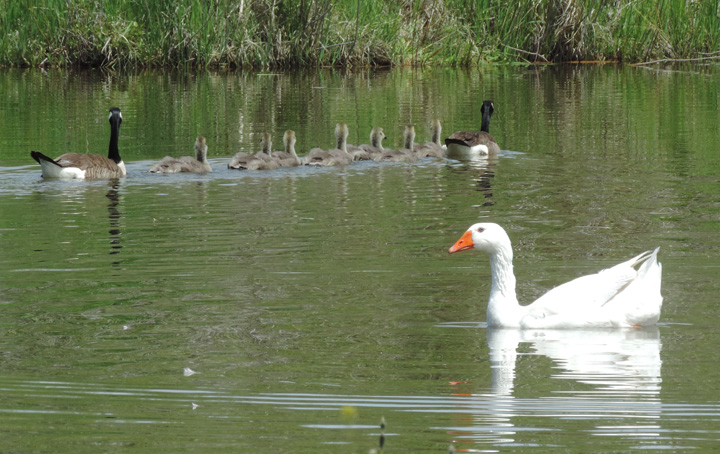
The domestics routinely interact with the wild Canada Geese on the pond during spring and summer when
 the wild ones are here to nest and raise their young.  While I don't understand the dynamics, 
the Canadas always win and keep the larger domestics away from their young.


Below, are images of the two different species on the pond. 


Below, is an early watercolor tinted etching of domestic geese . . . created in 1978.


Go to the BLOG INDEX on the right for more information.

Blog, text, photos, drawings, and sculpture . . . © Sandy Scott and Trish


Sunday, 31 May 2015

#639 Wyoming studio, the pond . . . con't: Canada Geese


Please see the previous post for more information about our pond at the Wyoming studio.


Below, is an image of John James Audubon's lithograph of Canada Geese.


Canada Geese return to our pond every spring to nest, breed, molt, and raise their young.
Typically, the same pair return year after year to where they previously nested and found a safe haven.
They find shelter on secluded ponds like ours which provide security from predators.  This year, we have two different mated pair of Canadas who are raising their young on the pond's island and the surrounding fringe cover. 

While the two families don't interact much, below is a image of the two mated pair with their young taken this morning.


When Canada Geese molt, they lose their primary flight feathers in early summer and become flightless until new feathers grow in about mid-August.  Being flightless is nature's way of causing the pair to breed and stay with their young . . .  
protecting them from harm and teaching them to fly at the end of summer, away from the frigid Wyoming winter.
Most large birds like Canada Geese mate for life and it's a thrill to hear them arrive at our pond every spring.

There's a fascinating website about the molt and migration entitled:   www. geesepeace.com

Below, is a photo of primary flight feathers at the edge of our pond . . . evidence of the molt.
Also shown, is a drawing of a wing showing the primary flight feathers that will molt and quickly grow back again.


There's an old cabin next to the pond where we throw out a scoop of corn for the geese.
Below, a Mule Deer doe walked into view as the geese waited for their corn this morning.


Below, are additional images of the Canada Geese on our pond with their young.


Note:  Canada Geese have long been a favorite subject for my art, both etchings and sculpture. . .
I named the book about my work - "Spirit of the Wild Things",  published in 1998 -  after an early
monumental sculpture depicting Canada Geese with the same title.


Below, is an image of the above mentioned monument, an image of the book cover, and a link to the book -
"Spirit of the Wild Things - the Art of Sandy Scott".   The book is still available for purchase.

http://www.SpiritOfTheWildThings


Go to the BLOG INDEX on the right for more information.

Blog, text, photos, and sculpture . . . © Sandy Scott and Trish


Wednesday, 27 May 2015

#638 Wyoming studio, the pond: Great Blue Heron


I spend lots of time in the field traveling far and wide to experience the wildlife subjects that I use for my art.  
A pleasant feature of being in residence in Wyoming is I only have to walk a few paces from the studio to take part in the unfolding drama that constantly takes place at our pond.   Among the birds typically there, I might see a raft of migrating ducks in the fall, always nesting Canada Geese, Mallards, and Mergansers in the spring, pheasants, an occasional Sandhill Crane, Mourning Doves,  many different songbirds, White-faced Ibis, Belted Kingfisher,  Osprey, Bald Eagles,
and one of my favorites: The Great Blue Heron; which is the focus of this blog post.

Below, is John James Audubon's lithograph of the Great Blue Heron.


We've had lots of rain this spring, the pond is full, and the Great Blue has occupied the little island on the pond and fishes for small trout with its dagger-like bill.  When the heron arrives, the nesting Canadas vacate the island and move their brood to the pond's edge but always come back to the safety of the island in the evening when the heron flies off to roost.


Below, the Great Blue Heron has arrived, strides to its favorite fishing spot as the
Canada Geese move off the island with their brood.


There's an old cabin next to the pond, which along with bushes and a jon boat, provides cover when we photograph.
I'll show a picture of the old cabin in the next blog which is about the resident Canada Geese.
Below, are photos of recent events at our pond featuring the Great Blue Heron.
Trish took the first one of the bird behind the jon boat.


The Great Blue Heron is the largest North American heron and is commonly seen in every region of America except the highest elevations of the Rockies.  The big bird slowly wades or waits patiently, staring into the water when feeding and then quickly strikes any prey that comes within its reach.  They have a six to seven foot wingspan and the male is larger than the female.  The bird usually has blue-gray plumage, but in some areas it is completely white. 


Below, are two early etchings of the Great Blue Heron.


Go to the BLOG INDEX on the right for more information.

Blog, text, photos, drawings, and sculpture . . . © Sandy Scott and Trish