Showing posts with label quail. Show all posts

Wednesday, 26 February 2014

#508 Ex Libris


I love books and I love to read.

I collect books - new books, old books, and rare books . . .
about many different subjects.  My focus, however, is on art,
animals, and history.  I have a real library filled floor to
ceiling with books arranged in a peculiar system that only
I know but cannot explain.  When I shuttle a book
between the library and studio, I always return it to the
same place.  Typically, I can lay my hands on any
book at any given time and I have an uncanny way
of knowing if a book is missing or is out of place. 
I love ripping cellophane off of new books and the sound of a book
being opened for the first time.  I love the pictures, illustrations,
and maps in books.  I love the bindings, marbling, bookplates,
and pressed flowers that I find in old books.


My library is a baronial-sized room that is my sanctuary,
and when I enter it, adventure is imminent.
I love the reassurance of having a book nearby,
and I'm uncomfortable in a room where there are no books. 


   Although the internet has opened a wealth of access and knowledge to "information  junkies" like me . . .
nothing will ever replace a book.
While a computer can answer specific questions
and epitomizes the ultimate reference source. . .
a book offers the surprise of discovery and may present information that one, perhaps, had not thought to ask about! 


Below, are images of my library and various studio bookcases and shelves.


What are books without bookends?  I love bookends and over the years have created over
30 different designs . . . below are samples.


Quail Gamebird Bokends


 Remembering Will James Bookends


 Reflection and Resolve Bookends


 Rooster Head Bookends


Turkey Bookends


To learn more about the subjects in this blog go to the links below.  
For a complete list of the blog index go to the Index Page and 
type the subject in the Search This Blog link on the right.


Blog, text, photos, drawings, and sculpture . . . © Sandy Scott and Trish Smith


Wednesday, 26 June 2013

#438 In the studio: Bird anatomy, con't . . .


Please start this bird anatomy series with post #403,  March 10.

I continue to be influenced by oriental art . . . many of my compositions 
demonstrate what the Japanese refer to as "formal sparseness of design".

Asymmetrical composition and negative space allows much to be imagined by the viewer.


Spring Pride
6"H 11"W 8"D


The artist controls the visual direction and provides both movement and repose.
Simplicity and understatement allows focus on the subject . . .
an area of profusion or detail may be balanced by a sweeping passage of quiet.


All sculpture and drawings - copyright Sandy Scott

Sunday, 23 June 2013

#437 In the studio: Bird anatomy, con't . . .


Please start this bird anatomy series with post #403,  March 10.


Composition is the arrangement of visual elements in a work of art, composition means "putting together."  
A good composition gives the viewer's eye both movement and repose.  
There must be an area of interest contrasted by areas of rest.

There are three main principles of composition:

1.  Composition is a harmonious arrangement of two or more elements, one of which dominates all others in interest.  
     The dominant element becomes the focal point or center of interest.

2.  There should be as few secondary elements as possible and these should be arranged to support the main interest.

3.  The position of the center of interest depends upon the feeling of balance created by the distribution of the different
     elements in the composition.


In the first box the dot is centered, static and not interesting.  This is not good composition.


In the second box, the dots are symmetrical and not interesting, and therefore not a good composition.


In the third box we're getting there.  The space seems to balance the dot.  The Japanese call this "formal sparseness of design."


The fourth box has a composition.


Hummer and Rose
10"H 4"W 4"D

Composition combines clear spatial organization and harmony . . . a simple placement of the figure in nature.


All sculpture, drawings, and etchings - copyright Sandy Scott

Sunday, 16 June 2013

#435 In the studio: Bird anatomy, con't . . .


Please start this bird anatomy series with post #403,  March 10.


Sculpture is the study of a thousand silhouettes.
                                                               - Rodin   


In sculpture, the subject represented is the positive shape.  The empty space around the subject is the negative shape.

The viewer usually does not think about or consider the shape around the sculpture.  
The sculptor, however is constantly aware of both the positive and negative shapes 
as they are a device for designing and organizing the sculpture.


The sculptor should practice designing and seeing in this way, and here's how to do it:  
Select a sculpture of an animal and direct your gaze intently on the figure itself.  
Choose a sculpture with a quiet and simple pose.  
Then, concentrate on the negative shapes or the space surrounding the sculpture.  
You must wait until your vision accepts the negative shape and think of it as a totally separate form.


Now, imagine that the sculpture vanishes.  What is left?  You will find that the negative shapes have 
become distinctive shapes in their own right, and if you focus on these shapes, they become forms.


The sculpture that you are looking at has drawn you into it visually and almost physically.  
The realization of negative shapes adds a new dimension to the image before you, adding to 
your appreciation of its beauty and content. 


Below, look at the lighted sculpture and practice seeing the negative shapes around the subject. 


Height of Land


 Shade of Paradise


 Cochin China


Gamble's Sunset


For more information about negative space see previous post, #434.

All drawings and sculpture copyright Sandy Scott.

Wednesday, 12 June 2013

#434 In the studio: Bird anatomy, con't . . .


Please start this bird anatomy series with post #403,  March 10.

Below are clarified drawings of grouse and quail with folded wings.  The two species are similar, are classified in the same order, Galliformes, and although quail are smaller, their shapes and form resemble each other.
Both have one of the four basic wing shapes discussed earlier in Post #423, May 5, 2013.


Shown below, is a clay model of a quail species - Gambel's Quail - that resides in the Western United States.

Formal sparseness of design, the use of negative space and clarity of silhouette was my goal while modeling this sculpture: Negative space balances and supports the subject and gives visual activity to the composition.  
The arrangement of positive and negative shapes forms the design and creates a new dimension to the image.  Painters use the elements of color, perspective, value and shape to create a composition . . . 
sculptors design with positive form and negative shapes.


Shown below, is a clay model and different composition of the same species . . . Gambel's Quail.


My goal while designing and modeling the quiet pose below was clarity of 
silhouette and organization of positive and negative shapes. 

Harmony and the simple placement of the figure in nature is evident as vision 
accepts the negative shape and thinks of it as a totally separate form.  
Sculpture is the arrangement of shapes - both positive and negative.


Gambel's Roost
8"H 12"W 8"D


 Gambel's Sunset
10"H 12"W 9"D


All sculpture, and drawings - copyright Sandy Scott


Sunday, 9 June 2013

#433 In the studio: Bird anatomy, con't . . .


Please start this bird anatomy series with post #403,  March 10.

My teaching method concentrates on knowledge of the bird's anatomy and blocking in the subject's large shapes.  
The block-in helps to simplify what is most important and causes the sculptor to define the big shapes and form first, before indicating any detail.  
All that can be said with large shapes should be expressed before indicating detail.

The sculptor must determine what shapes are important for identification, 
and establish proportion of the individual species by defining the large shapes first.  


Below, is a clarified drawing of a grouse.
The sculptor must understand what they are seeing when looking at this drawing.
A bird's wing feather sets are basic and every bird has they same groupings as explained in previous posts.
When blocking in the wing the sculptor should think of the wing as large shapes . . .
not individual feathers.


Begin by thinking of the sets of feathers as individual shapes.
For it is shapes and the arrangements of shapes that make sculpture.
Sculpting birds is assembling shapes.

Birds in flight do not "pose" for the sculptor.
As you approach your sculpture stand and embark upon modeling a bird in flight, you will find that knowing the information presented in this series of bird anatomy posts is far more important than the technical ability to sculpt.  Painters paint what they see, sculptors sculpt what they know.


Below and in progress is a clay block-in of grouse.


Quail and grouse are both upland gamebirds, are in the same classification order - Galliformes - and although
quail are smaller, they are similar to grouse in shape and form.


Below is a clarified drawing of a quail in flight.


Birds in flight don't "pose" for the artist . . . knowledge of the subject's structure is mandatory.
Below is a sculpture of quail in flight.


Quail Gamebird Bookends
12'H 18"W 10"D


All sculpture, and drawings - copyright Sandy Scott


Friday, 21 December 2012

#362 In the studio: Etching, the early years


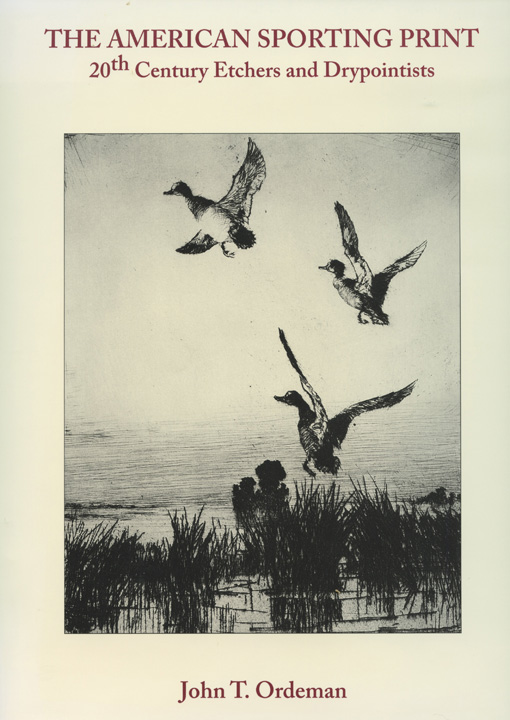
Although, the Oredman book was published in black
and white, the etchings included, will be posted at
a later date, showing the original sepia and colors.
During the early 1970's,  my etchings of wildlife, sporting, and rural subjects became widely known to collectors and galleries across the United States.  They received national attention when Gray's Sporting Journal selected a new etching for every back cover of their early publications.  The etchings were also used as illustrations in many national magazine, book publications, and advertising such as
Remington Arms and Leupold Optics.

I had been exposed to original printmaking at the Kansas City Art Institute in the early 60's and later developed a unique and innovative technique, using sepia ink and applying transparent watercolor washes.  The warm, sepia earth-toned ink acted as an underpainting and the result became my trademark. The small, hand-pulled editions were printed on exquisite French buff-colored rag paper and at one time could be found in over 100 galleries nationwide.

In 1980, I turned my attention to sculpture and produced my last portfolio of etchings in 1983.  They were put in storage to be reintroduced at
a later time and recently, I've begun sending a limited few to select galleries.


Below, Trout and Mayfly, appeared on the back cover of an early issue of Gray's Sporting Journal. 
The warm, sepia ink plate-tone provided underpainting for the transparent watercolor.


Below, in 2007, John T. Ordeman's publication included my etchings.


Saturday, 10 March 2012

#182 In the field: Up the creek - in search of birds con't . . .


Recently we rode horses on a remote trail along Oak Creek (see yesterday's blog)
in search of birds.  We were not disappointed!  Gambel's Quail, Roadrunners, Eagles,
Hawks and a variety of waterfowl including the abundant Great Blue Heron were sighted.

Left, looking up, Trish spots a Great Blue Heron in flight.  Over the past few weeks I've experienced the great bird often on my daily walks along the creek and am under the
influence of the creature.


Friday, 24 February 2012

#169 In the field: At the Autry con't . . .


Ice craving of  quail presentation sculpture
Friend and Collector Lynn Friess with Howard Terpning's
Traders Among the Crow


Museum shows such as Autry Museum's Masters of the American West have played an important role in the resurgent interest in representational art.  Quality, originality and healthy competition among the artists has been the result and astute collectors and museums recognize it.  theautry.org/


Fire and ice: Patina being applied to Sandy's California Roost, presentation piece for the museum's trustees


Friday, 10 February 2012

#157 In the field: Artist in residence


Adele, Susan and Trish
Beautiful Sedona, Arizona is situated along Oak Creek and is surrounded by spectacular Red Rock Country.  It is home to many artists, writers, galleries as well as art and nature lovers.

Although most of my time is spent working, I always find the time to enjoy the company of my artist friends who call Sedona home. Trish and I shared dinner with painters, Adele Earnshaw (a New Zealander and 35 year Sedona resident) and Susan Faust this week and as usual, the lively conversation revolved around art. Adele conducts workshops in New Zealand and you will love her Blog. adeleearnshaw.blogspot.com,

Sandy and Trish - Red Rock Country from restaurant window


Children, like animals, use all their senses 
to discover the world.  
Then artists come along and discover 
it the same way all over again.
                           
                                   -Eudora Welty  


"Arizona Sunrise" in clay was modeled last year while
artist in residence at Mountain Trails Gallery in Sedona


Friday, 3 February 2012

#151 Remarque - "California Roost"


My goal while designing and modeling this quiet pose of the California Quail (also known as the Valley Quail) was clarity of silhouette and organization of positive and negative shapes. 

Harmony and the simple placement of the figure in nature is evident as vision accepts the negative shape and thinks of it as a totally separate form.  Sculpture is the arrangement of 
shapes - both positive and negative.


Sculpture is the study of a thousand silhouettes.
                                                       - Rodin


This work is one of five new sculptures being introduced at the 
Autry Museum's Masters of the American West Show and Sale. 


California Roost
8"H 12"W 8"D