Showing posts with label ducks. Show all posts

Monday, 19 October 2015

#682 "Mallard Duet" New Outdoor Installation at Brookgreen


Earlier this month Trish and I were at Brookgreen Gardens in Murrell's Inlet, South Carolina and attended the 
National Sculpture Society's 82nd Annual Awards Exhibition and the Brookgreen Board of Trustees meeting. 
Brookgreen is home to the largest and most important collection of American figurative sculpture in existence. 
For more information regarding this post,  please see the previous blog.

A  highlight of the recent visit to Brookgreen was the new Low Country Waterfowl Exhibit. 
Last spring, I saw the ponds, landscaping, walkways, etc. under construction and was excited to see the exhibit 
completed and inhabited by the 8 waterfowl species who are now residents of the new aviary.
The 8 species are Wood Duck, Redhead, Hooded Merganser, Northern Pintail, Ruddy Duck, 
Blue-winged Teal, Fulvous Tree Duck, and Black-bellied Tree Duck.

I was delighted to see my sculpture, "Mallard Duet" installed outdoors in the new waterfowl aviary!
The piece has been in Brookgreen's collection for many years and had previously been exhibited in one of the indoor galleries called the Offner Center . . . named after the American sculptor, Elliot Offner.

It was a thrilling experience to see "Mallard Duet"  amidst all the waterfowl and the installation ranks among my 
favorite all-time presentations.  Simply put:  It could not be displayed in a more appropriate setting!
Thank you, Robin Salmon:  Curator of Collections and Bob Jewell:  President and CEO of Brookgreen!  

Below, are images of the new waterfowl aviary and the "Mallard Duet" installation.


Go to the BLOG INDEX and Reference Page for more information.  

Blog, text, photos, drawings, and sculpture . . . © Sandy Scott and Trish


Sunday, 13 October 2013

#469 A new book: "Art of the National Parks"


Earlier this year, a new book entitled, "Art of the National Parks", was introduced.
The book includes 70 artists who offer distinctive visions of 8 of the nation's beloved national parks.

With more than 450 artworks in 430 pages, this glorious, large format book is a must for
anyone who has hiked the trails, watched a sunset, marveled at buffalo herds,
or yearned to experience America's mythic and transformative vistas.  

Published by Fresco Fine Art Publications, co-authored by Susan Hallsten McGarry,
well-known author;  Jean Stern,  curator and art-historian;  and Terry Lawson Dunn,
biologist and educator, the book is an indispensable compendium of artists who are at the
forefront of 21st century American landscape and wildlife art.


Below, included in Yellowstone section of the book are friends and fellow artists . . .
Clyde Aspevig, Scott Christensen, Ralph Oberg,  Jim Wilcox, and more.
Jim's painting is featured on the cover of the magnificent book.


My work was included in the Yellowstone National Park section.
Below, are images of works featured.


 Sleepy Fox
18"H 15"W 9"D


 Ancient Way
20"H 24"W 11"D


 Red-tailed Hawk at Sappa Creek
42"H 30"W 25"D


 Harbinger of Light
13H 20"W 16"D


Hay Bay
19"H 25"W 14"D


Blog, text, photos, drawings, and sculpture . . . © Sandy Scott

Wednesday, 8 May 2013

#424 In the studio: Bird anatomy, con't . . .


Please start this bird anatomy series with post #403, March 10.

How many times have you sat in an airplane and marveled at the mystery of a ponderous machine taking you aloft? What could possibly make this enormous device fly?  The answer is a complex series of events, but if one word had to be used to describe why an airplane flies, that word would be SHAPE.  The SHAPE of the airplane's wing, like the SHAPE of the bird's wing when moved through the air, causes lift.

Drawing number 1 at right; note the leading edge of a wing's SHAPE is blunt and thick, which causes the moving wing to part the air more effectively.  The back or trailing edge of the wing thins dramatically to speed the wing through the air.

The SHAPE of the upper surface of the wing is more rounded and air moving over the top has more surface and distance to cover which creates low pressure.

The SHAPE of the underside of the wing is slightly concave and air has less distance to travel, therefore moving slower and causing high pressure.

Lift is produced as the high pressure on the under surface of the wing attempts to occupy the low pressure on the upper surface.


Drawing number 2 at right; if the wing is held at too high an angle of attack, the air cannot smoothly flow over the wing's surface.  An interruption or "burble" forms at the trailing edge of the wing, which causes loss of lift and the wing  stalls.

Airplanes and birds take off into or facing the wind because it expedites the air that must move over the wing surface to create lift.  They land into the wind as well because at slower landing speed, air must continue to move over the wing's surface.
The scientific term for the above is Bernoulli's Principle.


 Why is all of this important to the bird sculptor.
In two words: pose and gesture.
Principles of flight and the SHAPES involved are the same for airplanes as they are for birds.

Below is a sculpture entitled Hay Bay.
Knowledge of the wing and aerodynamics create the illusion of descending flight.


Hay Bay
19"H 25"W 14"D


All sculpture and drawings - copyright Sandy Scott

Sunday, 5 May 2013

#423 In the studio: Bird anatomy, con't . . .


Please start this bird anatomy series with post #403, March 10.


Wing shapes vary among birds, reflecting the adaptations they have made to different environments.  There are four basic wing shapes, and all birds fall into a semblance of one of the four configurations.  The size and shape of the wings give clues to how the bird lives:

   1.  Long, wide wings are used by soaring birds such as hawks, eagles, and
        ravens.  A wing is considered long when it exceeds the length of the
        bird's body.
   2.  Narrow and pointed wings are used by fast flying birds such as swallows,
        swifts, and many migratory birds such as ducks and geese.
   3.  Long and narrow wings are used by gliding birds such as albatrosses,
        gulls, terns, fulmars, and shearwaters.
   4.  Wide and rounded wings are used for short, fast, and quick-escape flight
        birds such as grouse, pheasants, pigeons, and owls.

The wings of birds do not all have the same shape and size, but all fall into one of the four basic categories.  The shape and size of the wings determines what style of flying a bird executes.  Wing shape is one of the primary ways to identify different species.

Below are illustrations of four different wings.  Each fall into one of the four wing shape categories.


Below is a drawing of a Canada Goose . . . the large bird is migratory and falls into the
basic wing shape of number 2.  However, the wing is also wide and can be considered
to fall into a slight semblance of wing shape number 1, even though it cannot soar. 


All sculpture and drawings - copyright Sandy Scott


Wednesday, 1 May 2013

#422 In the studio: Bird anatomy, con't . . .


Please start this bird anatomy series with post #403, March 10.

A bird's wing feather sets are basic and every bird has the same groupings. 
Once the basics are understood, the artist can adapt them to any species.

Below is a drawing comparing the underside of the wing with the top of the wing.
  Birds have a set of feathers in the armpit region on the underside of the wing called the axillars. 
This group of fan shaped feathers help close the gap between inboard wing feathers and the body during flight.  

Note the various sets of coverts and structured underwing feather lining.


Why is knowledge regarding the wing and the feather groups important to the bird artist?
There is nothing random in nature, and the bird artist should know the feather groups
so well that the wing can be modeled at will from understanding and memory.

Below . . . Note the axillar group in the armpit region.

Mallard Rising
15"H 26"W 16"D

All sculpture and drawings - copyright Sandy Scott


Sunday, 21 April 2013

#419 In the studio: Bird anatomy, con't .


Please start this bird anatomy series with post #403, March 10.

The bird's tail is actually a combination of left and right tail feathers.  One side cannot be spread without  the other spreading also but each side can move up and down independently.  Because of the two sides, there are always an even number of tail feathers.

The bird's tail is shaped differently depending on the species and how nature intended the bird to live and eat:  
The function of the tail is braking, steering, balance, aerodynamic lift, display, and signaling.

Below is an illustration showing several basic tail shapes for different bird species: 
                  1.  Square - starling or nuthatch             5.  Pintail - duck
                  2.  Cleft - Finch                                       6.  Wedge - raven
                  3.  Deep forked - tern or swallow            7.  Fantail - cuckoo
                  4.  Spiked feathers - woodpecker           8.  Elongated center feathers - bee-eater  

There are also variations, such as rounded (crow), pointed (mourning dove),
graduated (magpie), and several unique . . . such as roosters, peafowl, etc. 


Below is a recent sculpture of a Fantailed Pigeon . . . pigeons are in the dove family of birds.

Hearts Entwined 
12"H 22"L 11"D
Copyright - Sandy Scott


Below, detail . . . Hearts Entwined
All drawings and sculpture, copyright - Sandy Scott


Wednesday, 3 April 2013

#413 In the studio: Bird anatomy, con't . . .


Please start this bird anatomy series with post #403, March 10.

The bird's leg is similar in structure to the human.  Many believe that a bird's knee bends backwards 
because they mistake the ankle for the knee.  As in man . . . a bird's knee bends forward.

The bird's knees and thighs are hidden under feathers . . . you don't see the bird's knee 
and the joint that appears to be the knee is actually the ankle.

Below is a drawing comparing the human leg with a bird's leg.
Scroll to the last blog and see how the bird's leg attaches to the skeleton.

Copyright - Sandy Scott

Below, is one of my favorite works entitled Hay Bay.  The sculpture depicts a live-sized Mallard pitching in for a landing.  Note the bend at the bird's ankle . . . the knee is hidden by feathers.

Hay Bay
19"H 25"W 14"D
Sandy Scott

Friday, 29 March 2013

#411 In the studio: Bird anatomy, con't . . .


Please start this bird anatomy series with post #403, March 10.


Recently, while attending an art exhibition in San Antonio, I had the pleasure of photographing and sketching along the city's famed Riverwalk.  What a delightful "in the field" experience!  

Below, a duck sweeps it's femur or thigh out and sideways from the body . . . thus giving free play and movement to the leg.  A duck is in it's element in the water and awkward on land. 


More about the duck's anatomy on the next post.


Below, is a sketch of a mallard taking off along the San Antonio Riverwal


Drawing copyright - Sandy Scott


Sunday, 24 March 2013

#409 In the studio: Bird anatomy, con't . . .


Please start this bird anatomy series with post #403, March 10.

Once the artist researches each species' behavior to perceive size, habits, proportion, gesture, pose,
and knows the basics of the skeleton, anatomy, and the sets of feather groupings inherent to all birds,
the bird sculptor simply uses this knowledge to assemble shapes.


I tell participants in my workshops that once bird anatomy is understood,
they will never again look at a bird in the same way.

Below, is a sculpture of a Bufflehead duck stretching it's wings.
Since birds in flight or in motion don't pose for you . . .
  knowledge gained from knowing the supermarket chicken anatomy,
knowing a bird's feather groups,
as well as many hours afield; resulted in Day on the Bay . . .
one of my all-time favorite works.


A Day on the Bay
12"H 15"W 10"D (life-size)
Copyright - Sandy Scott


Note: There will be more about the creation of this sculpture, including field sketches and notes,
in an upcoming blog.


Friday, 21 December 2012

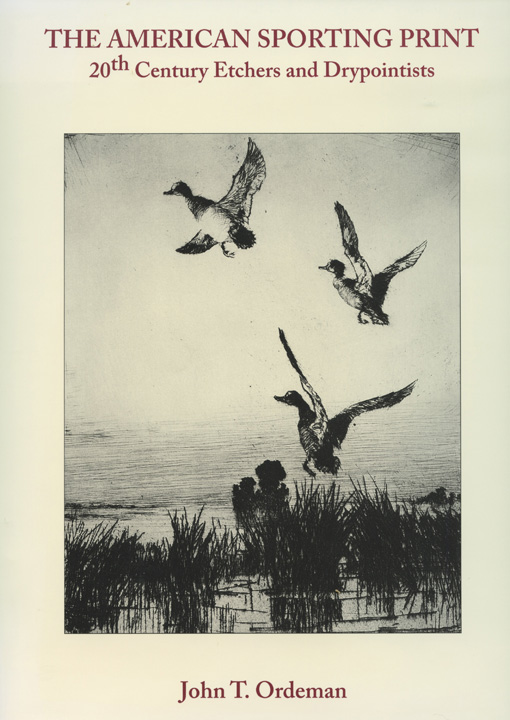
#362 In the studio: Etching, the early years


Although, the Oredman book was published in black
and white, the etchings included, will be posted at
a later date, showing the original sepia and colors.
During the early 1970's,  my etchings of wildlife, sporting, and rural subjects became widely known to collectors and galleries across the United States.  They received national attention when Gray's Sporting Journal selected a new etching for every back cover of their early publications.  The etchings were also used as illustrations in many national magazine, book publications, and advertising such as
Remington Arms and Leupold Optics.

I had been exposed to original printmaking at the Kansas City Art Institute in the early 60's and later developed a unique and innovative technique, using sepia ink and applying transparent watercolor washes.  The warm, sepia earth-toned ink acted as an underpainting and the result became my trademark. The small, hand-pulled editions were printed on exquisite French buff-colored rag paper and at one time could be found in over 100 galleries nationwide.

In 1980, I turned my attention to sculpture and produced my last portfolio of etchings in 1983.  They were put in storage to be reintroduced at
a later time and recently, I've begun sending a limited few to select galleries.


Below, Trout and Mayfly, appeared on the back cover of an early issue of Gray's Sporting Journal. 
The warm, sepia ink plate-tone provided underpainting for the transparent watercolor.


Below, in 2007, John T. Ordeman's publication included my etchings.


Tuesday, 11 December 2012

#357 Throw on another log: "Style"


A figurative sculptor must know the structure and anatomy of the subject portrayed.  The subject, whether quadruped, bird, human, etc, is the design source.  Shape, form, mass, design, pattern, balance, line, contour, texture are all components of the sculptural vocabulary.

I am routinely asked while teaching workshops: "How does the sculptor have their work recognized and become successful when so many sculptors seem to be doing the same thing."
In a word, the answer is STYLE.  A sculptor's personal STYLE will emerge after structure and anatomy is so completely understood that artistic possibilities are communicated and the subject is not portrayed as a specimen.  The sculptor cannot copyright a pose, but can copyright treatment and STYLE.

When you walk into a museum, you recognize Van Gogh, Rodin, Rungius, Turner, Bugatti, Sargent, etc, from across the room.  The same is true today of popular and successful sculptors and painters . . . their STYLE is recognized.
A friend of mine, the late and great wildlife painter, Bob Kuhn, once said:  "Go to as many museums, art shows,
and galleries as you can and see what everyone else is doing . . . then do something different".


Hay Bay 19"H 25"W 
Copyright, Sandy Scott


Tuesday, 8 May 2012

#230 Beyond my window: The Flower Moon


Saturday night, May 5, was the night of the Full Flower Moon . . . May is the month of abundant flowers.  The unusually large moon was closer to the earth this year and was spectacular.  Full moon names date back to Native American tribes of what 
is now the northern United States and southern Canada.

The nesting Canada Geese and Mallards share the pond with my four big domestic geese.  I took this picture by my studio on a cold, Wyoming spring night.

At left is page from my sketch book, and below is the
Flower Moon rising over my pond at dusk.