Showing posts with label in the field. Show all posts

Monday, 2 November 2015

#684 In the field: Pronghorn Antelope and Sage Grouse


The "in the field" experience is a necessity for the wildlife artist.  There's no way to convince your viewer that your work is authentic unless you've been there yourself.  Autumn is a special time to be in the field for many reasons . . .
 especially if an artist is in search of game for studio reference as well as meat for the table.

Trish and I both drew antelope doe tags this year and were successful in putting meat in the freezer for the winter.  Wyoming antelope country is austere, vast, and beautiful.   After we filled our tags, we returned to our 
 hunting area several times with the cameras to collect photo reference material and to experience the animals.  
Below, are images taken this September and October.


Below, are images of Sage Grouse.  The big bird is not on the endangered species list but could be soon.
A great time to photograph them is in the spring during mating season . . . the male has a spectacular display!


We do not hunt them for the table . . . only with a camera. Also, from what I understand, they're not very good eating and I'm spoiled with the succulent Ruffed Grouse we hunt in the north country.  Our Brittany, Penny loves to find them after the day's hunt and I was able to photograph the secretive birds last month for reference material that will be used in the studio.  I'm currently working on a new antelope sculpture and a Sage Grouse composition is mentally in the works.  


Below, is an image of an early antelope sculpture created in the 1990s.


Go to the BLOG INDEX and Reference Page for more information.  

Blog, text, photos, drawings, and sculpture . . . © Sandy Scott and Trish


Wednesday, 12 August 2015

#670 Africa Portfolio 1 . . . "Recumbent Giraffe"


In October, 2013, Trish and I traveled to Africa with a group of 9 internationally known artists to sketch, photograph, paint, observe, and experience the amazing wildlife in Tanzania.  The purpose of the trip was and is to raise awareness and funds to combat the African poaching crisis where thousands of elephants are slaughtered annually for their ivory tusks.  

To learn more about the trip, please go to blog #477, posted Nov. 10, 2013 through #497, posted Jan. 19, 2014.
https://www. Post #477

Last weekend Columbine Gallery in Loveland, Colorado hosted the first show for the group of 9 artists -
Artist Ambassadors Against Poaching  [AAAP] - and a generous portion of the sales went to our anti-poaching efforts . . . "Ivory Orphans" which cares for the young elephants after the adults are killed for their ivory.  More shows are planned.
To learn more about the art show at Columbine Gallery to raise funds for "Ivory Orphans", see the previous 3 posts.

http://www.columbinegallery.com/african-wildlife-trust.html


The focus of this blog is the Giraffe;  a favorite subject depicted in one of the new works in Africa Portfolio 1. 
The new bronze sculpture was introduced at the Columbine art show in Loveland, Colorado last weekend.


Below, are photos of the sculpture, "Recumbent Giraffe"


Below, are photos of Giraffe taken in the field in Tanzania.


Next Sunday's blog spotlights the creation of "Recumbent Giraffe".


For anatomy reference, see page #616 and #655
Go to the BLOG INDEX  and Reference Page for more information.  

Blog, text, photos, drawings, and sculpture . . . © Sandy Scott and Trish


Sunday, 24 May 2015

#637 In the studio: Green Heron


Compared to most herons, the Green Heron is small, dark, short and stocky with short legs, broad wings, 
long bill, and thick neck.   The crow-sized bird is sometimes call the Green-backed Heron.

Below, is John James Audubon's (1785 - 1851) lithograph of the Green Heron.


The Green Heron is typically concealed in vegetation and is hard to see because its coloration appears dark.
The little heron is solitary and secretive and lives around small bodies of water or densely vegetated areas.  
Seeing them is tricky and I've seen the bird only a few times in the wild and always along shallow marsh edges.

Below, are drawings created during a rare encounter with a Green Heron while in the South Carolina Low Country.


The Green Heron's neck is often pulled up against the body when at ease . . .  but when feeding, 
the bird thrusts its neck forward and the long, dagger-like bill strikes swiftly to catch prey.

Below, is a clay model of a recent sculpture of the Green Heron.  I chose a pose that depicts the bird hunting and about
to plunge for its its prey.  The heron appears dark while hunting in the shadows, but is beautifully colored in the sun.


The sculpture was modeled with a dark brown Classic Clay which is a very fine product and one 
of several different types and brands of oil based plasteline clay I use.  Typically, if the wings are extended, 
I use Chavant's Le Beau Touche clay because it is sticky and will adhere to armature wire and aluminum foil better.
 Note:  It's difficult to photograph Classic Clay because of its dark pigment


Below, is the new sculpture, "Green Heron" cast in bronze.
The patina was achieved with liver of sulfur, cupric nitrate, and a trace of ferric nitrate.


Green Heron
11"H 15"W 9"D
Edition 50
3,000


Go to the BLOG INDEX on the right for more information.

Blog, text, photos, drawings, and sculpture . . . © Sandy Scott and Trish


Sunday, 17 May 2015

#635 "Jake"


Please see the previous post for more information about this subject.


Wild Turkeys have a distinguished ancestry and are truly an all-American bird.
The big bird has survived since early pioneer days and our forefathers once
feasted upon its delicious meat just as we do now.

For wariness and cleverness, it is unsurpassed by any other bird but it's possible
to get relatively close to them in the wild at Brookgreen Gardens because
they are used to human activity.

 www.brookgreen.org


Over the years, the species has been one of my favorite subjects for not only sculpture,
but for etchings and drawings.   Brookgreen Gardens in Murrell's Inlet, South Carolina offers
an "in-the-field" experience and a great place to observe, sketch, and photograph Wild Turkeys.

Below, are images of a new sculpture entitled "Jake".  The bronze will be introduced at the 2015 Prix de West Exhibition
in Oklahoma City next month at the  National Cowboy and Western Heritage Museum.   The show opens June, 13.


"Jake"
3600


Shown below, is the clay model in progress.


Below, our Brittany, Penny joins Trish in the mold room while making the flexible rubber mold of Jake.


Below, I'm at the foundry placing the sculpture on a base plate for welding and the addition of terrain shapes.


 Below are two photos of Jake on the patina rack . . . after patina and before wax.


A Jake Turkey is an immature male turkey.  A Jake has shorter feathers on each side
of the tail fan and a small snood above the beck.  A snood is a flappy piece of skin that hangs over a turkey's beak.
All of the tail feathers on a mature Tom will be the same length and will appear as a symmetrical semi-circle
when he struts.  See the previous post for an image of a strutting Tom and the sculpture entitled "Tom".

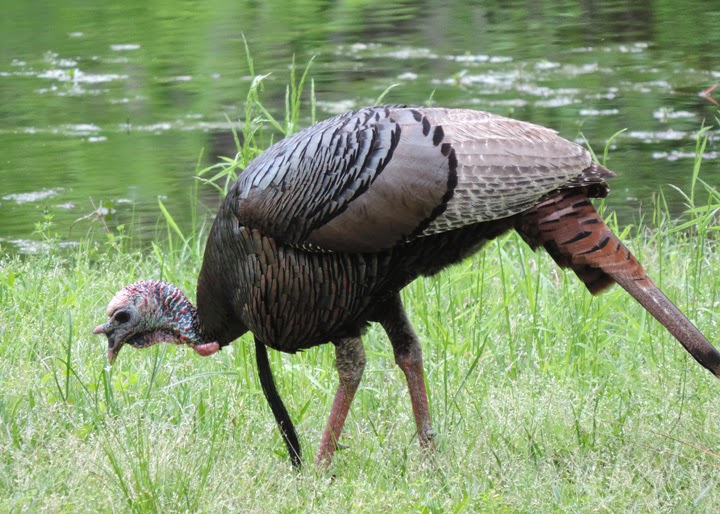
Below, are photos of Wild Turkeys taken last month at Brookgreen Gardens.


The photos shown below are of a mature male gobbler or Tom. . . . a Jake's beard is short and grows with age.


Go to the BLOG INDEX on the right for more information.

Blog, text, photos, drawings, and sculpture . . . © Sandy Scott and Trish


Wednesday, 13 May 2015

#634 Wild Turkeys at Brookgreen Gardens


For more information about Brookgreen Gardens, see blog posts #625 and #627 throughout #631.
Additional info can be obtained by typing in Brookgreen Gardens in the "search this blog" box.

brookgreen.org

Brookgreen Gardens, located in Murrell's Inlet, South Carolina is an accredited museum boasting the the largest and most important collection of American figurative sculpture in existence.  I recently returned from there and am still under the spell of beautiful Brookgreen.  While the sculpture collection is paramount, the 9,000 acre grounds are an award winning horticulture masterpiece and home to an accredited zoo and aviary.  Over the years, I've come to know Brookgreen well 
and upon entering the grounds - especially in the early morning - I'm sure to encounter free ranging 
Wild Turkeys which is the subject of this and the next two blog posts.

For many years I have visited Brookgreen and continue to know it as an "in the field" experience. . . 
a camera and sketchbook is always close by and I've accumulated lots of photos and drawings of Wild Turkeys.

Below, are photos taken last month at Brookgreen.


Below, is a new sculpture entitled "Tom".  Also shown,  is the clay model in progress before the mold was made.


Additional images are shown of the bronze sculpture during the patina process at the foundry.
The patina was achieved with the following chemicals:  Liver of sulfur, cupric nitrate, and ferric nitrate.


Go to the BLOG INDEX on the right for more information.

Blog, text, photos, drawings, and sculpture . . . © Sandy Scott and Trish