Wednesday, 10 December 2014

#590 The Greeks, fragments, Rodin, and modern art . . . con't


Please start this series of blogs with # 584 . . . posted Nov. 19, 2014
The focus of this blog is art history . . . specifically fragments, the Greeks, Rodin, and modern art.

Rodin greatly influenced the direction of modern sculpture in the 20th century and is considered a father of modernism.  He pioneered the technique of repeating the same figure multiple times in one sculpture to produce a new composition.  Among his innovations was fragmenting, resizing, and assembling figures without concern for the subject.
 He was the first to consider fragments, assemblages, and partial figure such as hands
to be complete works of art capable of conveying meaning and emotion.

Below, is an image of "The Cathedral".


Rodin adhered to the studio practices that date back to the Renaissance but rarely participated in the production of his finished pieces.  He created in clay or wax and assistants replicated them in plaster, enlarging or reducing them according to his desires.  As his fame and demand for his work spread, he had over 50 assistants in his studio.
 His plasters were both exhibited and sent to the foundries for casting in bronze.

Below, are two images of one of my favorite sculptures by the master:
"She Who Was the Helmet Makers Beautiful Wife"


One of Rodin's ongoing sources of inspiration was the antique and excavations and discoveries
 of fragments from the glory of the Greco-Roman Period and by frequent visits to the antique sculpture galleries
at the Louvre . . .  the Egyptian, Greek, and Etruscan.
He had a  large collection of artifacts in his studio and delighted in showing them to visitors.
His use of the partial figure, the fragment and the creation of new forms by assemblage
as a complete work of art in effect, posed a question crucial to modern sculpture:
What can sculpture do without?

Below, is an image of "Bust of the Painter Puvis De Chavennes"


Go to the BLOG INDEX on the right for more information. 


Blog, text, photos, drawings, and sculpture . . . © Sandy Scott and Trish


Sunday, 7 December 2014

#589 The Greeks, Fragments, Rodin, and modern art


Please start this series of blogs with # 584 . . . posted Nov. 19, 2014
The focus of this blog is art history . . . specifically fragments, the Greeks,  Rodin, and modern art.

By accident of the year of his birth, Rodin should be considered an Impressionist,
but that label detracts from the scope of his contributions to sculpture.
The key to his facility as a sculptor rests with his ability to translate emotional gestures and movement.

Rodin achieved movement and life in his sculptures by creating a broad range of surface treatments.
These undulating, uneven surfaces come alive when struck by light as shown in the close-up images below of
"Monumental Head of Balzac", modeled in 1887.


Rodin preserved the sketch-like surface qualities and textures of his clay and wax models when they were cast in bronze.   Rodin's rugged, irregular sculpture surfaces went against the accepted convention of highly finished surfaces.

Shown below in the of image of "Jean d'Aire", 2nd maquette from the "Burgher of Calais", 1885.
Photos were taken last spring at the Nelson-Atkins Museum of Art in Kansas City.


  Rodin's style and talent reasserted sculpture's position as a vital art form in modern times.
He cleared away the academic limits on the sculptor's imagination and prepared the way
 for the twentieth-century modern artist's unlimited experimentation with form and mass.


Go to the BLOG INDEX on the right for more information. 


Blog, text, photos, drawings, and sculpture . . . © Sandy Scott and Trish


Wednesday, 3 December 2014

#588 Fragments, the Greeks, Rodin, and Michelangelo . . . con't


Please start this series of blogs with # 584 . . . posted Nov. 19, 2014
The focus of this blog is art history . . . specifically fragments, the Greeks, Michelangelo, and Rodin.

Rodin visited Italy in 1876 to study the work of the great Renaissance sculptor Michelangelo and the antique Greek
 and Roman fragments and sculpture that had not only influenced Michelangelo, but cast a spell on Rodin as well.
The momentous journey inspired and revolutionized his sculpture.
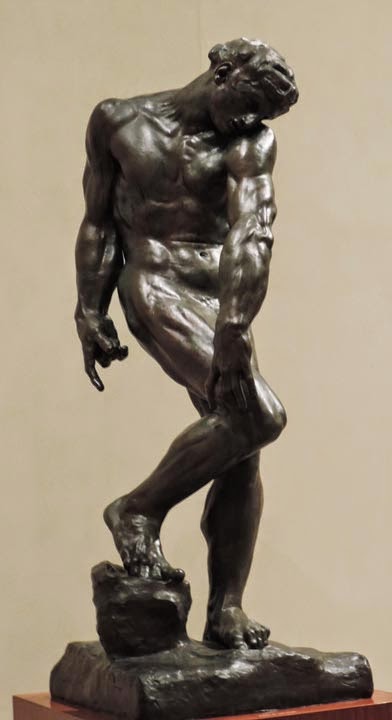
After his return to France, he created "Adam" which reveals the influence of the Italian master
with its twisting torso, obliquely crossed arm, and bent knee.

Shown below, is an image of Rodin's "Adam" that I photographed in the
Nelson-Atkins Museum of Art in Kansas City last spring.


Both Michelangelo and Rodin were influenced
and inspired by ancient Greek sculpture.
The eloquent truncated mass of the
Belvedere Torso shown at right and
located in the Vatican in Rome,
had a great effect on both
sculptors.  Rodin kept a huge
collection of ancient Greek
fragments and antiques in his
studio that he considered
precious and inspirational.

Shown below, is Rodin's "Small Torso of Falling Man" modeled in 1882.
The most conspicuous variety of the partial figure is the torso-fragment,
in which the core of the human torso is represented without head and/or limbs.
Rodin created scores of independent fragments and partial figures that were not drawn from an identifiable previous work.


Shown below, is "Narcissus" also modeled in 1882 . . . another Rodin sculpture in the Iris and B. Gerald Cantor
 collection on display at the Nelson-Atkins Museum of Art in Kansas City.


Go to the BLOG INDEX on the right for more information. 


Blog, text, photos, drawings, and sculpture . . . © Sandy Scott and Trish


Sunday, 30 November 2014

#587 Fragments, the Greeks, Rodin, and Michelangelo . . . con't


I've taught sculpture in workshops for almost 30 years and am routinely asked to discuss art history.
 I was fortunate to have an academic background by studying at the Kansas City Art Institute.
My time there inspired a life-long interest in art history . . . then and now I devour information
and continue to be inspired by artists from the past.
This short series of blogs is in response to requests from students and others
who also posses a passion for the arts and its history.

Please start this series of blogs with # 584 . . . posted Nov. 19, 2014
The focus of this blog is art history . . . specifically, the Greeks, fragments, Rodin, and inspiration.

Below, are two sculptures by Rodin:  "St. John the Baptist", 1878; and "The Age of Bronze", 1876


Auguste Rodin,  was born in Paris in 1840 and died in1917.  When he was young, he spent several
years of his apprenticeship with an ornamental modeler doing nothing but leaves, fruit, and flowers.
He could not afford to study with French masters of the time and turned to antique Greek statues and
fragments and to the works of Michelangelo, Donatello, and the Renaissance for inspiration in 1876.

When he was 36 years old, he traveled to Rome, Florence, Venice, and Naples to study the works of Michelangelo and Donatello and returned to Paris filled with the influence of the Renaissance.  While in Italy, he saw how the Greek sculptor, Phidias and other masters of the Golden Age of Greece modeled strength into their figures by studying ancient fragments and statuary discovered in Italy and elsewhere.   Rodin, like Michelangelo was greatly inspired by the discoveries of ancient Greek fragments and sculpture and had a collection of them in his studio.

Soon after returning from Italy, Rodin created what was to become a key juncture in his career . . .
the monumental bust, "Bellona".  The sculpture established him as an artistic personality in his own right.
 Note:  The helmet is similar to the helmet of Michelangelo's "Lorenzo de Medici"
and like other works of this period, reflects Rodin's close study of Michelangelo.


 While Rodin's 1876 trip to Italy was an inspirational turning point in his career, his early known works are few.
"Man With the Broken Nose", created in 1864, was refused by the Salon.  A close-up of the sculpture is shown below.   Also shown is a sculpture created in 1863, entitled "Father Pierre-Julien Eymard".
After his enlightening and inspirational trip to Italy and under the influence of the
 Greeks, Michelangelo, and the Renaissance, his career and reputation grew rapidly.


Go to the BLOG INDEX on the right for more information. 


Blog, text, photos, drawings, and sculpture . . . © Sandy Scott and Trish


Wednesday, 26 November 2014

#586 Fragments, the Greeks, and Rodin


Please start this series of blogs with # 584 . . . posted Nov. 19, 2014
The focus of this blog is art history . . . specifically fragments, the Greeks, and Rodin.

While the fragmented Greek discoveries in Rome and elsewhere during the Renaissance were
accidental amputation, in the late 1890s, his fame firmly established, Auguste Rodin explored the
creative possibilities offered by fragmentation, the partial figure, and deconstruction of his own work.

Rodin, who was greatly influenced and inspired by Greek and Roman antique sculpture believed in the
aesthetic self-sufficiency of the fragment and truncated sculpture he had experienced in Italy years earlier.
 He produced hundreds of studies of the human hand in a passionate investigation of the form's expressive capabilities.
Note:   Not all of Rodin's partial figures are fragments of previously executed works.

 Shown below, his hand study studies are invested with such vitality that each exists as an independent work of art.


Late in Rodin's career, he abandoned sculpting from living models
and turned to the huge quantity of already sculpted figures and
fragments of heads, legs, hands, and feet that he had produced
during his career.  He assembled them to create new works
such as "Head of Shade with Two Hands" shown below.


 While studio assistants made plaster copies of his clay or wax models, the innovative
process allowed him to produce a startling number of variation on identical figures.
The sculpture shown below is comprised of three identical casts of  Rodin's "Adam"
and is entitled, "The Three Shades".
Rodin compensated for the viewer's inability to see the figure in the round by
presenting views from the front and sides.


Go to the BLOG INDEX on the right for more information. 


Blog, text, photos, drawings, and sculpture . . . © Sandy Scott and Trish


Sunday, 23 November 2014

#585 Fragments, the Greeks, and Michelangelo


Since my art school days in the 1960s and ongoing travels to the world's great museums over the years, I have been captivated and greatly influenced by ancient sculpture.  The legacy of Greek art and art of older civilizations is the root of Western figurative art and to this day, I can be found in the antique sculpture galleries when visiting a world-class museum.

At left, I'm in one of the antique sculpture galleries
at the Metropolitan Museum in New York.

Below, is an image of a resin casting of an antique fragment from the Parthenon frieze  purchased in the museum's gift shop. . .
                                                                                  a constant inspiration in my studio.


The focus of this blog is art history . . . specifically, fragments, the Greeks, and Michelangelo.

Artistically speaking, Greek art reached perfection during the fifth and fourth centuries B. C.   These periods,
called the Golden Age and the Hellenistic Age to the end of the second century, B.C.
 are considered one of the highest levels of artistic achievements ever attained by man.
Sculptors broke away from old laws of frontally and studied athletes in action.
Sculpture was created which depicted anatomy, balance, and ideal proportions of the human body.

When the Romans conquered Greece and plundered her art treasures, they filled their
villas with Greek art and copies of Greek art . . . much of it was discovered in places like the
Forum in Rome in the form of broken and fragmented pieces during the early Renaissance.

The discovery of acknowledged Greek masterpieces like "The Apollo Belvedere", "The Belvedere Torso",
 and "The Laocoon",  located in the Vatican in Rome,  created a universal standard of art and perfection
in Western art.  Greek truncated, fragmented, and partial figures were highly collected and regarded
 as the ideal in figurative art.  Today, they remain the pinnacle of perfection.

Shown below, are images of the above mentioned Greek masterpieces.

Apollo Belvedere


Belvedere Torso


Laocoon


  "The Belvedere Torso" located in the Vatican Museum was greatly admired by Michelangelo and there's no
doubt that these discoveries greatly influenced the Renaissance.  Although Michelangelo represents the
final spirit of the Renaissance,  his early stay in Rome brought him into contact with ancient sculpture
and firmly directed his style as he initiated mannerism and the Baroque in Florence.

 Note:  The fragmented or truncated figures that were discovered and have survived the centuries,
would have been intolerable to the Greek ideal of wholeness and beauty.

 Shown below are images of sculpture by Michelangelo and shows the influence of  Roman copies
of  Greek fragments that ushered in his classical perception of the perfect nude.  More about his
"emerging" or "unfinished" style presented in these works in an upcoming blog.

Young Captive


 Captive Awakening


Captive Known As Atlas


Go to the BLOG INDEX on the right for more information. 


Blog, text, photos, drawings, and sculpture . . . © Sandy Scott and Trish

Wednesday, 19 November 2014

#584 In the studio: "Raven VI Fragment"


 For several years I've explored the possibilities of challenging traditional concepts of figurative sculpture by deliberately deconstructing previous works.  My goal is to present the fragment or partial figure as the essence of a new idea.
By freeing the figure from limitations of subject matter, content, and narrative, the fragment becomes a unique form.
The focus of this blog is fragments.  


Fragments contemplate the line between realism and abstraction and while the concept draws from the antique,
the impression  remains contemporary.  I continue to search for expressive power that can be contained within
broken form and present, as finished work, a new idea gleaned from previously created designs.


Below, are two images of a new sculpture entitled, "Raven VI Fragment".
Positive and negative shapes have been arranged to form the design.
I've attempted to suggest fragmented and truncated relics from antiquity . . .  what appears
to be random is a deliberate, isolated form, created to stand alone as a unique sculptural statement.
When viewed from different angles, new designs are discovered.


 The sculpture, "Raven Fragment VI" was created by breaking off parts of the sculpture shown below,
entitled "Harbinger of Light" . . .  two views are shown.


Below, is a drawing of a Raven from my sketchbook . . . drawing is the genesis of all of my sculpture.


More about fragments in next Sunday's blog.


Go to the BLOG INDEX on the right for more information. 


Blog, text, photos, drawings, and sculpture . . . © Sandy Scott and Trish


Sunday, 16 November 2014

#583 In the Field: Birds of the North Country, con't . . .


This blog is part of a series of posts about
our island studio and cabin located on
Lake of the Woods in Ontario, Canada. 
The series starts with #568, posted
September 24 of this year.  There are
many earlier posts about the cabin that
can be seen by going to the blog index.


Much of my in the field experience and reference is gathered at the 
island studio located on Lake of the Woods.  Starting with blog #578, 
the birds of the North Country including those who remain during Ontario's frigid winter weather have been explored.  The focus 
of this blog is the different species of owls who stay
during the winter in the vicinity of my island studio.

Although we've never wintered at the cabin when the lake is frozen over,  my thoughts often go to the animals who are able to withstand the bitter cold winter months.  Owls are among the creatures who are
able to adapt to a world of wind, ice, and snow.

Among the different species of owls who remain in the frozen North Country in the Lake of the Woods region
are the Great Gray Owl, the Snowy Owl, the Northern Hawk Owl, the Northern Saw-whet Owl,
the Boreal Owl, the Barred Owl, and the Great Horned Owl.


At left above and below are photos of the Great Horned Owl.


Owls are members of the order Strigiformes, are mainly nocturnal predators, have
 distinctive forward-facing eyes which gives depth perception much like your own eyes,
 and a facial disk which helps the bird hear . . . much like a satellite dish.

Owls have the best night vision of any creature on earth allowing them to hunt in the dark.
 Interestingly, one of an owl's ear holes is higher than the other which helps the bird find prey. . .
owls have superb hearing and vision.  The tufts of feathers on some owls are not ears . . .
the ears are behind their moveable facial discs allowing hearing from different directions.
Also, an owl's wing feathers have soft, frayed edges which permits silent flight while hunting.

Below is a photo of a Barred Owl. . . a species without ear tufts.


Below, is a drawing of a Great Gray Owl . . . an enormous, secretive Northwoods owl who more than any other,
defines the Lake of the Woods coniferous forest.  I've experienced the Great Gray only a few times
while in residence at the island studio.  Once, at dusk I heard its distinctive deep hooting and was
finally able to locate it in a pine tree.  On another occasion, I saw the beautiful bird
cruising through the woods on the wing while grouse hunting.


Below, is a head study of a Great Horned Owl.  The drawing was created at the Brookgreen Gardens Aviary
and was the precursor to a sculpture demonstration for students in the workshop.


Below, is the clay model of the workshop demonstration depicting a head study of a Great Horned Owl created at the
 Brookgreen Gardens Aviary.  Also shown, is the bronze casting of the demo entitled, "Wind in the Woods".


Below, is a little acrylic painting of a Snowy Owl created in Alaska during a canoe trip on
the Noatak River recently. The Snowy does not nest in the Lake of the Woods region where my island
studio is located but moves in from its nesting area in the arctic tundra during the winter to feed.

Oil on panel


Go to the BLOG INDEX on the right for more information. 


Blog, text, photos, drawings, and sculpture . . . © Sandy Scott and Trish


Wednesday, 12 November 2014

#582 In the Field: Birds of the North Country, con't . . .


This blog is part of a series of posts about
our island studio and cabin located on
Lake of the Woods in Ontario, Canada.
The series starts with #568, posted
September 24 of this year.  There are
many earlier posts about the cabin that
can be seen by going to the blog index.


Much of the inspiration for my art is gleaned from the wildlife and wilderness experience that surrounds the studio.
Trish and I have closed the cabin for the season but the influence and memories of the past remains.

The focus of this blog is woodpeckers.  Among the species of woodpeckers who remain in the frozen North Country
 winter and are able to cope with the brutal weather are the Pileated, Black-backed, Red-headed, Downy, Three-toed,
 and the Northern Flicker.  All woodpecker species have evolved with unique characteristics which enable them
 to exploit food sources, year around, that are untapped by other species.  Their sharp beaks enable them
 to excavate food from branches and trunks of trees that other birds can't reach.

Below, is a drawing of a Downy Woodpecker. . .  common in the Lake of the Woods region year around.


Another species of woodpecker that is common in the region where my cabin studio is located is the magnificent
Pileated Woodpecker.  These beautiful birds are large with a 30 inch wingspan and are routinely seen on our island.
They are almost entirely black with white neck stripes and white wing lining.
 Both sexes have a bright red head and a "mustache" which is black on females and red on males.

Below, is a drawing of a Pileated Woodpecker from my ever-present sketchbook.


Below, is a head study of a male Pileated Woodpecker.


A woodpecker's tongue if four times longer that it's beak and is amazingly flexible.
 It is mounted at the back of the skull, acts as a spring-like device which enables it to tunnel out wood eating insects.
Interestingly, the strong beak is mounted on the skull in such a way that the hardy bird
can withstand the stress of repeated hammering of trees.

Most birds have three forward-facing toes and one rear-facing toe.  Shown in the drawing below, woodpeckers
 have two front-facing and two rear-facing toes which give a stable platform while hammering away at a tree.


Below, is John James Audubon's imaginative illustration of the Pileated Woodpecker.
This is one of my favorite engravings from his celebrated,  Birds in America, published in 1830.


Woodpeckers are often heard long before they are seen.   In the fall, I love to walk
 in the woods and hear their tap-tapping ringing through the birch and conifers.
 The bitter winter will soon envelope the North Country . . . they will stay and I will go south.


Go to the BLOG INDEX on the right for more information. 


Blog, text, photos, drawings, and sculpture . . . © Sandy Scott and Trish