Sunday, 16 June 2013

#435 In the studio: Bird anatomy, con't . . .


Please start this bird anatomy series with post #403,  March 10.


Sculpture is the study of a thousand silhouettes.
                                                               - Rodin   


In sculpture, the subject represented is the positive shape.  The empty space around the subject is the negative shape.

The viewer usually does not think about or consider the shape around the sculpture.  
The sculptor, however is constantly aware of both the positive and negative shapes 
as they are a device for designing and organizing the sculpture.


The sculptor should practice designing and seeing in this way, and here's how to do it:  
Select a sculpture of an animal and direct your gaze intently on the figure itself.  
Choose a sculpture with a quiet and simple pose.  
Then, concentrate on the negative shapes or the space surrounding the sculpture.  
You must wait until your vision accepts the negative shape and think of it as a totally separate form.


Now, imagine that the sculpture vanishes.  What is left?  You will find that the negative shapes have 
become distinctive shapes in their own right, and if you focus on these shapes, they become forms.


The sculpture that you are looking at has drawn you into it visually and almost physically.  
The realization of negative shapes adds a new dimension to the image before you, adding to 
your appreciation of its beauty and content. 


Below, look at the lighted sculpture and practice seeing the negative shapes around the subject. 


Height of Land


 Shade of Paradise


 Cochin China


Gamble's Sunset


For more information about negative space see previous post, #434.

All drawings and sculpture copyright Sandy Scott.

Wednesday, 12 June 2013

#434 In the studio: Bird anatomy, con't . . .


Please start this bird anatomy series with post #403,  March 10.

Below are clarified drawings of grouse and quail with folded wings.  The two species are similar, are classified in the same order, Galliformes, and although quail are smaller, their shapes and form resemble each other.
Both have one of the four basic wing shapes discussed earlier in Post #423, May 5, 2013.


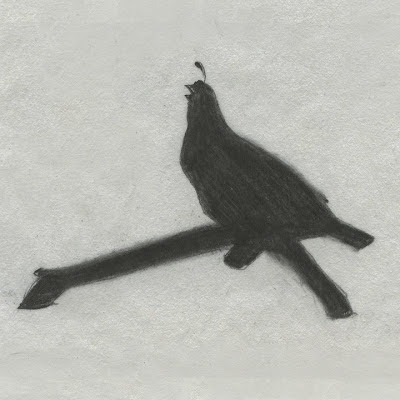
Shown below, is a clay model of a quail species - Gambel's Quail - that resides in the Western United States.

Formal sparseness of design, the use of negative space and clarity of silhouette was my goal while modeling this sculpture: Negative space balances and supports the subject and gives visual activity to the composition.  
The arrangement of positive and negative shapes forms the design and creates a new dimension to the image.  Painters use the elements of color, perspective, value and shape to create a composition . . . 
sculptors design with positive form and negative shapes.


Shown below, is a clay model and different composition of the same species . . . Gambel's Quail.


My goal while designing and modeling the quiet pose below was clarity of 
silhouette and organization of positive and negative shapes. 

Harmony and the simple placement of the figure in nature is evident as vision 
accepts the negative shape and thinks of it as a totally separate form.  
Sculpture is the arrangement of shapes - both positive and negative.


Gambel's Roost
8"H 12"W 8"D


 Gambel's Sunset
10"H 12"W 9"D


All sculpture, and drawings - copyright Sandy Scott


Sunday, 9 June 2013

#433 In the studio: Bird anatomy, con't . . .


Please start this bird anatomy series with post #403,  March 10.

My teaching method concentrates on knowledge of the bird's anatomy and blocking in the subject's large shapes.  
The block-in helps to simplify what is most important and causes the sculptor to define the big shapes and form first, before indicating any detail.  
All that can be said with large shapes should be expressed before indicating detail.

The sculptor must determine what shapes are important for identification, 
and establish proportion of the individual species by defining the large shapes first.  


Below, is a clarified drawing of a grouse.
The sculptor must understand what they are seeing when looking at this drawing.
A bird's wing feather sets are basic and every bird has they same groupings as explained in previous posts.
When blocking in the wing the sculptor should think of the wing as large shapes . . .
not individual feathers.


Begin by thinking of the sets of feathers as individual shapes.
For it is shapes and the arrangements of shapes that make sculpture.
Sculpting birds is assembling shapes.

Birds in flight do not "pose" for the sculptor.
As you approach your sculpture stand and embark upon modeling a bird in flight, you will find that knowing the information presented in this series of bird anatomy posts is far more important than the technical ability to sculpt.  Painters paint what they see, sculptors sculpt what they know.


Below and in progress is a clay block-in of grouse.


Quail and grouse are both upland gamebirds, are in the same classification order - Galliformes - and although
quail are smaller, they are similar to grouse in shape and form.


Below is a clarified drawing of a quail in flight.


Birds in flight don't "pose" for the artist . . . knowledge of the subject's structure is mandatory.
Below is a sculpture of quail in flight.


Quail Gamebird Bookends
12'H 18"W 10"D


All sculpture, and drawings - copyright Sandy Scott


Wednesday, 5 June 2013

#432 In the studio: Bird anatomy, con't . . .


Please start this bird anatomy series with post #403, March 10.

A sculptor knows that drawing strengthens observations skills.
Understanding the subject enables the sculptor to see, draw, and model the animal.
Furthermore, drawing forces careful observation causing the sculptor to
understand and know the creature.
Painters paint what they see . . . sculptors sculpt what they know.


Below, is a sculpture of an owl.
The sculptor must break the figure down into basic shapes.
Regardless of how complicated the animal appears . . . train yourself to see the big shapes first.


Marauder of the Night
14"H 8"W 6"D
Copyright - Sandy Scott


Below, is a watercolor tinted etching of an owl.
Through drawing, the sculptor transforms an intangible idea into an understood design.


Below, is a oil study of an owl, painted from life at the Brookgreen Gardens Zoo.
The sculptor must be the perpetual student . . .
and never stop experimenting, seeking, and taking chances.


All sculpture, drawings, painting, and etchings - copyright Sandy Scott

Sunday, 2 June 2013

#431 In the studio: Bird anatomy, con't . . .


Please start this bird anatomy series with post #403, March 10.

Sculpture involves the consideration of three dimensions - width, height, and depth.
                        All shapes and forms in nature can be reduced to controllable simplicity.  
The artist must think in terms of these elementary shapes and forms.  


Shapes: Shapes are 2-dimensional and have length and width


Simple shapes are the foundation of drawing, and to draw accurately we must use all these shapes - 
circles, squares, triangles, rectangles, ovals, etc - in correct relation to each other.

Simple shapes and form are the foundation of sculpture.
A sculptor learns to think in terms of these basic shapes and forms.  
Details are simply decorations on the surface of these shapes.

Form:  When depth is added to shape, it becomes form 


Typically, I begin a sculpture with drawings.
Shown below, is a preparatory drawing of a Western Screech Owl.
The artist must determine what shapes are important for identification and establish the larger shapes first.


Below, is a two hour block-in of a Western Screech Owl.
Notice the assemblage of exaggerated shapes and form . . .
drawing lines and waypoints on the clay is an effective way for the sculptor
to understand form and large masses as the sculpture develops.


A drawing can do the work of thousands of words, defining something that cannot be described in words.
Through drawing, the sculptor transfers an intangible idea into an understood design.


Shown below, is an original etching.
An etching is a drawing executed on a metal plate, then etched into the plate with acid.
The plate is covered with ink, then wiped clean allowing ink to remain in the etched lines.
Paper is placed on the inked plate and printed on a hand-pulled press.
Much more on the etching process later.


All sculpture, etchings, and drawings - copyright Sandy Scott

Wednesday, 29 May 2013

#430 In the studio: Bird anatomy, con't . . .


Please start this bird anatomy series with post #403, March 10.

Birds' feet have very different shapes and sizes, a reflection of the many ways which birds make their living.
Most birds have only four toes, and the toes show many adaptations to the bird's way of life . . .
such as swimming, climbing, grasping, wading, walking, perching, etc.


Below, are drawings depicting eight different types of birds' feet.


Depicted below is the foot of a bird of prey.  It is equipped with long talons
and are so adapted to grasping prey that the birds have trouble walking.


Below, is another view (see previous post) of Artful Angler, showing the distinctive shape of the pelican's foot.
The sculptor who understands that each individual species has unique shapes and characteristics is able to create work that expresses distinct gesture, pose, and personality.
The goal of the artist is to leave the world of specimens and create art.
Although every shape is important, the bird's feet have the potential to
express more individuality than perhaps any other element.


Below is a recent sculpture entitled After the Hunt - Pheasant Still Life.  
Note the placement of the birds foot . . . note the sentiment and effect realized by the simple gesture.

After the Hunt - Pheasant Stiff Life
29"H 19"W 4"D

All sculpture - copyright Sandy Scott

Sunday, 26 May 2013

#429 In the studio: Bird anatomy, con't . . .


Please start this bird anatomy series with post #403, March 10.

Wings, body, bill, beak, feet, and a myriad of other shapes are assembled
after the sculptor researches, observes, and understands how nature,
the master designer, intended the bird to fly, feed, and function.

These shapes also reflect the way the creature lives on earth;
how they feed and how they fit into their surroundings.

Some birds have all-purpose beaks and feed on many foods while others specialize in just one type of food.
The beak or bill is fully adapted and shaped to do this vital task.


The shape of a bird's beak or bill reflects it's way of life and reveals different ways that birds gather food.
Each individual bird must be researched and it's unique characteristics must be understood.


Below are two images of a large fountain entitled Artful Angler.
When installed, water emerges from the mouth of the fish.
Pelicans have a pouch on the lower mandible which becomes a "scoop" for obtaining their supply of fish.
A bird's beak or bill is shaped by the world it inhabits.


Artful Angler
76"H 42"W 45"D


Wednesday, 22 May 2013

#428 In the studio: Bird anatomy, con't . . .


Please start this bird anatomy series with post #403, March 10.


Below is a clarified drawing of a hawk with folded wings.  
Feather groups such as coverts impart definite shape, form, and thickness to the bird.
Feather groups are critical information to understand because they shape the contour of the bird . . .
Feathers modify the skeletal configuration considerably.
Every bird has the same groupings, from the tiny songbird to the largest hawk.


Below are two recent works.
Solitude depicts a quiet pose with closed wings . . .
notice how the stiff primaries separate the dove's tail feathers.
Reflection and Resolve shows various feather groupings around the head.

 Solitude
10"H 10"W 8"D


Reflection and Resolve
7"H 8"W 6"D


All sculpture and drawings - copyright Sandy Scott

Sunday, 19 May 2013

#427 In the studio: Bird anatomy, con't . . .


Please start this bird anatomy series with post #403, March 10.

Understanding the bird's anatomy takes the mystery out of drawing and modeling.  
The skeleton influences the surface appearance even though the bird is covered with feathers.
Identifying the bird's wrist establishes a point of reference . . . a landmark or waypoint . . . 
a unit of measure to determine wing shapes and proportions.  

All birds fall into a semblance of four basic wing shapes - see post 423, May 5, 2013.  
Identifying the wrist helps the artist establish proportion and pose.   
No waypoint is more important than the bird's wrist when modeling the folded or partially folded wing.  
By locating this boney waypoint, the sculptor can easily determine where the secondaries and primaries originate.  


Harbinger of Light
15"H 20"W 16"D

All sculpture and drawings - copyright Sandy Scott

Wednesday, 15 May 2013

#426 In the studio: Bird anatomy, con't . . .


Please start this bird anatomy series with post #403, March 10.

A bird's feathers grow in sets and groups and the bird artist must know how both body groupings 
and flight feathers are arranged.  Feathers grow in tracks, in orderly rows, and overlap like shingles on a roof.  
Plumage patterns are organized in a similar manner across all species.

If there is a conflict between sculpting what you see - or think you see - as in a photo, video, or in the field . . . 
rely on what you know.  The goal of a sculptor is to UNDERSTAND what they are looking at.  
A sculptor must sculpt what they KNOW, while a painter paints what they see.


Above, are clarified drawings of a bird's most basic and simple forms.  
The sculptor should omit the unimportant and block in the essentials.
Major shapes, planes, and correct proportions, should be established first.

Below, is a recent sculpture of a Peregrine Falcon modeled life-sized.
My goal was to cause the viewer to feel speed and the beauty of flight by eliminating detail.
One does not see detail when animals are in motion.
A Peregrine reaches speeds of up to 200 miles per hour when hunting. 

Falcon Heart Humming
20"H 20"W 16"D


All sculpture and drawings - copyright Sandy Scott

Sunday, 12 May 2013

#425 In the studio: Bird anatomy, con't . . .


Please start this bird anatomy series with post #403, March 10.


At right is a drawing of 3 of a bird's 10 primary flight feathers . . . the artist must know that each of the 10 individual primaries is shaped differently.  The outermost primaries - numbers 1  2 are narrower at the tips, thus creating "slots" necessary for flight maneuverability.  The primaries closest to the secondaries are shaped more like the secondary feathers.   


At right is a cross-section drawing of a wing:  Both an airplane and a bird can change the angle in which the shape moves through the air.  This adjustment is called the wing's angle of attack. . . see post # 424.  When an airplane comes in for a landing, the nose comes up allowing the shape and resistance of the fuselage to slow the airplane.  When the landing gear is lowered, creating more drag, it slows the airplane as it descends.  The pilot continues pulling the nose up, or increasing the angle of the wing's attack, until the wing stalls or stops flying, placing the machine on terra firma.  A bird is analogous to an airplane . . . it drops the backend of it's body, splays the tail feathers, and drops the legs to create drag,  thus permitting the flaring and stalling of the wings which results in a landing!


Why is this information important to the bird artist?  Understanding wing shapes, attitude, 
and aerodynamics will open the door to breathing life into the artist's work.  the artist must 
realize that it is the superb shape of the bird's wing that causes the wonder of flight.


Below is an original, hand-tinted etching of mallards pitching in for a landing . . .
tail feathers flared, body angled, "gear" down, and wings angled high . . .
the ducks are slowing down to alight on a pond.

Mallards
7 1/4 x 8 1/4


All sculpture and drawings - copyright Sandy Scott

Wednesday, 8 May 2013

#424 In the studio: Bird anatomy, con't . . .


Please start this bird anatomy series with post #403, March 10.

How many times have you sat in an airplane and marveled at the mystery of a ponderous machine taking you aloft? What could possibly make this enormous device fly?  The answer is a complex series of events, but if one word had to be used to describe why an airplane flies, that word would be SHAPE.  The SHAPE of the airplane's wing, like the SHAPE of the bird's wing when moved through the air, causes lift.

Drawing number 1 at right; note the leading edge of a wing's SHAPE is blunt and thick, which causes the moving wing to part the air more effectively.  The back or trailing edge of the wing thins dramatically to speed the wing through the air.

The SHAPE of the upper surface of the wing is more rounded and air moving over the top has more surface and distance to cover which creates low pressure.

The SHAPE of the underside of the wing is slightly concave and air has less distance to travel, therefore moving slower and causing high pressure.

Lift is produced as the high pressure on the under surface of the wing attempts to occupy the low pressure on the upper surface.


Drawing number 2 at right; if the wing is held at too high an angle of attack, the air cannot smoothly flow over the wing's surface.  An interruption or "burble" forms at the trailing edge of the wing, which causes loss of lift and the wing  stalls.

Airplanes and birds take off into or facing the wind because it expedites the air that must move over the wing surface to create lift.  They land into the wind as well because at slower landing speed, air must continue to move over the wing's surface.
The scientific term for the above is Bernoulli's Principle.


 Why is all of this important to the bird sculptor.
In two words: pose and gesture.
Principles of flight and the SHAPES involved are the same for airplanes as they are for birds.

Below is a sculpture entitled Hay Bay.
Knowledge of the wing and aerodynamics create the illusion of descending flight.


Hay Bay
19"H 25"W 14"D


All sculpture and drawings - copyright Sandy Scott

Sunday, 5 May 2013

#423 In the studio: Bird anatomy, con't . . .


Please start this bird anatomy series with post #403, March 10.


Wing shapes vary among birds, reflecting the adaptations they have made to different environments.  There are four basic wing shapes, and all birds fall into a semblance of one of the four configurations.  The size and shape of the wings give clues to how the bird lives:

   1.  Long, wide wings are used by soaring birds such as hawks, eagles, and
        ravens.  A wing is considered long when it exceeds the length of the
        bird's body.
   2.  Narrow and pointed wings are used by fast flying birds such as swallows,
        swifts, and many migratory birds such as ducks and geese.
   3.  Long and narrow wings are used by gliding birds such as albatrosses,
        gulls, terns, fulmars, and shearwaters.
   4.  Wide and rounded wings are used for short, fast, and quick-escape flight
        birds such as grouse, pheasants, pigeons, and owls.

The wings of birds do not all have the same shape and size, but all fall into one of the four basic categories.  The shape and size of the wings determines what style of flying a bird executes.  Wing shape is one of the primary ways to identify different species.

Below are illustrations of four different wings.  Each fall into one of the four wing shape categories.


Below is a drawing of a Canada Goose . . . the large bird is migratory and falls into the
basic wing shape of number 2.  However, the wing is also wide and can be considered
to fall into a slight semblance of wing shape number 1, even though it cannot soar. 


All sculpture and drawings - copyright Sandy Scott


Wednesday, 1 May 2013

#422 In the studio: Bird anatomy, con't . . .


Please start this bird anatomy series with post #403, March 10.

A bird's wing feather sets are basic and every bird has the same groupings. 
Once the basics are understood, the artist can adapt them to any species.

Below is a drawing comparing the underside of the wing with the top of the wing.
  Birds have a set of feathers in the armpit region on the underside of the wing called the axillars. 
This group of fan shaped feathers help close the gap between inboard wing feathers and the body during flight.  

Note the various sets of coverts and structured underwing feather lining.


Why is knowledge regarding the wing and the feather groups important to the bird artist?
There is nothing random in nature, and the bird artist should know the feather groups
so well that the wing can be modeled at will from understanding and memory.

Below . . . Note the axillar group in the armpit region.

Mallard Rising
15"H 26"W 16"D

All sculpture and drawings - copyright Sandy Scott