Showing posts with label Canada goose. Show all posts

Wednesday, 3 June 2015

#640 The pond, con't . . . Geese - domestic and wild


Please see the previous two posts for more information about the pond at the Wyoming studio.

Domestic geese have historically been kept as poultry for their eggs, meat, and down.  We currently have nine that we keep because they are beautiful on our pond, they're efficient "lawnmowers" and are alert "watchdogs".  
Although they're messy when they get on the deck, - as shown below - they have become a part of our life.


Due to their upright posture, their large, heavy body, short wings, and much of their weight being aft in spite of 
their large, meaty breasts . . . domestics are flightless.  Below, are images of our geese.


A few years ago we only had four domestics and what you see below, happened.
We try to prevent more breeding and I'll keep you posted about the outcome.


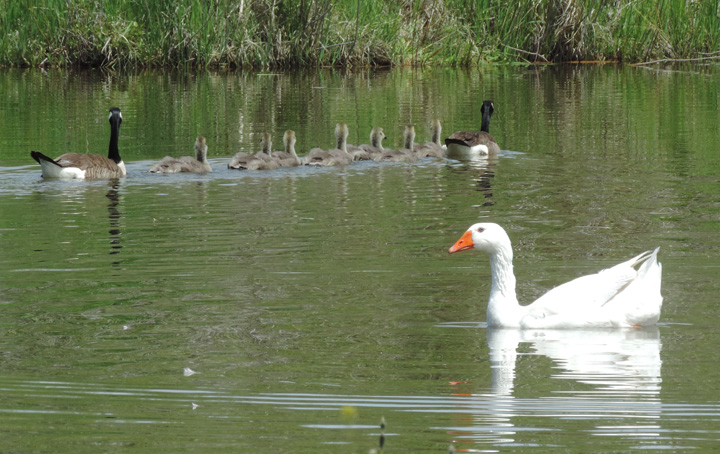
The domestics routinely interact with the wild Canada Geese on the pond during spring and summer when
 the wild ones are here to nest and raise their young.  While I don't understand the dynamics, 
the Canadas always win and keep the larger domestics away from their young.


Below, are images of the two different species on the pond. 


Below, is an early watercolor tinted etching of domestic geese . . . created in 1978.


Go to the BLOG INDEX on the right for more information.

Blog, text, photos, drawings, and sculpture . . . © Sandy Scott and Trish


Sunday, 31 May 2015

#639 Wyoming studio, the pond . . . con't: Canada Geese


Please see the previous post for more information about our pond at the Wyoming studio.


Below, is an image of John James Audubon's lithograph of Canada Geese.


Canada Geese return to our pond every spring to nest, breed, molt, and raise their young.
Typically, the same pair return year after year to where they previously nested and found a safe haven.
They find shelter on secluded ponds like ours which provide security from predators.  This year, we have two different mated pair of Canadas who are raising their young on the pond's island and the surrounding fringe cover. 

While the two families don't interact much, below is a image of the two mated pair with their young taken this morning.


When Canada Geese molt, they lose their primary flight feathers in early summer and become flightless until new feathers grow in about mid-August.  Being flightless is nature's way of causing the pair to breed and stay with their young . . .  
protecting them from harm and teaching them to fly at the end of summer, away from the frigid Wyoming winter.
Most large birds like Canada Geese mate for life and it's a thrill to hear them arrive at our pond every spring.

There's a fascinating website about the molt and migration entitled:   www. geesepeace.com

Below, is a photo of primary flight feathers at the edge of our pond . . . evidence of the molt.
Also shown, is a drawing of a wing showing the primary flight feathers that will molt and quickly grow back again.


There's an old cabin next to the pond where we throw out a scoop of corn for the geese.
Below, a Mule Deer doe walked into view as the geese waited for their corn this morning.


Below, are additional images of the Canada Geese on our pond with their young.


Note:  Canada Geese have long been a favorite subject for my art, both etchings and sculpture. . .
I named the book about my work - "Spirit of the Wild Things",  published in 1998 -  after an early
monumental sculpture depicting Canada Geese with the same title.


Below, is an image of the above mentioned monument, an image of the book cover, and a link to the book -
"Spirit of the Wild Things - the Art of Sandy Scott".   The book is still available for purchase.

http://www.SpiritOfTheWildThings


Go to the BLOG INDEX on the right for more information.

Blog, text, photos, and sculpture . . . © Sandy Scott and Trish


Wednesday, 9 July 2014

#546 Beyond my studio window: geese


We had two pair of Canada Geese nest and raise their broods on our pond this spring.
The pond outlet flows into the Popo Agie River which surrounds the property and the wild
geese have taken the maturing juveniles downstream to prepare them for flight and migration.
Below, are photos taken this spring of the wild geese.


Below, is a working drawing of an idea for future consideration in the design studio.
Contemplating, experiencing, and observing birds in nature is the best . . .
and for me the only way to create sculpture.


Below, is a drawing of a big Canada stretching it's wings.


We have 4 enormous domestic French geese who hatched goslings over the 4th of July week-end.
We not only enjoy their majestic beauty as they glide on our pond but they also serve as an
effective alert system - similar to watchdogs - with their raucous honking
when anything out of the ordinary invades their territory.

Below, are recent photos of the geese and their goslings.


Below, the brood's first outing on the pond.


The domestic goslings are a daily delight and this is only the second time in six years that they've had their eggs hatch . . . so many predators in our remote and untamed area!  The pond, with it's little island sanctuary provided safety
for both the wild and the domestic geese and the birds were able to protect their clutch.
Domestic geese are built different than wild geese and because their weight and center of gravity
is set so far back compared to wild geese,  the domestics are flightless.

Below, is a painting of a gosling with one of my sculptures.  It was painted by Adele Earnshaw,
one of my all-time favorite artists whose work I collect and whose friendship I enjoy.
adeleearnshaw.blogspot.com/


To learn more about the subjects go to the links below.

For a complete list of the blog index go to the Index Page and
type the subject in the Search This Blog link on the right.


Blog, text, photos, drawings, and sculpture . . . © Sandy Scott and Trish

Wednesday, 2 July 2014

#544 Beyond my studio window . . . bird reference


I experience many wild birds at my studio headquarters in Lander, Wyoming.
On the north and east boundaries of the rural property, the Popo Agie River flows.  The beautiful river, which is a tributary of the Wind River, is home and sanctuary to many species of birds and as the seasons change, I've come to anticipate and understand when to have my camera and sketchbook close by.

My barn cat had kittens a few weeks ago which caused a Great Horned Owl to hang out in the willow tree by the studio.  The kittens survived and I was able to photograph and sketch the great bird shown at right.

My pond is a favorite nesting site for Canada Geese and other waterfowl.
There's a little island that provides a safe place for spring nesting and typically, several broods will hatch including Canada Geese, Mallards and Mergansers.  


Below, are photos taken at the pond this spring.


Below, a migrating flock of White-faced Ibis spent several days feeding in the pasture with the resident Mallards.


Pheasants are non-migratory and can be seen year around.  Below, is an image taken in the winter.


Below, the Great Blue Heron is routinely in residence at the pond.


Shown below, is a small portfolio of bird art of the subjects mentioned in this blog.

Hay Bay
19"H 25"W 14"D


 Marauder of the Night
14"H 8"W 6"D


Nesting Heron
15"H 25"W 26"D


After the Hunt
29"H 19"W 4"D


To learn more about the subjects go to the links below.

For a complete list of the blog index go to the Index Page and
type the subject in the Search This Blog link on the right.


Blog, text, photos, drawings, and sculpture . . . © Sandy Scott and Trish


Sunday, 5 May 2013

#423 In the studio: Bird anatomy, con't . . .


Please start this bird anatomy series with post #403, March 10.


Wing shapes vary among birds, reflecting the adaptations they have made to different environments.  There are four basic wing shapes, and all birds fall into a semblance of one of the four configurations.  The size and shape of the wings give clues to how the bird lives:

   1.  Long, wide wings are used by soaring birds such as hawks, eagles, and
        ravens.  A wing is considered long when it exceeds the length of the
        bird's body.
   2.  Narrow and pointed wings are used by fast flying birds such as swallows,
        swifts, and many migratory birds such as ducks and geese.
   3.  Long and narrow wings are used by gliding birds such as albatrosses,
        gulls, terns, fulmars, and shearwaters.
   4.  Wide and rounded wings are used for short, fast, and quick-escape flight
        birds such as grouse, pheasants, pigeons, and owls.

The wings of birds do not all have the same shape and size, but all fall into one of the four basic categories.  The shape and size of the wings determines what style of flying a bird executes.  Wing shape is one of the primary ways to identify different species.

Below are illustrations of four different wings.  Each fall into one of the four wing shape categories.


Below is a drawing of a Canada Goose . . . the large bird is migratory and falls into the
basic wing shape of number 2.  However, the wing is also wide and can be considered
to fall into a slight semblance of wing shape number 1, even though it cannot soar. 


All sculpture and drawings - copyright Sandy Scott


Saturday, 16 June 2012

#259 In the studio: Shape and line


Shapes are two-dimensional and are surrounded by line.  Shape has length and width, while line has only length.  

A page from my sketchbook . . . much can be said with line


Thursday, 31 May 2012

#248 Beyond my window: Geese, con't . . .


At the far end of the pond, a mated pair of Canada Geese are pictured taking their brood for a swim.  Wild and alert, 
the adult's erect heads indicate they are on the lookout for danger.  There is a little island on our pond and the geese are headed for its safe haven.  They will stay until the juveniles learn to fly in late summer.  In the fall, before the pond freezes, they will head south for the winter.  It's the animals I notice most as the seasons change.  

Every year, a pair of Canadas nest on our pond and I often wonder if it's the same pair.


Mates  4 7/8 x 4 7/8
Original hand-tinted etching, copyright Sandy Scott 


Wednesday, 9 May 2012

#231 Beyond my window: Geese


I have domestic geese which are fat, flightless, and as aggressive as guard dogs.  They are beautiful to watch
as they glide across my pond and intimidate the smaller,
nesting wild Canada Geese.  Somehow, they have worked
out a "pecking order" and co-exist.

It's interesting to note the difference between domestic geese and wild geese:  Wild geese have a slimmer, more horizontal body posture and are excellent flyers.  Domestic geese have
a large fat area toward their tail which causes a more upright posture and prevents flight.


Above - the geese get along fine until the wild ones get near the corn feeder.
Below - an original watercolored etching - Sleeping Geese - copyright, Sandy Scott