Saturday, 12 May 2012
Friday, 11 May 2012
#232 In the studio: "After the Hunt - Pheasant Still Life"
Now and then I create a piece of work that I want to live with in my home. Most recently,a pheasant game piece found its way into the big common room. There's no way I can display all of my work - even my favorites . . . there are simply too many.
Living in a new log home and studio influenced my choice. The decorative sculpture, hanging in the rustic setting, has the "lodge-look" I was in search of and I hope it speaks
to other outdoorsmen and those who enjoy the time-honored tradition of still life in art.
Below, the new still life on a log wall in my home. See post #205, April 7, 2012.
Wednesday, 9 May 2012
#231 Beyond my window: Geese
I have domestic geese which are fat, flightless, and as aggressive as guard dogs. They are beautiful to watchas they glide across my pond and intimidate the smaller,
nesting wild Canada Geese. Somehow, they have worked
out a "pecking order" and co-exist.
It's interesting to note the difference between domestic geese and wild geese: Wild geese have a slimmer, more horizontal body posture and are excellent flyers. Domestic geese have
a large fat area toward their tail which causes a more upright posture and prevents flight.
Above - the geese get along fine until the wild ones get near the corn feeder.
Below - an original watercolored etching - Sleeping Geese - copyright, Sandy Scott
Labels:
birds,
Canada goose,
etching,
geese,
horses,
Wyoming studio
Tuesday, 8 May 2012
#230 Beyond my window: The Flower Moon
Saturday night, May 5, was the night of the Full Flower Moon . . . May is the month of abundant flowers. The unusually large moon was closer to the earth this year and was spectacular. Full moon names date back to Native American tribes of what is now the northern United States and southern Canada.
The nesting Canada Geese and Mallards share the pond with my four big domestic geese. I took this picture by my studio on a cold, Wyoming spring night.
At left is page from my sketch book, and below is the
Flower Moon rising over my pond at dusk.
Labels:
Canada goose,
drawings,
ducks,
full moon,
geese,
Wyoming studio
Monday, 7 May 2012
#229 In the studio: "Equus Found Fragments I & II" enlarge, con't . . .
The Equus Found Fragments I & II enlargement was modeled twice the size of the maquette, making each fragment 42" wide. The sculpture was modeled with yellow clay and pink clay was used to define the undulating outline of the fragment design.
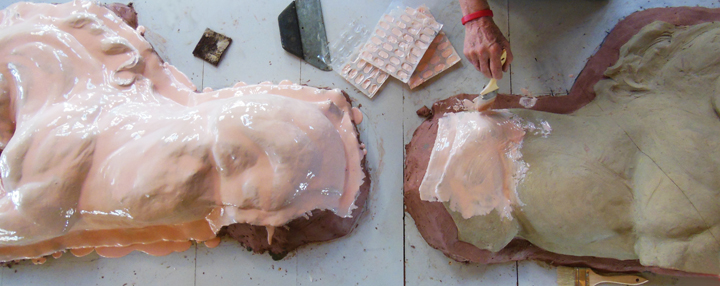
The pink "clay-up" was necessary for this mold- making process; which is called a blanket mold. Liquid rubber was brushed on the sculpture and clay-up. After the rubber hardened (or cured) a rigid plaster shell was required to hold the rubber in its proper shape during wax pour and the foundry process.
At right: Equus Found Fragments I & II maquette
Sunday, 6 May 2012
#228 In the studio: "Equus Found Fragments I & II" enlarge, con't . . .
Fragment design need not be an imitation of a ruin or an accidental decorative work.
When designing Equus Found Fragments I & II, my goal was to create an expressive
silhouette and present the partial figure as a self-sufficient artistic entity.
To achieve this, I eliminated limbs and striped down detail and projections,
which inhibited the figure's force and clarity.
Saturday, 5 May 2012
#227 In the studio: "Equus Found Fragments I & II" enlarge, con't . . .
Friday, 4 May 2012
#226 In the studio: "Equus Found Fragments I & II" enlarge, con't . . .
Equus Found Fragments I & II were inspired and influenced by the four stallions on the facade of the Basilica of San Marco in Venice, Italy. The powerful equine masterpiece is the only quadriga known to have survived from antiquity. I have seenand photographed the sculpture several times over the years.
While modeling the eyes, I created a negative shape - called a lunula - which is a half-moon device that picks up a deep shadow and highlight in the eyes of horses. This technique
was used in Roman sculpture of the second to fourth century.
Wednesday, 2 May 2012
#225 In the studio: "Equus Found Fragments I & II" enlargement . . .
Last year I was commissioned to enlarge Equus Found Fragments (see image at right) and the work is now being cast. Resizing the award-winning piece was an unusual assignment since the process was neither in-the-round: having length, width, and depth; or bas-relief: having length and width only.
Below, measurements were taken from the maquette; the piece was doubled in size, making each fragment approximately 42" wide. A block-in of dense foam was created and laid on a flat surface. I then covered the foam with warm clay and modeled the sculpture. The piece will be presented as a wall-hanging.
Tuesday, 1 May 2012
#224 In the studio: How I work
Typically, I have at least forty or more sculptures in various states of completion in progress at one time. Bird subjectsalone include Great Blue Heron, Little Blue Heron, Green-backed Heron, Canada Geese, Ruffed Grouse, Bufflehead Ducks, Bobwhite Quail, Common Tern, roosters, macaws,
Bald Eagle, pelicans, pheasants, Roadrunner, Mockingbird, doves, wild turkeys, and more.
I move around the studio, or take a model down from a shelf, tweaking and making adjustments as the urge inspires me.
New reference, realization, in-the-field experiences or deadlines initiates finishing the piece and taking it to mold.
At right is a study of a Great Blue Heron in progress.
Labels:
art technique,
clay model,
heron,
Wyoming studio
Monday, 30 April 2012
#223 Beyond my window: Geese
Every spring a mated pair of Canada Geese appear on schedule and build a nest on my pond in Lander, Wyoming. They share the pond with the domestic geese and I never tire of watching them from the studio window. The Canadas will remain and raise their brood and then climb to the sky as they have for thousands of years.
No other creature connects me to the wilderness like the Canada Goose. Their haunting call is the call of the wild and symbolizes the human need for freedom for we are all wanderers in spirit.
What are human beings without animals?
If all animals creased to exist, human beings
would die of great loneliness of the spirit.
Saturday, 28 April 2012
#222 Remarque: "Simple Pleasure"
Spring comes late in the Rockies. On this day, a pair of Mallards and a pair of Canada Geese are nesting on my pond and a riot of blossoms are on my wild plum trees. Robins are building a nest outside my window and the mule deer are losing their winter coats. Still, a Wyoming spring means a fire at night.
I love the simple pleasures of living in the high country.
Again the blackbirds sings; the streams,
Wake , laughing , from under their winter dreams,
And tremble in the April showers,
The tassels of the maple flowers.
- John Greenleaf Whittier
Simple Pleasure
9"H 12"W 7"D
Thursday, 26 April 2012
Wednesday, 25 April 2012
#220 In the field: Low country birds
The South Carolina marshes, waterways, and piney-woods are alive with birds and are a bird artist's paradise. As a Trustee of Brookgreen Gardens, I spend lots of time in South Carolina and always take time to teach a yearly workshop and take my camera and sketch book afield in search of birds. Spring is the time for wild turkeys and last week the big gobblers were on the prowl. After a rain, when the ground was quiet, I slipped in close to a group of wild turkeys to photograph and sketch the wily birds. Of the six species of North American wild turkeys, I see Merriams in Wyoming, and the rufous-tipped Eastern in South Carolina. I returned to my Wyoming studio headquarters this week with enough turkey reference to start
a new sculpture of the magnificent creature.
I enjoy designing functional art and have created many bookends.
Turkey Bookends 7"H 16"W 7"D
Tuesday, 24 April 2012
#219 In the field: Brookgreen Gardens, con't . . .
Presidential Eagle is one of four of my sculptures in the permanent collection of Brookgreen Gardens, Murrells Inlet, South Carolina. The casting, at right was installed in 2005, one year after it's placement and dedication at the William F. Clinton Presidential Library in Little Rock, Arkansas
Presidential Eagle has a 16' wingspan
Monday, 23 April 2012
#218 In the field: "Atalaya" at Brookgreen Gardens, Murrells Inlet, SC
with Robin Salmon, Curator of Sculpture at Brookgreen Gardens; see yesterday's Post. brookgreen.org
![]() |
| Atalaya's Courtyard and tower in the rain. We had the place to ourselves. |
The ocean-front home, studio and Brookgreen Gardens were constructed from 1931 to 1933.The home, named Atalaya, which is a Spanish term for watchtower, was designed by Archer after Moorish architecture, and consists of 30 rooms. Anna sculpted from live animals so facilities such as horse stables,
dog kennels, and bear pens were built adjoining her studio.
In 1960, the 2,500 - acre tract across from Brookgreen Gardens was leased to the state by the Board Trustees to create Huntington Beach State Park.
North facade of Atalaya
Sandy in the doorway of Anna's Studio Sign above the studio fireplace, click to enlarge
Sunday, 22 April 2012
#217 In the field: Brookgreen Gardens
Last week was spent at Brookgreen Gardens in Murrells Inlet, SC teaching a bird anatomy and sculpture workshop, and in the field; researching and photographing birds and animals of the low country.
Above right is the entrance to Brookgreen Gardens: Fighting Stallions by Anna Hyatt Huntington
Eat More Beef, located in the Children's Sculpture Garden at Brookgreen,
is one of 4 of my sculptures in the museum's permanent collection
Saturday, 21 April 2012
#216 In the field: Brookgreen Gardens Workshop, con't . . .
The bird sculptor must know and understand bird anatomy and how a bird is structured.
Birds, like mammals (including humans) are vertebrates.
Vertebrates simply means that the animal has a backbone.
Nature has designed just one basic pattern, with many variations, for all vertebrates.
The skeleton of the bird's wing is more easily understood when compared to the human arm.
Comparison between human arm above and bird wing below
Wing drawings, copyright Sandy Scott, from the book Spirit of the Wild Things - The Art of Sandy Scott
Labels:
bird anatomy,
bird skeleton,
Brookgreen Gardens,
drawings,
workshops
Friday, 20 April 2012
#215 In the field: Brookgreen Gardens Workshop, con't . . .
This week I taught a 3-day Bird Anatomy and Sculpture Workshop at Brookgreen Gardens at Murrell's Inlet, SC;see posts #213 and #214 and refer to the REFERENCE link
under PAGES for more information about bird anatomy.
Though animal sculptors do not need to be scientists, they
must know and understand the important bones, joints and muscles, not only where they attach but how they articulate.
In addition to this knowledge the bird sculptor must know the major feather groups, individual feather construction and
the mechanics of flight.
All birds have a basic and predictable structure:
the bird sculptor must know the basic skelton and the
sets of feathers inherent to all birds.
The humerus, elbow, and portion of the radius/ulna drawn on the clay model
Labels:
art theory,
Brookgreen Gardens,
clay model,
drawings,
workshops
Thursday, 19 April 2012
#214 In the field: Brookgreen Gardens Workshop, con't . . .
Yesterday was the last day of my 3-day 2012 Brookgreen Gardens Bird Anatomy and Sculpture Workshop;
see yesterday's post. For more information about bird anatomy, refer to the REFERENCE link under PAGES.
All birds - from the tiny hummingbird to the giant albatross - have the same basic feather groupings. Once these
are known, the sculptor simply researches the individual bird to be modeled to establish relative proportions.
There are four basic wing shapes and all birds fall into a semblance of one of the four configurations.
The size and shape of wings give clues to how the bird lives:
1. Long and wide wings are used by soaring birds
such as hawks, eagles, and ravens. A wing is
considered long when it exceeds the length of
the bird's body.
2. Narrow and pointed wings are used by fast
flying birds such as swallows, swifts, and many
migratory birds such as ducks and geese.
3. Long and narrow wings are used by gliding
birds such as albatrosses, gulls, fulmars,
shearwaters, and terns.
4. Wide and rounded wings are used for short,
fast and quick-escape flight birds such as
grouse, pheasants, pigeons, and owls.
Please go to HOME, then to REFERENCE under PAGES and click on Posts #143 and #144.
Wing drawings, copyright Sandy Scott, from the book Spirit of the Wild Things - The Art of Sandy Scott
sandyscott.com/sandyscottbronzh.html
Labels:
bird anatomy,
Brookgreen Gardens,
drawings,
workshops
Subscribe to:
Posts (Atom)


