Showing posts with label etching. Show all posts

Tuesday, 26 May 2020

#754 "Guinea Fowl"


Original etching "Guinea Fowl"


Blog, text, photos, drawings, and sculpture . . . © Sandy Scott and Trish

Sunday, 29 November 2015

#688 Elk review


Elk (wapiti) are common where I live in Wyoming.
Shown below, are images of this magnificent member of the deer family.    

Wind River Descent


Below, is a photo taken of elk about two miles from our cabin on the Wyoming/Colorado border.
This image was taken two weeks ago . . . a major snowstorm was imminent and the herd was leaving the high country.


Go to the BLOG INDEX and Reference Page for more information.  


Blog, text, photos, drawings, and sculpture . . . © Sandy Scott and Trish

Wednesday, 29 July 2015

#656 In the field . . . birthday #72


Last week was my birthday and we returned to the rustic
cabin in remote northern Colorado where we celebrated 
July 24 last year.  We lived in Colorado for many years
and know the area very well . . . we know all of the backroads,
 the best places to fish for Rainbow and Cutthroat Trout,
the trails to the little streams where the Brook Trout
hang out,and where to see wildlife.
The old camp where we stay is close to
timberline and is heavily populated with moose . . .
we never fail to see them.


Below, are images of moose taken last week in the high country.


Below, I spotted a recumbent young bull in the shade from a distance . . .
we left him at peace but got him with a telephoto.


Below, Trish is fishing at a favorite high country lake where we saw nesting Ospreys.


Shown below, is another favorite lake . . . I photographed a Mule Deer doe while enjoying a cold beer and the scenery.


The temperature dips down at night and the old housekeeping cabin is heated with an ancient wood burning cookstove.
The wood and kindling is provided for us, chopped, split, and always plentiful . . . I'm used to wood heat and love it!
Below, is a photo of the dogs warming up on a chilly morning in front of the cookstove while the boiled coffee perks.


The proprietors of the camp are fellow bird lovers and have hummingbird feeders everywhere.  
Below, are photos of Trish, a feeder outside our cabin, and along with the resident Chipmunk,
we could count on a live model and plenty of entertainment during the cocktail hour!


Below, is an early etching of hummingbirds.


Go to the BLOG INDEX on the right for more information.

Blog, text, photos, drawings, and sculpture . . . © Sandy Scott and Trish


Wednesday, 3 June 2015

#640 The pond, con't . . . Geese - domestic and wild


Please see the previous two posts for more information about the pond at the Wyoming studio.

Domestic geese have historically been kept as poultry for their eggs, meat, and down.  We currently have nine that we keep because they are beautiful on our pond, they're efficient "lawnmowers" and are alert "watchdogs".  
Although they're messy when they get on the deck, - as shown below - they have become a part of our life.


Due to their upright posture, their large, heavy body, short wings, and much of their weight being aft in spite of 
their large, meaty breasts . . . domestics are flightless.  Below, are images of our geese.


A few years ago we only had four domestics and what you see below, happened.
We try to prevent more breeding and I'll keep you posted about the outcome.


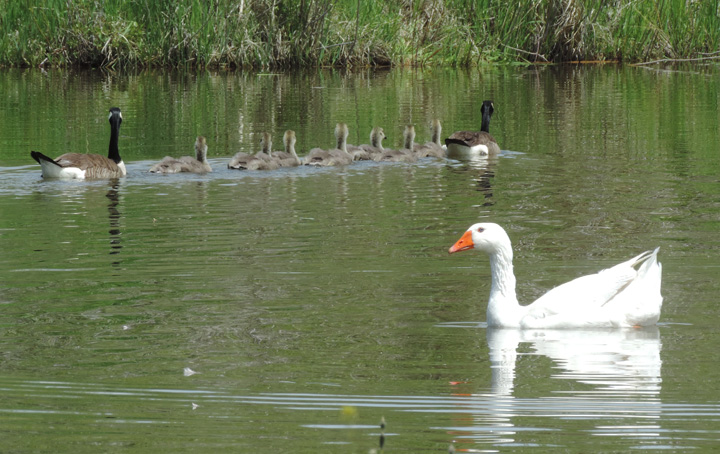
The domestics routinely interact with the wild Canada Geese on the pond during spring and summer when
 the wild ones are here to nest and raise their young.  While I don't understand the dynamics, 
the Canadas always win and keep the larger domestics away from their young.


Below, are images of the two different species on the pond. 


Below, is an early watercolor tinted etching of domestic geese . . . created in 1978.


Go to the BLOG INDEX on the right for more information.

Blog, text, photos, drawings, and sculpture . . . © Sandy Scott and Trish


Wednesday, 4 March 2015

#614 Snow Moon


Since the heaviest snow usually falls during this month, Native American and Canadian tribes of the north call
February's full moon the Full Snow Moon.  Some tribes referred to this moon as the Full Hunger Moon 
since harsh and frigid weather made hunting food difficult.  

Shown below, a Mule Deer doe slowly passes under last night's Full Snow Moon in the sub-zero cold.


The night before last, a snowstorm dumped over ten more inches on our studio headquarters at the foot of the Wind River Range in Wyoming.  We woke up this morning to -16 degrees temperatures and as usual, the first thing one thinks about are the animals . . . both domestic and wild.  We have horses, goats, poultry, and feral barn cats that share the property with a resident herd of mule deer and wintering pheasants.  At the base of heated buildings such as the studio, animals congregate because the temperature is actually a few degrees warmer.  We keep a water heater in a big rubber tub and put out hay and corn for the geese.  The chickens have a heat lamp in their coop and we enjoy fresh eggs in the winter because the light induces laying eggs.  While all of this is a necessity for the domestic animals, we are careful not to tame the deer which would inhibit their wildness and ability to survive . . . after all, in the big scheme of things, we are predators.

Below, are images taken at our place along the frozen Popo Agie River in Wyoming.  
Although the surface is frozen, the big river flows underneath to join the Wind River downstream.
This photo was taken from the studio deck this morning . . . below zero but sunny!


The barn protects horses, goats, and barn cats but on this sunny day, the warm sun will feel good on their backs.

Geese are amazingly adaptable to frigid weather and like all creatures, require an open source of water.  Water, in this climate, can freeze in less than an hour!
Below and at right, the big domestic geese are fed corn and hay is given to the deer when snow covers the ground.  Trish cries,"goose-goose-goose" and the geese come running!


Below, Trish and Penny enjoy a warm fire after chores are done.


Below, no sun yesterday but the deer, with their long winter's coat, nestled in the snow
and bedded down for warmth and the pheasant found morsels by scratching through the snow.


In the bleak midwinter, Frosty wind made moan,
Earth stood hard as iron, Water like a stone;
Snow had fallen, snow on snow, snow on snow,
In the bleak midwinter, long ago.

                                                                                     - Christina G. Rossetti


Deer have always been a favorite subject.  Below is an early etching (1979) entitled, "First Snow".


Go to the BLOG INDEX on the right for more information.


Blog, text, photos, drawings, and sculpture . . . © Sandy Scott and Trish


Thursday, 27 September 2012

#320 In the field: Yellowstone


After the Cody show last weekend, see yesterdays blog post # 319, we headed for Jackson through the east entrance of Yellowstone.  I live two and a half hours from the majestic park, have visited many times, and never tire of its beauty
. . .  especially in late September.  The color was stunning!  Lunch at the Old Faithful Inn and then a slow drive through the Grand Tetons to Jackson.

Buffalo are one of my favorite subjects, for sculpture, etching, drawing, and painting; I saw this big bull from a distance and captured him with a long lens.


Original sepia-toned etching, copyright Sandy Scott


Ancient Way, 19"H 24"W 10"D, Sandy Scott 


Tuesday, 26 June 2012

#267 Throw on another log: Original prints and reproductions


Traditionally, fine art prints or original prints are etchings, drypoints, engravings, lithographs, block prints, and serigraphs - all meeting standards set by the Print Council of America. printcouncil.org/  Original prints are produced by hand presses, are created directly on the plate, block, stone, etc., using pigmented inks and are sometimes hand-tinted by the artist. Editions of these prints are usually limited to a few hundred or less, thus insuring rarity, collectibility, and value.

In the early 1970s, large national companies began to produce photomechanical offset reproductions of paintings issued in large editions.  Although they were hand-signed by the artist and advertised as "limited", some editions were so large as to be considered unlimited by standards of just a few years earlier.  Moreover, the offset dye inks were not permanent and if the "print" was exposed to light, it would soon fade.

Today, there are new printing techniques, using permanent inks, that make it possible to own a hangable reproduction of a painting by an artist whose work would otherwise be unavailable or unaffordable.  Many are produced in small editions.  The designation for such work is "photomechancial reproduction" and not the time-honored term, "print".


Sheep
Original Etching by Sandy Scott;  7 X 9 3/4