Showing posts with label bird reference. Show all posts

Wednesday, 2 July 2014

#544 Beyond my studio window . . . bird reference


I experience many wild birds at my studio headquarters in Lander, Wyoming.
On the north and east boundaries of the rural property, the Popo Agie River flows.  The beautiful river, which is a tributary of the Wind River, is home and sanctuary to many species of birds and as the seasons change, I've come to anticipate and understand when to have my camera and sketchbook close by.

My barn cat had kittens a few weeks ago which caused a Great Horned Owl to hang out in the willow tree by the studio.  The kittens survived and I was able to photograph and sketch the great bird shown at right.

My pond is a favorite nesting site for Canada Geese and other waterfowl.
There's a little island that provides a safe place for spring nesting and typically, several broods will hatch including Canada Geese, Mallards and Mergansers.  


Below, are photos taken at the pond this spring.


Below, a migrating flock of White-faced Ibis spent several days feeding in the pasture with the resident Mallards.


Pheasants are non-migratory and can be seen year around.  Below, is an image taken in the winter.


Below, the Great Blue Heron is routinely in residence at the pond.


Shown below, is a small portfolio of bird art of the subjects mentioned in this blog.

Hay Bay
19"H 25"W 14"D


 Marauder of the Night
14"H 8"W 6"D


Nesting Heron
15"H 25"W 26"D


After the Hunt
29"H 19"W 4"D


To learn more about the subjects go to the links below.

For a complete list of the blog index go to the Index Page and
type the subject in the Search This Blog link on the right.


Blog, text, photos, drawings, and sculpture . . . © Sandy Scott and Trish


Sunday, 1 June 2014

#535 In the field: Brookgreen Gardens, con't . . . turkeys


Start this series with  #522,  April 16, 2014.  http://www.brookgreen.org/
http://www.brookgreenworkshops.com

While in South Carolina in April, I encountered the Wild Turkey.  The big bird is a common resident on the more than 8,000 acres of Brookgreen Gardens, located along South Carolina's coastal lowcountry.  I spent many early morning hours before my bird sculpture workshop began, stalking and photographing the Wild Turkey.  Spring is mating season and I could hear and spot them in the piney timber in Brookgreen's natural and untouched areas.  It was also possible to experience them in the more formal and manicured sections of the grounds and although they were always wary and unapproachable, quiet mornings and a telephoto lens proved invaluable.

Below, are photos taken on the Brookgreen grounds.


The Wild Turkey is a North American native.  The four main sub-species are the Eastern, Osceola, Rio Grande,
and Mirriam's.  The Eastern is what I encountered in South Carolina . . . they range the entire eastern half
of the United States.  The Osceola is common in the Florida peninsula.  The Rio Grande ranges through
Texas, Oklahoma, Kansas, New Mexico, Colorado, Oregon, and California.  Merriam's ranges
through the Rocky Mountains and the prairies of Wyoming, Montana, and South Dakota.

A friend of mine is a South Carolina turkey hunter and gave me the wings and tail
 of a beautiful Eastern gobbler to use as reference for a
strutting turkey sculpture in progress in the Wyoming studio.

Below, are photos of Hal Cunnigham's turkey.


Below, are drawings of the Wild Turkey.


Below, in 1992, I created the art for the Arkansas Turkey Stamp. . .  an original watercolor-tinted etching.
The Eastern Wild Turkey is common in the state of Arkansas.


The Strut
Original Etching by Sandy Scott


To learn more about the subjects in this blog go to the links below.

For a complete list of  the blog subjects go to the Index Page and
type the subject in the Search This Blog link on right.


Wednesday, 28 May 2014

#534 In the field: Brookgreen Gardens, con't . . . peacocks and goats


Start this series with  #522,  April 16, 2014.  http://www.brookgreen.org/
http://www.brookgreenworkshops.com

Peacocks and goats seem like an odd combination unless one visits Murrell's Inlet on the South Carolina coast.
Located only two miles from Brookgreen Gardens, it's where I enjoy great seafood and outstanding bird watching, sketching, and photographing while teaching my yearly bird sculpture workshop and attending board meetings.

Across from a favorite Murrell's Inlet eatery is Goat Island.  Goats and peafowl have lived on the tiny 20,000 square foot island in harmony for many years and share their domaine with herons, egrets, pelicans, and ducks.
During hurricane evacuation, the goats and peafowl are taken off the island to safe ground.

Below, are photos of Goat Island residents taken from the deck while enjoying lunch last month in Murrell's Inlet.


Below, are sketches of a peacock that resides on Goat Island . . . the female of the species is called a peahen.


Peacocks and goats are among my favorite subjects.  Below is a recent sculpture entitled,
Shade of Paradise.  The sculpture was juried into the 2012 Birds in Art.

 Shade of Paradise
13"H 23"W 11"D

Below, is a recent sculpture entitled,  Tethered Goats.  The sculpture was recently
purchased by the Briscoe Museum in San Antonio and is in their permanent collection.

Tethered Goats
8"H 14"W 9"D


To learn more about the subjects in this blog go to the links below.

For a complete list of  the blog subjects go to the Index Page and
type the subject in the Search This Blog link on right.

Sunday, 25 May 2014

#533 In the field: Brookgreen Gardens, con't . . . pelicans


Start this series with  #522,  April 16, 2014.  http://www.brookgreen.org/
http://www.brookgreenworkshops.com

The focus of this blog post is the Brown Pelican.
The Brown Pelican is a year-round resident of South Carolina and I experienced, photographed, 
and sketched the big bird at one of my favorite places in the Brookgreen Gardens area:  Murrell's Inlet.
Commonly found around fishing piers, I'm sure to see them when I enjoy seafood at one of the many 
restaurants along the Murrell's Inlet wharf.  I never dine there without a sketchbook and camera!

Below, are photos taken last month at Murrell's Inlet, South Carolina while teaching 
my yearly bird sculpture and anatomy workshop at Brookgreen Gardens.
The Brown Pelican is enormous, with a wingspan of up to 80 inches.  The pelicans on
 the Atlantic coast are usually smaller, however, than those on the Pacific or Texas coast.


Below, are drawings from the decks of my favorite Murrell's Inlet seafood restaurants along the wharf.  
Interestingly, the Brown Pelican dives for their food and North America's other pelican 
- the White Pelican - swim in a group and "herd" fish that they scoop up in their pouch.


I've created two larger than life-sized sculptures of pelicans.  Below, is "Las Brisas" which was 
commissioned by the R.W. Norton Museum in Shreveport, Louisiana.  
The Brown Pelican is the state bird of Louisiana.  Another casting of the fountain is scheduled 
to be installed this year in Little Rock, Arkansas in the wetlands area on the grounds 
of the Clinton Presidential Library along the Arkansas River.


The second large sculpture with the pelican as subject matter is "Artful Angler."
Below, are photos of the fountain.  Water emerges from the fish fount and 
is then recycled.  There is a casting installed at Pelican Lakes golf course 
in Colorado and was placed by Columbine Galleries of Loveland, Colorado.


To learn more about the subjects in this blog go to the links below.

For a complete list of  the blog subjects go to the Index Page and
type the subject in the Search This Blog link on right.


Wednesday, 21 May 2014

#532 In the field: Brookgreen Gardens aviary . . . egrets


Start this series with  #522,  April 16, 2014.  http://www.brookgreen.org/

The focus of this blog is egrets . . . specifically, the Snowy Egret, Cattle Egret, and the Great Egret.
I spent many hours photographing, drawing, and observing wading birds in the Brookgreen Gardens aviary
in South Carolina last month and among the birds I experienced were the Snowy Egret and Cattle Egret.

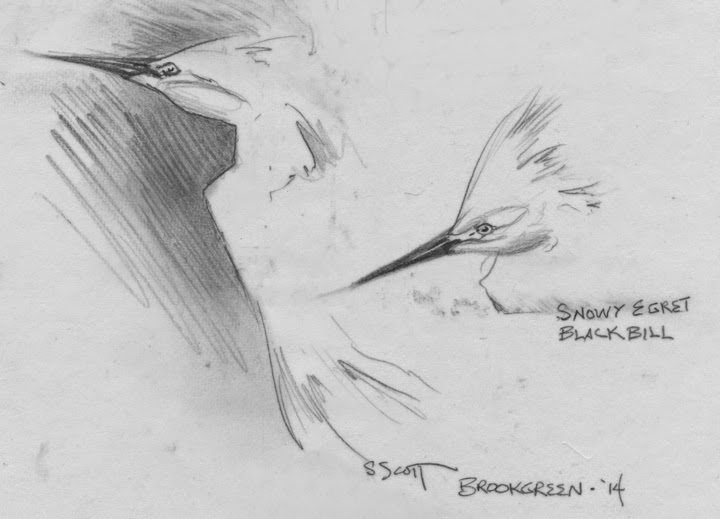
Below, are photos of the beautiful Snowy Egret.  Note the narrow black bill, the black legs, and yellow feet.
The Snowy always has a crest of feathers on its head which is displays when excited.
The typical size of the species has a 36 inch wingspan and is 24 inches in length.


Below, are photos of the Cattle Egret.  The bird is stockier-shaped compared to the Snowy and can be distinguished
by its orange bill.  The bird is shorter in length than the Snowy but has the same-sized wingspan.


Below, we took a long walk on a lonesome trail in the Santee Delta and spotted the elegant Great Egret.  
The beautiful bird has a wingspan of 51 inches and is 39 inches in length.


The Santee Delta is formed by the Santee River and is the largest river delta on the Atlantic coast.
The posted sign reminds hikers and birders that the trail is closed to foot travel in the fall due to deer hunters.

Below, are photos taken in the Santee Delta swamp.


Below, we encountered this large alligator in the swamp while eating our lunch and kept a safe distance from it.


Below, are drawings from my sketchbook created during my excellent egret adventure in South Carolina's Lowcountry.


To learn more about the subjects in this blog go to the links below.

For a complete list of  the blog subjects go to the Index Page and
type the subject in the Search This Blog link on right.


Blog, text, photos, drawings, and sculpture . . . © Sandy Scott and Trish