Showing posts with label deer. Show all posts

Monday, 7 December 2015

#689 White-tailed deer


Both Mule Deer and White-tailed deer are found in Wyoming
but Mule Deer are more prevalent.I see muleys daily where I live in
the Lander Valley located on the eastern slopes of the Wind River Range.
Occasionally, White-tails are to be found on the western slopes of the continental
divide, but not often.White-tails are typically considered an eastern deer but we have
them and the further east you go from Wyoming,the more common they become . . .
the Rocky Mountains are the cut-off of their range to the west.

My studio is located on a river that flows into the eastern drainage of the Wind River
and there is a resident herdof White-tail deer a few miles northwest of us . . .
we don't see them often but today a doe and a yearling were out in the harsh,
snowy weather.  Below, are images.


Below, are images of etchings entitled,"First Snow" and "White-tail in Snow".


Below, are images of sculptures entitled, "Swamp Buck" and "White-tail".


"Swamp Buck"
15"H 13"W 6"D
Edition 65
2,400


"Whitetail
12"H 12"W 4"D
Edition 65
2,400


"Whitetail
12"H 12"W 4"D
Edition 65
2,400


Blog, text, photos, drawings, and sculpture . . . © Sandy Scott and Trish


Wednesday, 29 July 2015

#656 In the field . . . birthday #72


Last week was my birthday and we returned to the rustic
cabin in remote northern Colorado where we celebrated 
July 24 last year.  We lived in Colorado for many years
and know the area very well . . . we know all of the backroads,
 the best places to fish for Rainbow and Cutthroat Trout,
the trails to the little streams where the Brook Trout
hang out,and where to see wildlife.
The old camp where we stay is close to
timberline and is heavily populated with moose . . .
we never fail to see them.


Below, are images of moose taken last week in the high country.


Below, I spotted a recumbent young bull in the shade from a distance . . .
we left him at peace but got him with a telephoto.


Below, Trish is fishing at a favorite high country lake where we saw nesting Ospreys.


Shown below, is another favorite lake . . . I photographed a Mule Deer doe while enjoying a cold beer and the scenery.


The temperature dips down at night and the old housekeeping cabin is heated with an ancient wood burning cookstove.
The wood and kindling is provided for us, chopped, split, and always plentiful . . . I'm used to wood heat and love it!
Below, is a photo of the dogs warming up on a chilly morning in front of the cookstove while the boiled coffee perks.


The proprietors of the camp are fellow bird lovers and have hummingbird feeders everywhere.  
Below, are photos of Trish, a feeder outside our cabin, and along with the resident Chipmunk,
we could count on a live model and plenty of entertainment during the cocktail hour!


Below, is an early etching of hummingbirds.


Go to the BLOG INDEX on the right for more information.

Blog, text, photos, drawings, and sculpture . . . © Sandy Scott and Trish


Sunday, 19 July 2015

#653 Locomotive anatomy . . . deer


Please see the previous post for more information about this blog.
The focus of this post is anatomical considerations of the deer in motion.

Every artist knows that it's difficult to sketch a jumping or running animal.  Studying skeletons, muscles, and proportions of a species and understanding "nature's one pattern" and waypoints - see blog #644 thru #648 - is invaluable knowledge
for the sculptor and will initiate an understanding of all quadruped locomotive anatomy . . . deer included.

Drawing action gestures and lines in the field, will help you catch the spirit of the pose and will  prevent becoming
involved in the details before you have established proportions and character of the pose.
The legs of a running or jumping deer are moved one after the other in rotation . . . a horse moves the legs diagonally.
Shown below, are quick sketches created afield.


In the field, you will observe that at the beginning of a deer's leap or jump, the head and neck are extended.
As the deer lands, the head is drawn back.  Below, are additional drawings depicting the deer's anatomical structure.
Remember . . . drawing in the field is about curiosity; not the final product.
Look for the big picture . . . don't get mired in details.


Photography is an invaluable tool for the artist in the field.  This little Mule Deer fawn didn't see me crouching behind a bush and ran right toward me before veering off!  All four legs were off the ground and it was demonstrating a maneuver
peculiar to Mule Deer called "stotting".  White-tailed Deer don't do it but some African antelope do.


Shown below, is a recent sculpture of a White-tailed Deer in motion entitled, "Swamp Buck".


Shown below, is another sculpture of a White-tailed Deer in motion entitled, "Whitetail".


Go to the BLOG INDEX and Reference Page for more information.  See post #616 and #655

Blog, text, photos, drawings, and sculpture . . . © Sandy Scott and Trish


Wednesday, 4 March 2015

#614 Snow Moon


Since the heaviest snow usually falls during this month, Native American and Canadian tribes of the north call
February's full moon the Full Snow Moon.  Some tribes referred to this moon as the Full Hunger Moon 
since harsh and frigid weather made hunting food difficult.  

Shown below, a Mule Deer doe slowly passes under last night's Full Snow Moon in the sub-zero cold.


The night before last, a snowstorm dumped over ten more inches on our studio headquarters at the foot of the Wind River Range in Wyoming.  We woke up this morning to -16 degrees temperatures and as usual, the first thing one thinks about are the animals . . . both domestic and wild.  We have horses, goats, poultry, and feral barn cats that share the property with a resident herd of mule deer and wintering pheasants.  At the base of heated buildings such as the studio, animals congregate because the temperature is actually a few degrees warmer.  We keep a water heater in a big rubber tub and put out hay and corn for the geese.  The chickens have a heat lamp in their coop and we enjoy fresh eggs in the winter because the light induces laying eggs.  While all of this is a necessity for the domestic animals, we are careful not to tame the deer which would inhibit their wildness and ability to survive . . . after all, in the big scheme of things, we are predators.

Below, are images taken at our place along the frozen Popo Agie River in Wyoming.  
Although the surface is frozen, the big river flows underneath to join the Wind River downstream.
This photo was taken from the studio deck this morning . . . below zero but sunny!


The barn protects horses, goats, and barn cats but on this sunny day, the warm sun will feel good on their backs.

Geese are amazingly adaptable to frigid weather and like all creatures, require an open source of water.  Water, in this climate, can freeze in less than an hour!
Below and at right, the big domestic geese are fed corn and hay is given to the deer when snow covers the ground.  Trish cries,"goose-goose-goose" and the geese come running!


Below, Trish and Penny enjoy a warm fire after chores are done.


Below, no sun yesterday but the deer, with their long winter's coat, nestled in the snow
and bedded down for warmth and the pheasant found morsels by scratching through the snow.


In the bleak midwinter, Frosty wind made moan,
Earth stood hard as iron, Water like a stone;
Snow had fallen, snow on snow, snow on snow,
In the bleak midwinter, long ago.

                                                                                     - Christina G. Rossetti


Deer have always been a favorite subject.  Below is an early etching (1979) entitled, "First Snow".


Go to the BLOG INDEX on the right for more information.


Blog, text, photos, drawings, and sculpture . . . © Sandy Scott and Trish


Sunday, 3 August 2014

#553 In the field: Wilderness aesthetics, con't . . .

Please start this series of blogposts with #549, Wed. July 23

 Last month, we spent the week of my birthday in the Colorado high country.  We explored lower
elevations in the vicinity of our cabin as well and encountered different flora and fauna . . .
the change of terrain was dramatic.  We followed familiar roads that, for the most part, followed
the creeks and tributaries that cut through the wilderness meadows to the beautiful, rolling foothills.

Below, is a landscape panorama showing the mountains in the distance and the
open country that we experienced in the foothills.


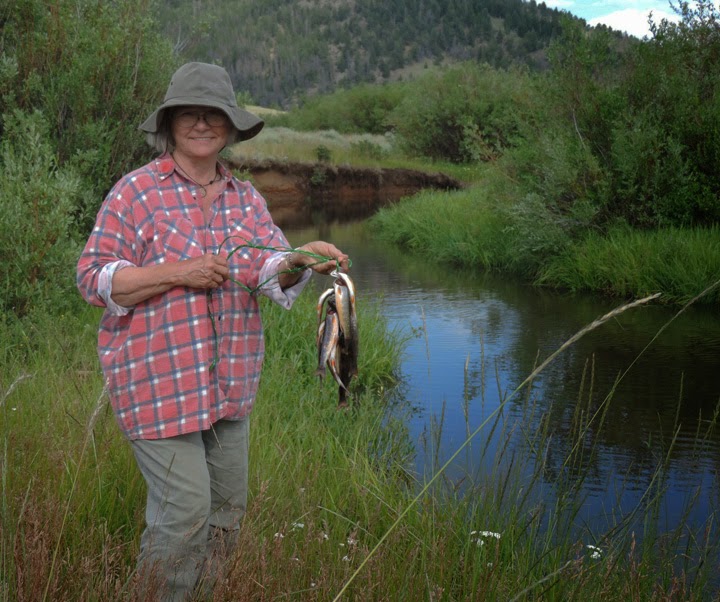
Fishing sunlit waters for Brook Trout, we looked for cut banks, overhangs, and shadows since brookies are
very secretive and one must sneak up on them.  The wild trout are only 4 to 10 inches and the creeks are
typically narrow with an occasional beaver pond that always promises action.  The best fishing is off the
beaten path and hiking is necessary.  Public land abounds and a BLM map will show you the way.

Below, is a stringer of brookies for the frying pan . . . although small, they are delicious and have very dark red meat.


Below, we saw lots of Pronghorn and Mule Deer as we made our way down from the high country to  lower elevations.


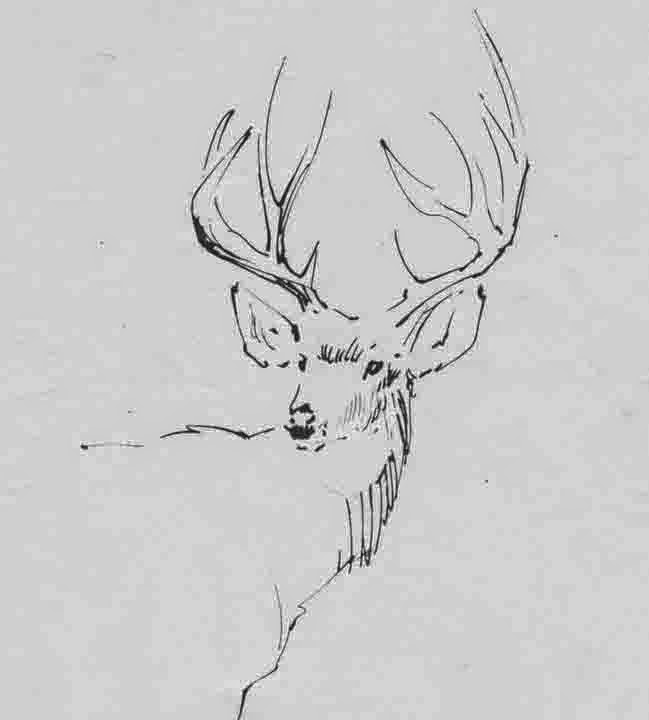
Below, are drawings and etchings of Mule Deer and Pronghorn.


Below, is a bronze sculpture entitled Muley hunter's Hook


Below, is an original etching entitled, "Lunch".


Below, is my recipe for trout pate'.

4 freshly caught gilled and gutted small trout
Fry trout in butter, canola oil, olive oil, or bacon fat, 4 to 5 min. per side
then take off skin and debone.
Mix flaked trout with 1 8oz. package of cream cheese and season with
lemon, hot sauce. lemon pepper if desired.
Mix in mayo for a nice consistency.
Mix in only ONE of the following ingredients . . . more that one confuses the taste buds.
Capers, onion, horseradish, green olives, black olives, tapenade, dill pickle relish,
sweet pickle relish, chopped pepperoncini, porcini, garlic, etc.

Note: The following herbs go well with trout . . . dill, chives, thyme, rosemary, parsley, cilantro.

Put mixture in a covered crock, refridgerate . . . spread on crusty bread and enjoy with red wine.


To learn more about the subjects go to the links below.

For a complete list of the blog index go to the Index Page and
type the subject in the Search This Blog link on the right.


Blog, text, photos, drawings, and sculpture . . . © Sandy Scott and Trish