Tuesday, 27 August 2019

#704 "Eternal Tang"


"Eternal Tang"
23"H 28"W 9"D 
Edition 35
7,800

The Tang Dynasty (618 – 907) was the most glorious historical period in China’s 
history.   It flourished culturally, reached unparalleled prosperity, and 
is regarded as the “golden age” in China’s civilization.
The horse was second in importance to the dragon in Chinese history and was the 
foundation of military power.  During the Tang Dynasty, elegant statues of horses 
with powerful arched necks and increased degree of naturalism 
were enjoyed by the upper classes.
In 1981, I visited China and witnessed the unearthing of over 7000 life-sized 
Terracotta sculptures of warriors and horses in the Tang capital of Xi’an. 
Discovered in 1974 and buried since the Han Dynasty over 2000 years ago, 
I was stunned by the spectacle as I peered down from the scaffolding 
high above the pits.  After that life-altering experience, I shifted gears 
from a career in original printmaking and returned to an early interest 
in sculpture. Chinese art and oriental sparseness of design continues to
 influence my work and I’m returning to Xi’an and China in Nov. of this year.

Blog, text, photos, drawings, and sculpture . . . © Sandy Scott and Trish


#703 "Tethered Nanny"


"Tethered Nanny"
17"H 20"W 12"D
Edition 25
7,800


          I use domestic animals and pets as live models.  Although we also have wild animals 
such as deer, pheasants, ducks, fox and more on the property, they cannot be called 
upon to pose.  However, domestic animals can substitute for wild animals and give
 the artist needed information by using comparative anatomy. 

Comparative anatomy is a logical understanding of an animal’s waypoints, 
bony landmarks, and points of articulation.  The artists must understand the
 peculiarities and proportions of a specific species – whether wild or domestic 
and understand skeletal structure that is similar and inherent to all vertebrates.  
Understanding comparative anatomy will revolutionize the artists 
approach to animal sculpture.

Currently in residence at the Lander studio headquarters are horses, dogs, cats,
 chickens, domestic geese, and goats.  Goats are excellent models, easy keepers, 
eat weeds, and horses like them as companions.

Tethered Nanny was modeled from life.


Blog, text, photos, drawings, and sculpture . . . © Sandy Scott and Trish


#702 "Southwest Express"


"Southwest Express"
17"H 17"W 8"D
Edition 65

This recent sculpture was created for a client of one of the galleries that represents me.  
The client was not sure of the pose she wanted so I presented several drawings for 
her to choose from.

I loved working with the Roadrunner as a subject.  There are so any species that I 
want to add to my portfolio that pleasing someone with a drawing before actualizing 
the sculpture is a great tool of the trade.  There are over 10,000 species of birds 
alone . . . I’m afraid I won’t get to all of them!


Blog, text, photos, drawings, and sculpture . . . © Sandy Scott and Trish


#701 "American Icon"


The images below were taken at the foundry in the patina room.


"American Icon"
42"H 64"W 25"D
Edition 5


"American Icon" was commissioned by the University of Colorado in Boulder, Colorado

The American Bison, or Buffalo, has been elevated to the stature of the American Bald Eagle 
as a national emblem of our great country. The bison became the National Mammal of the 
United States under recent legislation due to its economic and cultural significance in the 
history of our great country.  Over 60 million roamed North America at one time but by 1890, 
their story almost ended with extinction. The largest population today of the iconic mammal 
resides in Yellowstone National Park - two hours from my Wyoming studio. While the bison 
has long been a favorite subject for my sculpture, It is more than an animal to me, it is 
an emotional manifesto that exemplifies my deep affinity for the West and its history.


Blog, text, photos, drawings, and sculpture . . . © Sandy Scott and Trish


#700 Geranium and Red Rooster


Paintings for the Autry Museum "Masters Exhibition"
and the Briscoe Museum "Night of the Artists"
miniature walls.


"Geranium"
Oil on Panel
5" x 7"


"Red Rooster"
Oil on Panel
7' x 5"


Blog, text, photos, drawings, and sculpture . . . © Sandy Scott and Trish


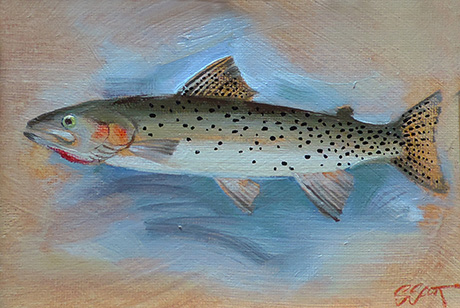
#699 Cutthroat and Rainbow Trout


Paintings for the Autry Museum "Masters Exhibition"
and the Briscoe Museum "Night of the Artists"
miniature walls.

"Cuthroat Trout"
Oil on Panel
7 x 5


"Rainbow Trout"
Oil on Panel
7 x 5


Blog, text, photos, drawings, and sculpture . . . © Sandy Scott and Trish


#698 "Cat Nap" and "Sleepy Kitten"


"Cat Nap"
4”H 16”W 7”D
Edition 100
1,800
"Sleepy Kitten"
5”H 16”W 7”D
Edition 75
1,800


Blog, text, photos, drawings, and sculpture . . . © Sandy Scott and Trish


#697 "County Fair Lops"


"County Fair Lops"
8"H 14"W 8"D
Edition 65
2,100


Blog, text, photos, drawings, and sculpture . . . © Sandy Scott and Trish


#696 "Ancient Passage"


"Ancient Passage"
23"H 23"W 8"D
Edition 25
9,000

Our Morgan gelding was used as the model for Ancient Passage.  My goal was to idealize 
the animal and create a powerful image.  I am preoccupied with modeling horses and 
consciously stylize my designs.  My obsession with modeling horses continues to lay 
a thorough foundation for my art, just as playing scales does for a musician.  In my 
opinion, horses and the human figure are the most difficult creatures to transform into 
a visual expression - perhaps it's because they are both so beautiful.


Blog, text, photos, drawings, and sculpture . . . © Sandy Scott and Trish


#695 "Wind River Encounter"


"Wind River Encounter"
22"H 32"W 22"D
Edition 65
18,000

The Grizzly is common where my studio is located at the base of the 
Wind River Range in the wild state of Wyoming.  I’ve encountered the animal 
only once while hiking in the local high country but routinely see them nearby in Yellowstone.

The anatomy of an animal with thick hair or fur such as a Grizzly must be understood 
in order to avoid modeling a shapeless mass.  Where the animal’s bones protrude 
and articulate the fur patterns break and reveal themselves thus showing how the 
skeleton is arranged.  There are times when artistic license must be employed to 
"trick" the viewer into seeing the animal's anatomy under thick fur or hair.  


Blog, text, photos, drawings, and sculpture . . . © Sandy Scott and Trish


#694 Remarque: "Equus Found III Frag"


The large clay model that was the matrix for Equus Found Fragment III 
depictes a charger with a Greek - style roached mane.

The original model was never cast but fresh discoveries 
were made when I edited to a partial figure.


Equus Found Fragment III
20"H 22"W 6"D
Edition 50
3000


Blog, text, photos, drawings, and sculpture . . . © Sandy Scott and Trish

#693 Remarque: "Bison Wall Hanging"


This sculpture was executed in high relief and designed to hang above eye level.

Bison Wall Hanging
19"H 10" 10"
Edition 50
2,400
(Please call for availability)


Bison Wall Hanging
19"H 10" 10"
Edition 50
2,400
(Please call for availability)

Blog, text, photos, drawings, and sculpture . . . © Sandy Scott and Trish


#722 "The Boss"


"The Boss"
11"H 15"W 7"D
Edition 25
4200


My new sculpture, "The Boss" depicts the distinctive presence of a Brahma Bull. 
Brahma cattle originated in India where they are considered sacred and were 
brought to the United States in the late 1800s.  Also referred to as Brahman, 
the breed is tolerant to heat and insects due its thick skin but also does well 
in cold climates.  Interestingly, Brahma cattle, like the camel, stores food 
and water in the hump on its back.

While creating "The Boss", I attempted to show the tension of skin stretched 
over the internal anatomy while retaining overall clarity and simplicity.  
This powerful animal was a delight to work with . . . the sentiment 
and spirit were derived from the subject! 


Blog, text, photos, drawings, and sculpture . . . © Sandy Scott and Trish


#721 "Crappie"


"Crappie"
9"H 13"W 4"D
Edition 50
900


  Blog, text, photos, drawings, and sculpture . . . © Sandy Scott and Trish

#720 "Muskie"


"Muskie" -  Fish of 10,000 Casts
12"H 9"W 5"D
Edition 50
1,200


Blog, text, photos, drawings, and sculpture . . . © Sandy Scott and Trish


Monday, 28 December 2015

#692 Retrospective


SANDY SCOTT: A RETROSPECTIVE
Traveling Museum Exhibition Produced by David J. Wagner, L.L.C.


TOUR ITINERARY


October 1 - December 31, 2015
Center for the Arts of Bonita Springs
Bonita Springs, FL
artcenterbonita.org

January 23 - April 24, 2016
Brookgreen Gardens
Murrells Inlet, SC
brookgreen.org

June 1 - August 31, 2016
Sternberg Museum of Natural History
Fort Hays State University
Hays, KS
sternberg.fhsu.edu

October 22, 2016 - April 30, 2017
National Museum of Wildlife Art
Jackson Hole, WY


Shown below, on the cover of  the current "Art of the West", is 
a brilliant painting by  Logan Maxwell Hagege.  


Shown below and on the inside cover, is an ad for the 
Retrospective in the current issue of
 "Art of the West" magazine.


This blog has been temporarily suspended due to retrospective commitments but will post again soon.

Go to the BLOG INDEX and Reference Page for more information.  


Blog, text, photos, drawings, and sculpture . . . © Sandy Scott and Trish

Monday, 21 December 2015

#691 Merry Christmas!


Merry Christmas from our house to yours!


We hope your Christmas is merry and bright . . . if you live in Wyoming, it's sure to be white!

Shown above is my little snowbound studio cabin along the Popo Agie River where I paint. 
The photo was taken this morning looking north from the sculpture design studio.


Go to the BLOG INDEX and Reference Page for more information.  


Blog, text, photos, drawings, and sculpture . . . © Sandy Scott and Trish
Monday, 14 December 2015

#690 Deer antlers


Male members of the deer family, including moose and elk,
grow antlers which are extensions of the skull.
Their main purpose is to attract females and to fight
other males.  Antlers and shed and grow back every year.
When a buck is growing antlers, they are referred to as being
in "velvet".  Along with moose and elk, the two other deer
species found in Wyoming are Mule Deer and Whitetail.

Below are etchings showing the difference between a Mule Deer and Whitetail buck's antlers.
Notice the points on a muley's antlers split and fork in two directions while a Whitetail
 buck's antler points grow off of one main beam and do not fork.

Mule Deer


Whitetail Deer


Below, is an etching of a Mule Deer entitled, "The Itch".


Below, is a little oil study in progress of a Whitetail buck.


Below is a sculpture of a Whitetail Deer
"Swamp Buck"
15"H 13"W 6"D
Edition 65
2,400

Below is a sculpture head study of a Whitetail Deer
"Whitetail Bust"
14"H 8"W 6"D
1,200


Blog, text, photos, drawings, and sculpture . . . © Sandy Scott and Trish